India said unremitting hostilities against minorities in Bangladesh are a matter of grave concern and condemned the lynching of Hindu youth Dipu Chandra Das.
New Delhi cited over 2,900 documented incidents of violence against minorities during the interim government’s tenure and demanded punishment for perpetrators.
India reaffirmed support for peace, stability and free, fair, inclusive elections in Bangladesh ahead of the February 12 polls.
India Flags Grave Concern Over Attacks On Minorities In Bangladesh
New Delhi condemns lynching of Hindu youth, seeks justice and accountability.

Summary
India has demanded punishment for those responsible for last week's lynching of a Hindu youth in the Mymensingh district, calling the "unremitting hostilities" against minorities in Bangladesh a "grave concern" on Friday.
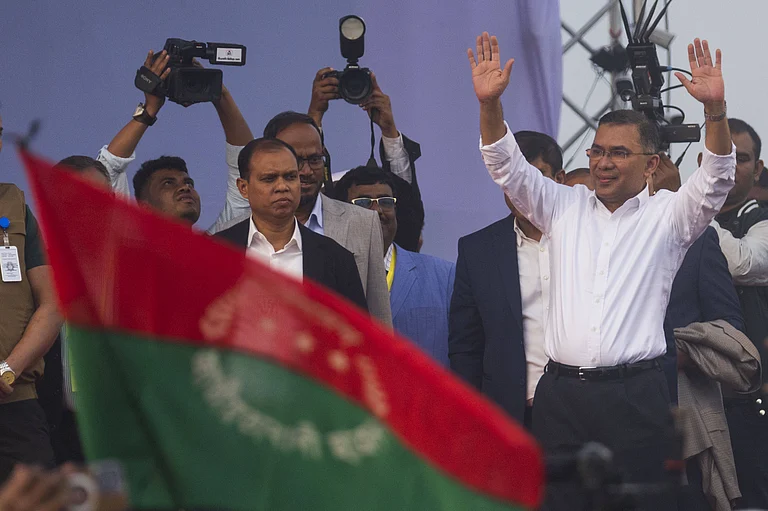
New Delhi also reacted cautiously to the return to Dhaka of Bangladesh Nationalist Party (BNP) acting chairman Tarique Rahman after 17 years, saying it should be seen in the context of India's push for ensuring free, fair and inclusive parliamentary polls in that country.
According to Randhir Jaiswal, a spokesman for the External Affairs Ministry, India denounced the recent killing of Dipu Chandra Das and called for the prosecution of those responsible.
"The unremitting hostilities against the minorities in Bangladesh, including Hindus, Christians and Buddhists at the hands of extremists, is a matter of grave concern." "We condemn the recent gruesome killing of a Hindu youth in Bangladesh and expect that the perpetrators of the crime will be brought to justice," Jaiswal said at his weekly media briefing.
Bangladeshi authorities have already arrested 12 people for Das's murder.
"Over 2,900 incidents of violence against minorities, including cases of killings, arson and land grab, have been documented by independent sources during the tenure of the interim government," Jaiswal said.
"These incidents cannot be brushed aside as mere media exaggeration or dismissed as political violence," he added.
Following the death of youth leader Sharif Osman Hadi, who was a key figure in the large-scale demonstrations that brought down the Sheikh Hasina government last year, Bangladesh has seen a new wave of unrest and political instability.
As some in Bangladesh attempted to connect New Delhi to his demise, his murder has also caused some new tension in India-Bangladesh relations.
The accusations were dropped by India.
"We have rejected the false narrative that has been projected in Bangladesh. The law and order situation and developments happening there are the responsibility of the government of Bangladesh. To portray a narrative where things go in another direction is completely false, and we reject that," Jaiswal said.
Advertisement
The external affairs ministry spokesperson said India is closely following all the developments in the neighbouring country.
India stands for strengthening our ties with the people of Bangladesh. We favour peace and stability in Bangladesh. And we stand for free, fair, inclusive and participatory elections in Bangladesh," he said.
The parliamentary elections are slated for February 12.
Jaiswal seems to connect the murder of another Hindu man, Amrit Mondal, also known as Samrat, by a mob in Rajbari town on Wednesday night to the worsening security situation and animosity against minorities in Bangladesh.
The Bangladeshi authorities said that the incident was not a communal attack and that Mondal was charged with multiple criminal charges, including extortion and murder.
On BNP leader Rahman's return to Bangladesh from London, Jaiswal said: "As you are aware, India supports free, fair and inclusive elections in Bangladesh. This development should be seen in that context." Rahman, 60, returned to Dhaka to a rousing welcome by thousands of his supporters on Thursday -- a homecoming that is expected to energise the BNP ahead of the February 12 parliamentary elections.
Advertisement
"India wants close and friendly relations with the people of Bangladesh, which is rooted in the Liberation struggle and strengthened through various development and people-to-people initiatives," Jaiswal said.
To a question on Dhaka's request to extradite former prime minister Hasina, he suggested that there is no change in India's position on the matter.
The relations between India and Bangladesh came under strain after the interim government headed by Muhammad Yunus came to power following the collapse of the Hasina government.
India has been expressing concerns over attacks on minorities, especially Hindus, in that country.
Published At: