The Central Board of Secondary Education’s (CBSE’s) newly introduced OSM system, rolled out this year for the Class 12 Board examinations, was pitched as a technological upgrade that would reduce manual errors, make evaluation faster and assessment more transparent. Under the model, physical answer sheets are scanned into digital copies and uploaded onto a secure portal where teachers evaluate them online instead of physically handling answer booklets. What was meant to modernise India’s school examination system has instead become the centre of a widening controversy over technical failures, inadequate preparation and a post-result verification process that many students claim they no longer trust.
CBSE OSM Evaluation Controversy: Technical Glitches, Blurry Answer Sheets and Students’ Distrust in Digital Marking
The CBSE’s on-screen marking (OSM) system, introduced to make evaluation faster and more transparent, has instead triggered allegations of blurry answer sheets and crashing portals, sparking a larger debate over the future of high-stakes public examinations

Nearly 23 per cent of Class 12 students sought scanned answer sheets this year, with 4,04,319 applications from 17,68,968 candidates, signalling distrust in the new system. Teachers, parents and students have flagged blurry answer sheets, missing pages and portal crashes, raising concerns that the CBSE’s digital evaluation system was rolled out without adequate testing or preparation.
For Jordy Jasper, a maths teacher at Delhi United Christian Senior Secondary School in Civil Lines who evaluated Class 12 answer sheets, the problems began during training itself, with software glitches, slowdowns during simultaneous logins and evaluators struggling to adapt to the new marking system. “We were submitting sheets but they weren’t getting submitted,” he said. Although the evaluation process improved as teachers adjusted to the software, Jasper said that around a dozen of the nearly 200 answer sheets he checked were blurry and had to be rescanned before being returned weeks later for evaluation. Several teachers flagged the steep digital learning curve, particularly for older evaluators unfamiliar with prolonged screen-based assessment. Others pointed to pressure to complete a fixed number of answer sheets each day, raising fears that speed may have compromised accuracy.
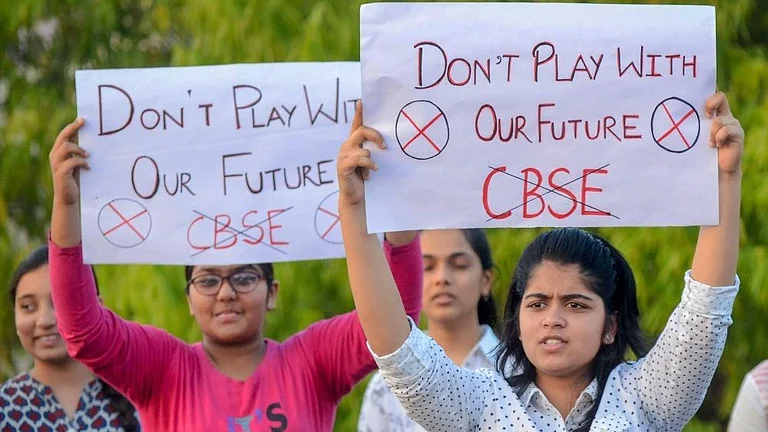
Aprajita Gautam, president of the Delhi Parents Association (DPA), said the controversy reflects a deeper implementation failure and argued that while digital evaluation is not inherently flawed, a pilot project may have been necessary. Gautam has also raised concerns over reports that in some centres, trained graduate teachers allegedly evaluated Class 12 papers despite official guidelines requiring postgraduate teachers. If true, the allegations would raise serious questions about adherence to the CBSE’s own evaluation protocols.
The controversy has disproportionately affected lower-income students who often lack digital access.
The controversy has disproportionately affected lower-income students who often lack digital access. Many have had to rely on cyber cafés simply to access scanned answer sheets and navigate the verification process. After struggling to access the rechecking portal, Rajkumar Kanojia, father of Ishant Kanojia, a Class 12 student at a Kendriya Vidyalaya in Delhi, said, “How are we supposed to trust that the rechecking process would even be fair?”
Advertisement
Questions over financial transparency persist. Though the CBSE cut scanned-copy fees from Rs. 700 to Rs. 100, parents argue that charging for digital access only fuels distrust.
Outlook reached out to CBSE officials, including controller of examinations Sanyam Bhardwaj, senior principal private secretary Sanjeev Kumar Sahni and joint secretary Punam Rani via email. A response is awaited.
From Technical Glitch to Political Flashpoint
Leader of Opposition in the Lok Sabha, Rahul Gandhi, amplified statements from National Eligibility cum Entrance Test aspirants and students affected by the CBSE controversy, and said their “anger was clearly visible” and that “the dam of their patience has broken”. He also directly targeted Union Education Minister Dharmendra Pradhan over the CBSE’s OSM system and the contract awarded for it, asking why the contract was allegedly handed to COEMPT, “a company already mired in controversy under its old name, Globarena”. Gandhi said, “The youth of the country will no longer tolerate the Modi government’s corruption and indifference” and accused the government of “ruining the futures of lakhs of students”. Pradhan defended the CBSE’s procurement process, accused Gandhi of opposing Digital India initiatives and urged leaders not to heighten students’ anxiety while taking responsibility for the inconvenience caused.
Advertisement
The episode has opened up a larger political contest over the Centre’s digital governance push, with the Opposition framing the controversy as evidence of technological haste and weak accountability and the government defending it as a necessary but evolving reform. For the lakhs of students caught in the middle, the question is far more immediate: whether the system evaluating their futures can still command their trust.
Zenaira Bakhsh is an Assistant Editor at Outlook. She covers governance, minority rights, gender and conflict
Published At: