Uttar Pradesh has remained the centre of Indian politics since Independence. The state has produced nine prime ministers, from Jawaharlal Nehru to the incumbent Narendra Modi. Yet political centrality never translated into economic transformation for much of the state. For decades, every party that came to power in Uttar Pradesh found itself navigating layers of caste coalitions and social compulsions that shaped governance as much as elections. The result was uneven development, weak infrastructure and a state where large parts continued to lag behind, barring Lucknow and sections of western Uttar Pradesh that benefited from their proximity to Delhi.
Caste, Community and Institutional Edge: How the BJP Consolidated the Hindi Belt
Regional strongholds are turning into besieged fortresses, facing the relentless advance of the BJP with the ambition and machinery to occupy the national centre almost alone

The Bharatiya Janata Party (BJP) under Modi sensed that exhaustion. In rally after rally during the 2014 Lok Sabha campaign, Modi spoke the language of aspiration. He promised uninterrupted electricity, highways and development—promises that sounded distant in a state where power cuts and broken roads had long become part of everyday life. Modi’s image as the leader who had transformed Gujarat into a model of infrastructure and industrial growth travelled ahead of him into Uttar Pradesh.
But development alone did not shape the political atmosphere of the election. The campaign unfolded in the shadow of the 2013 Muzaffarnagar riots, when the Samajwadi Party government was in power in Uttar Pradesh. The violence drove a wedge between the Jats and Muslims, two communities whose combined electoral strength had influenced caste-community alliance of the opposition parties, including the Congress, the Rashtriya Lok Dal (RLD) as well as the Samajwadi Party. What followed was not just communal polarisation, but the gradual unravelling of a vote-bank alliance that had sustained regional politics in the state for decades. The vote bank of RLD in western Uttar Pradesh was lost within a year, making it lose all the eight seats it had fought. Key leaders, including Ajit Singh in Baghpat and Jayant Chaudhary in Mathura, lost their seats as the BJP swept the region. Candidates lost their deposits in six of the eight constituencies.
The BJP and its allies won 73 out of the 80 Lok Sabha seats in Uttar Pradesh in 2014, the largest victory in the state by any party in decades, and a result that would become the foundation of the BJP’s national dominance. Ahead of the 2024 general elections, RLD chief Jayant Chaudhary decided to leave the INDIA bloc and joined the National Democratic Alliance (NDA). As an NDA ally, RLD won both the Lok Sabha seats it contested.
According to political analyst Sudha Pai who taught at the Jawaharlal Nehru University, and who has studied western Uttar Pradesh closely, the 2013 Muzaffarnagar riots fractured the Jat-Muslim agrarian alliance that had sustained Charan Singh’s politics for decades.
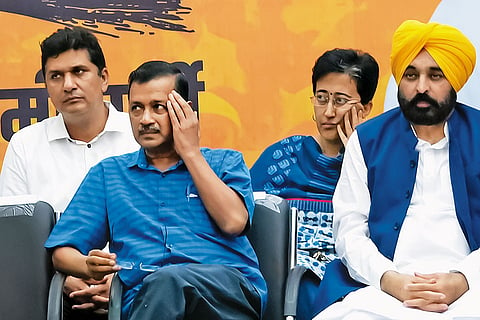
Parties in Decline: AAP’s Arvind Kejriwal with party leaders in New Delhi on September 15, 2024 | Photo: Suresh K. Pandey
Remembering What Mandal Missed
As summer crept in during the last week of February 2016—a year before the 2017 Uttar Pradesh Assembly elections—the then BJP president Amit Shah, in his brown Nehru jacket, and white kurta and pajama—was seen in Bahraich in eastern Uttar Pradesh, going up to the decorated stage to garland the statue of Maharaja Suheldev. A few months later, Shah met Om Prakash Rajbhar, the founder of the Suheldev Bharatiya Samaj Party (SBSP), and announced the BJP’s alliance with the SBSP.
Advertisement
One might wonder why Shah had to garland Maharaja Suheldev, the 11th century ruler of the region, and why he had to form an alliance with a party very few people had known about nationally before the BJP’s alliance in 2017. It turns out that Rajbhar is a crucial Other Backward Classes (OBCs) caste in eastern Uttar Pradesh. Its population in Ghazipur, Mau, Ballia, Azamgarh, Varanasi and Jaunpur districts of the Purvanchal range from 12-18 per cent, and they play the role of the kingmaker in 70-90 Assembly seats. Rajbhars voted for the Bahujan Samaj Party (BSP) till 2002, when Om Prakash Rajbhar, who used to be the BSP president from Varanasi, was denied a party ticket. In 2002, he formed the SBSP.
In the 2017 Assembly polls, the BJP allotted eight seats to the SBSP, out of which the party won four seats. Om Prakash Rajbhar became a cabinet minister for the Backward Classes Welfare Department in the Yogi Adityanath government. This was the first time that a Rajbhar leader was made a minister. Now the BJP government is actively working to implement Rajbhar’s demand to give Scheduled Caste (SC) status to his community because of its socioeconomic backwardness.
Advertisement
Mayawati’s alliances with the BJP made Dalits more open to the BJP’s direct outreach through welfare populism and identity engineering.
BSP supporters like Prem Nath Dhingra, a western Uttar Pradesh-based Valmiki leader, says the way the BJP wooed and co-opted the Rajbhar community into its larger Hindutva fold is the perfect instance of how the saffron party dismantled the caste coalition which sustained the Mandal-era politics. The party wooed and allied with almost all the OBC leaders who were once groomed by Kanshi Ram and who had started their political career with the BSP, he adds. These leaders include Swami Prasad Maurya, an OBC leader, R. K. Chaudhary, a Pasi from the second-largest Dalit caste in the state after Mayawati’s Jatavs and Om Prakash, a Rajbhar.
It took more than a decade for the BJP and its ideological parent, the Rashtriya Swayamsevak Sangh (RSS), to break the BSP’s caste coalition. Scholars who study Hindu nationalism and its appropriation of Bahujan politics like Christopher Jaffrelot talk about how the BJP appropriated Mandal language while transcending Mandal arithmetic, replaced caste pride with aspirational Hindu consolidation and fused welfare delivery with nationalism. The process took years of non-Yadav OBC consolidation, non-Jatav Dalit outreach, Hindutva superseding caste fragmentation and booth-level organisation.
Advertisement
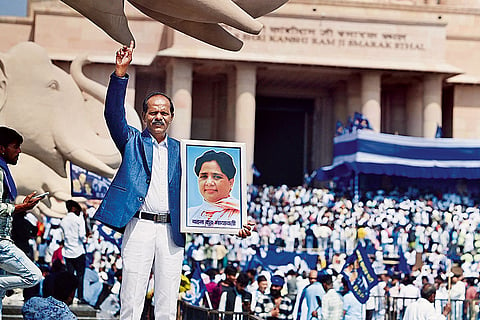
A BSP rally in Lucknow on October 9, 2025 | Photo: IMAGO/Hindustan Times
According to Sarwan Ram Darapuri, a former IPS officer and convener of Dalit Mukti Morcha, Mayawati’s alliances with the BJP made Dalits more open to the BJP’s direct outreach through welfare populism and identity engineering. It gave the BJP administrative legitimacy, political breathing space and time to build Dalit outreach programmes. And once the BJP no longer needed the BSP’s support, it absorbed sections of the Dalit vote independently.
The Samajwadi Party, which relied on the ‘MY’ (Muslim-Yadav) alliance to remain in power, had a moment of reckoning when the BJP started wooing its core vote bank through a myriad of tactics. The BJP gradually succeeded in attracting aspirational Yadav voters through a combination of Hindutva appeal, welfare delivery and the projection of Prime Minister Narendra Modi as a backward caste leader.
According to CSDS-Lokniti surveys, around 20-25 per cent of Yadav voters backed the BJP in the 2014 and the 2019 Lok Sabha elections. In the 2017 Assembly elections too, the BJP managed to secure roughly one-fifth of the Yadav vote, while in the 2022 Assembly elections, it retained a sizeable minority of Yadav support.
Advertisement
According to political scientist Sanjay Kumar of CSDS, the BJP’s success lay not in fully replacing the Samajwadi Party among the Yadavs, but in breaching what was once considered an impenetrable caste bloc.
In Haryana, politics had revolved around the dominance of the Jat community for decades, despite the community accounting for only a quarter of the state’s population. The BJP broke that dominance by successfully consolidating the non-Jat communities—Punjabis, Brahmins, OBCs and SCs—into a wider Hindu political coalition.
The Jat votes got fragmented because the Congress and the Indian National Lok Dal depended heavily on Jat support, while the BJP managed to emerge as the principal political force in a state—where it had once been peripheral entity—by combining Hindutva, welfare politics and the consolidation of non-Jat caste groups. After decades, a non-Jat Manohar Lal Khattar became the chief minister in 2014 when the BJP formed the government in the state.
The Patience of Power
Even as the BJP worked on caste coalitions across different parts of the country to establish itself as the dominant political force, dismantling the voter base of the Aam Aadmi Party (AAP) required a different strategy, one built on patience and the calibrated use of institutions in the national capital.
Arvind Kejriwal’s meteoric rise had once unsettled the established political order in Delhi. His anti-corruption movement drew support from the urban middle class, lower-income groups and first-time voters disillusioned with conventional politics. For many outside India too, Kejriwal appeared to represent a new form of middle-class political mobilisation, one that resonated in neighbouring countries such as Pakistan and Nepal, where anti-establishment movements were also gathering momentum.
But the decline of the party in Delhi after nearly 12 years in power was shaped, in part, by the very factor that had once fuelled its rise: the absence of a deeper ideological anchor. The AAP was built less around a defined political philosophy and more around governance, anti-corruption sentiment and the personality of Kejriwal himself. That flexibility allowed the party to expand rapidly across social groups, but it also made its support base vulnerable once the politics of governance collided with allegations of corruption, administrative confrontation and institutional pressure.
Kejriwal once explained AAP’s refusal to identify with traditional ideological categories. “We are common men. We are not Left, we are not Right,” he said.
According to political scientist Suhas Palshikar, who has written about the ideological character of the anti-corruption movement and the AAP, the anti-corruption movement was not anchored in a clear ideological position. Its appeal came from anger against the existing political class, especially the Congress-led United Progressive Alliance (UPA) government, and this gave the AAP considerable ideological flexibility.
The AAP built its electoral appeal around the promise of efficient governance for the tax-paying middle class and social welfare for those at the bottom of the economic ladder. Subsidised electricity, free water and free bus rides for women helped the party build a support base among both the lower-income groups and sections of the urban middle class. Over time, the AAP model of governance acquired visibility far beyond Delhi and began to be discussed as an alternative framework of urban welfare politics.

Seeking Relevance: Samajwadi Party’s Akhilesh Yadav addressing a press conference in 2024 Photo; Tribhuvan Tiwari
Yet the party itself remained an unusual political formation, bringing together individuals from sharply different ideological backgrounds. Kiran Bedi, who had been associated with the India Against Corruption movement that preceded the AAP, later joined the BJP. On the other hand, activists such as Medha Patkar came from a Left-leaning tradition that had opposed Modi’s government in Gujarat over issues such as the Narmada dam project.
That ideological flexibility gave Kejriwal room to position himself differently at different political moments. In its early years, the AAP drew strength from the anti-corruption sentiment that had weakened the Congress and indirectly reinforced the BJP’s national campaign portraying the Congress as a symbol of corruption and policy paralysis. At the same time, the absence of a rigid ideological framework also allowed Kejriwal to avoid direct political binaries, keeping channels open with both anti-BJP and anti-Congress constituencies depending on the political context.
Kejriwal was a man in a hurry from the very beginning. Within a year of launching an anti-corruption movement against the Congress establishment, he became the chief minister of Delhi. Soon, he began to nurture ambitions beyond the capital, positioning himself as a national challenger by contesting against the BJP’s prime ministerial candidate Modi from Varanasi in the 2014 Lok Sabha elections.
That decision to directly confront the machinery of an ascendant BJP altered the trajectory of the AAP. In many ways, it placed Kejriwal’s party on the same political path as several regional formations that eventually found themselves battling not just the BJP electorally, but also its organisational depth, ideological network and expanding institutional influence.
Political scientist Christophe Jaffrelot observes that once Kejriwal began to position himself as a national challenger to Modi, the BJP started treating the AAP not as a local formation, but as a serious political threat. Former AAP leader Yogendra Yadav says that the conflict between the BJP and the AAP was never just about governing Delhi; Kejriwal represented a rival political narrative, anti-corruption, welfare-driven and electorally successful in an urban space the BJP believed should naturally belong to it.
Structural Obstacles
AAP leaders like Sanjay Singh argue that the institution of the lieutenant governor became one of the biggest structural obstacles in the functioning of the AAP government in Delhi. Because Delhi is not a full-fledged state, the elected government does not have complete control over crucial subjects such as services, bureaucracy, and law and order, allowing the Union government-appointed lieutenant governor to exercise significant authority over the administration. This repeatedly led to confrontations between the Kejriwal government and successive lieutenant governors over issues such as transfers and postings of bureaucrats, approval of welfare schemes, control of files and implementation of policies which Kejriwal had promised to fulfil. This constant tussle effectively paralysed the government and slowed the implementation of several schemes that were central to AAP’s governance model and electoral promises.
Political observer Rasheed Kidwai says that another factor contributing to the BJP’s eventual rise in Delhi was the perception that Kejriwal had gradually shifted his political attention beyond the capital. After consolidating power in Delhi, Kejriwal increasingly focused on expanding the AAP nationally—first by aggressively contesting elections in states such as Goa and Rajasthan, and later by concentrating substantial political and organisational energy on Punjab, where the party eventually formed the government in 2022. This national ambition slowly distanced Kejriwal from the hyper-local governance politics that had originally made AAP successful in the capital. Many voters in the capital began to feel that the party was no longer singularly focused on Delhi’s governance concerns.
The fall of AAP in Delhi has reduced the party to a lone outpost in Punjab, where another electoral battle awaits next year. The movement that once rose on the promise of moral politics and middle-class rebellion now finds itself battling fatigue, defections and the slow erosion of belief. Several of its prominent faces, including Raghav Chadha, have drifted away with the BJP steadily widening its footprint around the party’s shrinking political space.
For the BJP, Punjab is no longer merely another election. It is part of a larger project to turn India’s fragmented political map into one dominated by a single pole of power. Armed with a formidable organisation, deep financial muscle and meticulous caste-and-community calculations, the saffron party will push hard to expand its footprint in the state. The story of AAP’s decline, then, is also the story of a changing Indian polity, where regional strongholds are turning into besieged fortresses, facing the relentless advance of a party with the ambition and machinery to occupy the national centre almost alone.
Mohammad Ali is an award-winning journalist, based in Delhi. He is senior associate editor with Outlook
Published At:
Tags