CAIT will meet on November 13 to discuss moving protest venues away from city centres
Praveen Khandelwal says long agitations in commercial areas hurt trade, supply movement and livelihoods
The traders’ body plans to approach the government and may also move court after the meeting
CAIT To Meet On November 13, Push For Protest Sites On City Outskirts
The proposal comes after weeks of disruption in Delhi and amid a wider debate over where protests should be held

Summary
The Confederation of All India Traders (CAIT) will meet on November 13 to weigh a proposal for protest sites on the outskirts of major cities. The traders’ body, led by BJP MP Praveen Khandelwal, argues that long political agitations in commercial areas disrupt trade and damage the economy.
The body plans to approach the government after the meeting and may also go to court to seek protest venues away from city centres. It says the push is aimed at protecting business activity, supply movement and livelihoods.
The proposal comes after weeks of disruption in Delhi and amid a wider debate over where protests should be held. CAIT also plans to take up tax compliance, cyber fraud and regulatory simplification at the November 13 meeting.
Delhi Protest Backdrop
Delhi saw major unrest in October as thousands of people took to the streets despite Metro closures, internet shutdowns, prohibitory orders and the deployment of 40,000 security personnel.
The city was effectively turned into a fortress, and the response drew criticism after many agitators were dragged, manhandled and detained.
That turmoil was followed by an official shift in protest policy. The Centre later withdrew Jantar Mantar’s three-decade run as Delhi’s designated protest site, and the Delhi Police issued an order on October 11, 2026, denotifying it and moving demonstrations to three alternative locations.
Those alternative sites are Ramlila Maidan in central Delhi, Burari Ground in north-west Delhi and CBD Ground in east Delhi.
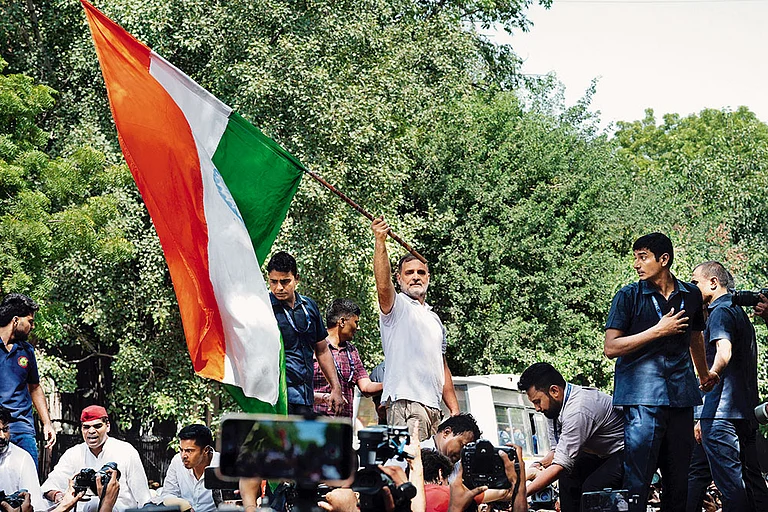
INDIA Bloc Protest Fallout
The latest demand also follows a large protest in central New Delhi on November 1, the INDIA bloc’s biggest show of strength.
The demonstration targeted the ruling BJP and sought Gyanesh Kumar’s removal over allegations of irregularities in the functioning of the Election Commission of India and the special intensive revision. That revision has already removed 130 million names from India’s electoral rolls, many of them in the absent, shifted or dead categories.
Advertisement
CAIT said those agitations caused “widespread disruption to business activities” in the national capital. The traders’ body linked the political mobilisation directly to losses for markets and commercial activity.
Khandelwal’s Proposal
Khandelwal outlined CAIT’s case in a statement. “Suitable locations should be designated on the outskirts of every city, or at other appropriate places, for protests and demonstrations,” the Chandni Chowk MP said, according to The Hindustan Times.
He argued for a national model. “The arrangement should be implemented across the country and not remain limited to Delhi. The proposed sites would enable peaceful demonstrations while protecting markets, commercial centres, transport routes and essential business activities.”
Khandelwal said disruption from protests hits more than shopfront sales. It also affects supply chains, the movement of goods, employees’ livelihoods and the cash flow of small businesses.

Supreme Court Plea
A court challenge is already underway. Kirana Committee Delhi and other traders’ bodies, represented by senior advocate Mukul Rohatgi, have already approached the Supreme Court, saying businesses in parts of the Capital suffered because of the demonstrations, particularly during the festive season.
Advertisement
He told the bench that Ramlila Ground, which has now been designated a protest site along with three others, lies close to Connaught Place and that the surrounding stretch was home to millions of residents as well as several shops and commercial establishments. Rohatgi urged the court to consider a solution that would protect the right to trade and earn a livelihood.
That protection, he argued, should cover small traders, daily-wage workers and transport operators as well. Rohatgi also sought a two-month ban on protests and dharnas in Delhi, whether held with or without permission.
Published At: