Residents in Chhatarpur oppose inadequate compensation and allege corruption.
They say they are not against the Ken–Betwa river-linking project itself.
The Daudhan dam is set to submerge thousands of hectares and affect over 1,900 families, fuelling tensions between locals and the administration.
Bundelkhand Diary: Villagers Demand Compensation As Ken–Betwa Project Advances
Protests since April have included symbolic funeral pyres and water satyagraha, with women demanding a share in compensation and recognition as separate households.

Summary
Symbolic Pyres, Steadfast Resistance
Leaving behind the world heritage site of Khajuraho, we took a road within the core area of the Panna Tiger Reserve. Instead of a road, here stood a pile of concrete rubble, and a habitation comprising mud houses. Some people were ferrying containers of water loaded on their motorcycles. Trailing them, we reached the village Daudhan. Here, for the first time, we saw the dam being built which had caused this region in Madhya Pradesh’s Bundelkhand to be in the news.
The mention of Bundelkhand always evokes the image of draught and water crisis. In this region’s Chhatarpur district, the country’s first river-linking project is in progress. As per the project, the Ken River is to be linked to the Betwa River. Within the first stage, the Daudhan dam is being built. As a consequence, 9,000 hectares of rural and forested land will be submerged. Among the submerged areas, 4.141 hectares in the Panna Tiger Reserve’s core and 1,314 hectares in its buffer will be the most affected. Besides, about 1,913 families within 10 villages will also be impacted.
Inaugurating the project on December 24, 2024, PM Narendra Modi had said, “If we are measured against certain parameters, the country shall see how dedicated we are to the common people.” However, the same common people have been protesting at the construction site of the Daudhan dam since April 4. For about 10 days, they protested by laying their own symbolic funeral pyres, by smearing mud on themselves, by symbolically hanging themselves, and through water satyagraha. At the centre of these events, along with the Daudhan dam, are the Majhgaon and Runj medium irrigation projects, through which 22,450 hectares of irrigated area is sought to be developed.
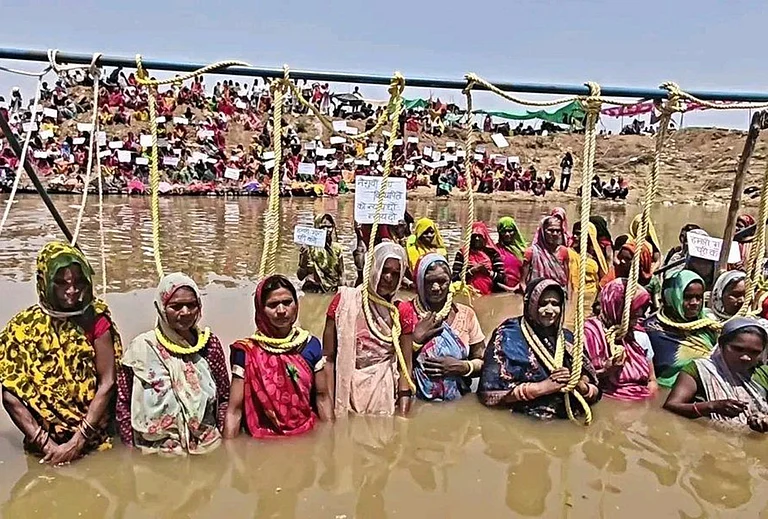
We asked the people protesting under the scorching April sun if they were against the project. All of them responded in the negative, saying that they were opposed to the compensation and relief packages being offered in lieu of their lands. Bhanu Pratap, a resident of Palkoha in Bijawar tehsil, has been given Rs. 12,50,000 as compensation. Besides, he has received 15 lakh in lieu of three acres of land. He maintains that he must be given at least 25 lakh as compensation.
Advertisement
Hailing from regions near Bundelkhand ourselves, we know that the veil here is linked inseparably with women’s very identity. Defying this norm, the women at the protest site were sloganeering and demonstrating by lying down on the symbolic funeral pyres. They maintained that all of the compensation that was offered went to the men. Should the men squander the money away, the women will be left with nothing. So, they demanded that women be given a share in the compensation. They also wanted girls over 18 years of age be considered separate households in their own right, and then be allotted compensation.
People stated that the names of some of the villagers had not been included in the list for compensation at all. They also accused the patwaris and other officials of demanding money in lieu of the compensation. In March, the Sagar Lokayukta had even arrested a patwari who was taking Rs. 50,000 as bribe. The patwari, Rahul Agrawal, had been accused of demanding Rs. 1,50,000 in lieu of facilitating the compensation.
Advertisement

This protest movement made it to the national news headlines in April. However, the friction between the villagers and the local administration has been ongoing since February. Between February 6 and 8, the local women, along with social activist Amit Bhatnagar, had brought the dam’s construction to a halt. Later, Bhatnagar’s arrest led to violent clashes between the villagers and the police.
Between February and April, the administration broached the matter of reconducting surveys many times. Yet, the discontent on the ground did not subside. This is why people resorted to peaceful satyagraha in the month of April.
Forty-one years ago, the Narmada Bachao movement against the Sardar Sarovar dam began in Madhya Pradesh. The protesters had resorted to water satyagraha during this movement, too. Now, in Chhatarpur, these people are using the same means to make the government relent.
Advertisement
We are seated in a small courtyard with Shanti, Tidiya and a few others. We ask them that since the government has power, which it can use to halt the protests, what is the way ahead? Tidiya promptly replies, “The people also have power. The government will not be able to win against the people.” Shanti, pausing for a bit, says that she is acting in the interest of her children’s future. Another lady responds in anger that she won’t let the dam be built, even if it costs her life.
On our way back, we remembered Phanishwar Nath Renu’s Rinjal-Dhanjal. On the last few pages of the book, Renu wrote: “What if Rattu Singh dies? Whatever happened when so many people died? Nothing happened. Nothing will happen.”
(Translated by Anwit Shahi)
This article is part of the magazine issue dated May 11, 2026, called 'Khela Hobe? ' about Assembly Elections 2026 and how West Bengal may prove to be the toughest battleground for the Bharatiya Janata Party.
Advertisement
Published At: