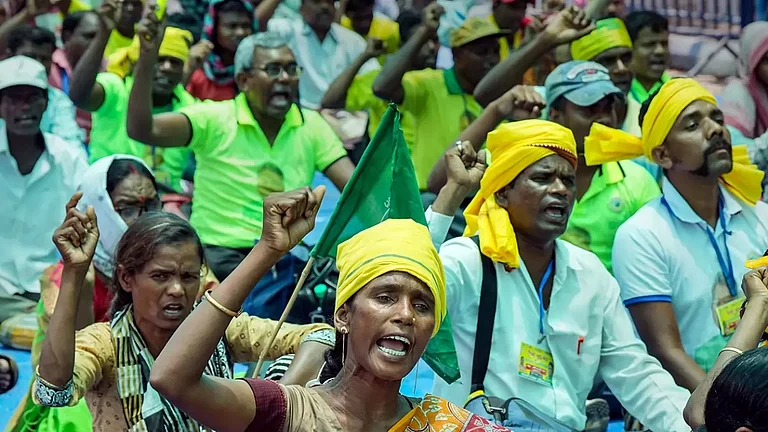
Thousands of natives in Palghar protested against Vadhavan port and other development projects on January 19.
Protesters comprising fisherfolks, tribals, farmers and youth raised environmental consequences- affecting marine ecology, traditional livelihood of fisherfolks and weakening power of Gramsabhas under PESA.
CM Devendra Fadnavis praised Vadhvan port project at the world economic forum at Davos in Switzerland, saying Vadhvan port will be among top 10 ports in the world.
Thousands Take To Streets in Palghar to Oppose Maharashtra’s Vadhvan Port
While Maharashtra Chief Minister Devendra Fadnavis praised the Vadhvan Port project at the World Economic Forum in Davos, thousands of Palghar local residents took out a march to the district collector’s office to protest the port and other proposed development projects
Summary
Around 25,000 tribals and fisherfolk across Palghar took to the streets to protest the proposed Vadhvan Port on India’s western coast, about 140 kilometres north of Mumbai. While Chief Minister Devendra Fadnavis praised the project at the World Economic Forum in Davos on January 19, local residents demanded that it be halted immediately.
Proposed in Palghar district, Vadhvan Port is projected to become one of India’s largest deep-draft ports and a global transhipment hub. It is being developed by Vadhvan Port Project Limited (VPPL), a joint venture incorporated in 2016 between the Jawaharlal Nehru Port Authority (JNPA), which is controlled by the Union government, and the Maharashtra Maritime Board (MMB). JNPA holds a 74 per cent stake in the company, while MMB holds 26 per cent.
The Maharashtra government has promoted the port as a major boost to logistics, trade and employment. However, it has faced sustained opposition from fisherfolk, Adivasi communities and environmental groups, who raise concerns about displacement, damage to coastal ecosystems and the loss of traditional livelihoods.
A massive protest march organised by the Vadhvan Bandar Virodhi Sangharsh Samiti and allied collectives on 19 January converged on the Palghar collector’s office. Residents were protesting the proposed Vadhvan Port alongside several other development projects, including Murbe Port, the Jindal Port and the Reliance Textile Park near Kelwa. Protesters met Palghar collector Indurani Jakhad and submitted a charter of demands.
“The collector accepted our demands as a formality, but repeatedly said she had no role in these projects, as they are being driven by higher authorities,” Vinit Patil told Outlook. Patil, a resident of Varor village in Palghar, has participated in multiple agitations against the Vadhvan Port and joined the protest on January 19.
Citizens, native fisherfolk and collectives have been resisting the development projects for years, staging multiple protests including a massive sit-in protest at Mumbai’s Azad Maidan in 2023. They have raised concerns of native livelihood of fisherfolks being endangered, pollution, environmental concerns including marine ecology, disbelief in the government’s ‘employment creation’ promise and the mandate of Gramsabhas not being followed.
Advertisement
Varor village in Palghar district, comprising 140 tribal households falls under PESA (Panchayat extension to scheduled areas Act), raised concerns of Gramsabha's mandate not taken into consideration for the Vadhvan project. No development projects can take place in PESA notified villages without the mandate of Gramsabhas according to the PESA act. Vinit Patil of the Varor village conducted two Gramsabhas in which resolutions of resistance to Vadhavan port were passed with majority, but the district collector didn’t recognise the constitutionally empowered mandate of Gramsabhas, Patil of Varor village alleges.
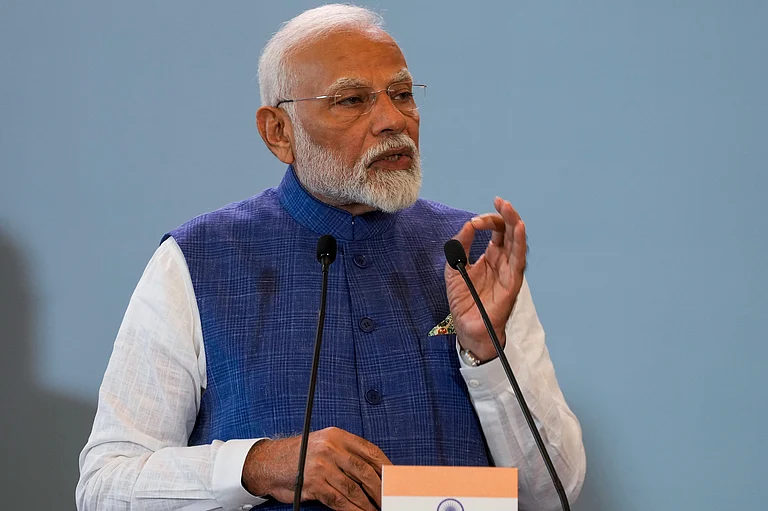
Chief Minister Devendra Fadnavis underscored the importance of the Vadhvan Port during an interview at the World Economic Forum in Davos on 19 January. He described maritime infrastructure as central to India’s economic ambitions.
“All developed economies are maritime powers. Our entire supply chain depends on the maritime ecosystem,” Fadnavis said. “With the India Maritime Vision 2030 and the Maritime Amrit Kaal Vision 2047, India is set to become a major player in global supply chains. We needed a new port, and Vadhvan is the right location. It is a natural deep-draft site capable of accommodating large vessels.”
Advertisement
He added that the project was first conceived in the early 1990s but was delayed by prolonged legal challenges. “Activists, rightly or wrongly, approached the Supreme Court, and the project was halted. Committees were formed and hearings took years. When I became chief minister, we restarted the process. Once again, approvals were sought from the High Court and the Supreme Court, and eventually all clearances were granted.”
Fadnavis also said the port would rank among the world’s top 10 once completed. “The foundation stone has been laid by Prime Minister Modi, construction is progressing rapidly, and the first phase of the Vadhvan Port will be operational within three years.”
However, No construction work has been started yet, locals told Outlook.
“CM Fadnavis is spreading lies to lure investors. There is no construction happening at all. Whenever trucks arrive with building supplies, we, the locals, resist them together,” said Vinit Patil of the Vadhvan Bandar Virodhi Sangharsh Samiti.
Advertisement
Local protesters interviewed by Outlook over the phone echoed his concerns.
“The Bombay High Court cleared the Dahanu Development Board to grant the necessary sanctions for Vadhvan Port. We have filed an appeal in the Supreme Court and are awaiting its final verdict. How can construction proceed without it?” said a young protester who wished to remain anonymous.
Residents also challenge the government’s promise of employment from the project. Palghar and Dahanu talukas are coastal regions with nearly 2 million people, of whom 800,000 youth are already employed. Over 5,000 small-scale industries are registered under Palghar MIDC (Maharashtra Industrial Development Corporation).
“There is already an MIDC in Palghar providing jobs for youth. The remaining 1–1.2 million older residents are self-reliant. Fishing is our traditional livelihood, and our economy sustains itself,” Patil added. “Now the government is trying to impose a ‘fourth Mumbai’ on us, even as the so-called world-class Mumbai model has failed. Along the coastline, Koliwada lands are being taken over by the state.”
Advertisement
Protesters also alleged that JNPA (Jawaharlal Nehru Port Authority) demanded 233 hectares of land for reclamation. Citizens fear that soon felling of trees and hills would take place. They also expressed their anxiety of their lands becoming barren due to development projects.
Patil of the Vadhvan Bandar Virodhi Sangharsh Samiti, along with several activists, carried out month-long door-to-door campaigns to inform people about the proposed development projects and their long-term consequences. Beginning from Zai, the last village on the Maharashtra–Gujarat border, activists launched an extensive mobilisation drive to rally public support for the January 19 protest.
The Vadhvan Bandar Virodhi Sangharsh Samiti and allied collectives have warned that they will call for a ‘Mumbai Bandh’ if their demand for an immediate halt to all development projects is not met.
Published At: