Iran and the UAE had competing demands over the West Asia conflict, forcing India to find wording both could accept.
The declaration avoided directly mentioning the Russia-Ukraine war while taking a stronger position on Gaza and Palestinian rights.
BRICS criticised unilateral tariffs and sanctions without naming the US, allowing members to oppose such measures without turning the document into an anti-US statement.
BRICS Delhi Declaration Explained: How India Got Iran, UAE, Russia And China On The Same Page
New Delhi avoided naming countries or assigning blame on the most divisive issues, using carefully negotiated language to secure consensus among Iran, UAE, Russia, China and other members.

Summary
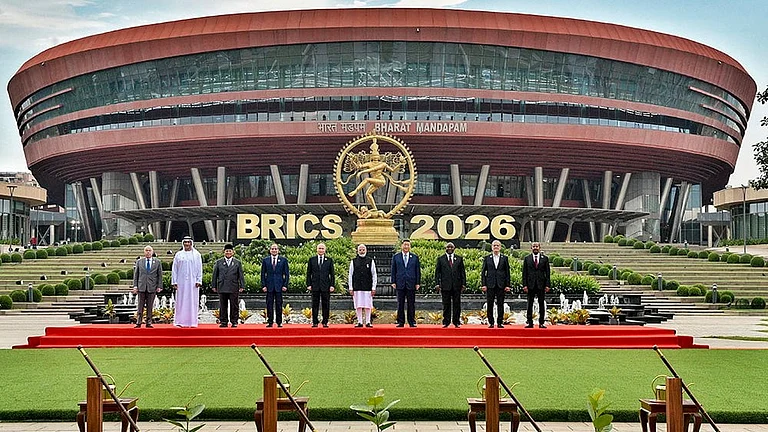
The adoption of the 2026 New Delhi Declaration was the result of a diplomatic balancing act that went down to the wire. Negotiations over some of the most contentious sections continued until around 4 AM on Saturday, as India tried to bridge sharply different positions among members of the expanded BRICS grouping.
The difficulty was not simply reaching agreement on the wording of a document. BRICS now brings together countries that are themselves divided over major geopolitical conflicts. Iran and the UAE have opposing positions on the West Asia conflict, Saudi Arabia has its own regional calculations, Russia remains sensitive to language that could be applied to the Ukraine war, while China wants BRICS to play a larger role in reshaping global governance.
So how did India get all of them to sign the same document?
Why Was The Declaration So Difficult To Negotiate?
The most difficult negotiations centred on West Asia. Iran reportedly wanted the declaration to explicitly refer to the unilateral attack on its territory and what it considered a violation of the UN Charter. The UAE, meanwhile, wanted recognition of Iranian attacks on its sovereignty and territory.
For India, directly endorsing either position risked alienating the other country.
The solution was to avoid deciding who was at fault. The declaration instead says BRICS members “recalling our respective national positions” are calling for “maximum restraint” and for actions that do not further aggravate the situation.
This allowed Iran and the UAE to retain their individual positions without requiring BRICS to endorse either side’s narrative.
The breakthrough came alongside a separate diplomatic engagement. Iranian President Masoud Pezeshkian met Abu Dhabi Crown Prince Sheikh Khaled bin Mohamed bin Zayed Al Nahyan on the sidelines of the summit, with the two discussing de-escalation, regional stability and peace.
As former Indian ambassador to the UAE Sunjay Sudhir put it, India had managed to “keep the difficult conversations going” and create space for countries with divergent positions to engage.
Why Did The Declaration Avoid Naming Iran, The US Or Other Key Actors?
The absence of names was itself part of the diplomacy.
Advertisement
Rather than directly assigning responsibility for the West Asia conflict, the declaration focused on principles that members could agree on: sovereignty and territorial integrity, protection of civilians, de-escalation, maritime security, energy flows and diplomacy.
A similar approach was visible in its treatment of the US. The declaration did not name President Donald Trump even while repeatedly referring to tariffs, trade restrictions and unilateral economic measures.
This gave members space to criticise policies they oppose without turning the declaration into an explicitly anti-American document.
How Did India Balance Iran And The UAE?
This was arguably the biggest test of India's BRICS presidency. Iran and the UAE are both members of the expanded grouping but have been on opposite sides of the Gulf conflict. Iran has also launched attacks on the UAE during the conflict, including against the Al Minhad Air Base in August.
India therefore had to find language that Tehran could accept without forcing Abu Dhabi to endorse Iran's position, and vice versa.
Advertisement
The final formulation — calling for restraint while “recalling our respective national positions” — effectively separated national positions from the collective BRICS position.
India did not need to make Iran and the UAE agree with each other. It needed to make it possible for both to agree to the same text.
Why Was There No Strong BRICS Position On The Ukraine War?
The 45-page declaration contains no direct reference to the Russia-Ukraine war.
This is a notable change from the 2025 Rio declaration, which had said BRICS members “recall our national positions” on the conflict.
Russia's presence at the negotiating table made stronger language difficult. Any criticism of Moscow could have threatened consensus, while India also had little interest in allowing Ukraine to dominate a declaration meant to cover a much broader BRICS agenda.
Once again, the compromise was silence rather than confrontation.
The declaration instead relies on general references to sovereignty, territorial integrity and the peaceful resolution of disputes through “dialogue, consultation and diplomacy”.
Advertisement
What Did BRICS Say About Gaza And West Asia?
Unlike Ukraine, the Israel-Gaza conflict is directly named.
The declaration reiterates positions from the 2025 Rio statement, while referring to UN Security Council Resolution 2803 and opposing the forced displacement of Palestinians. It also criticises arrangements that could legitimise or prolong occupation and calls for humanitarian aid.
On Lebanon, it calls on Israel to respect the agreed terms and withdraw its occupying forces.
On the wider West Asia conflict, however, the language is deliberately broader. BRICS expressed “deep concern” over the escalation and called for restraint, protection of civilians and respect for sovereignty and territorial integrity.
The declaration also stressed the importance of keeping trade, supply chains, energy flows and maritime security functioning.
Why Did BRICS Criticise Unilateral Tariffs And Sanctions?
Trade was another area where the declaration allowed countries with different interests to find common ground.
It condemns “unilateral coercive measures”, “unilateral economic sanctions and secondary sanctions” and protectionist trade restrictions. It also criticises the proliferation of trade-restrictive measures and rising tariffs.
Advertisement
The wording is significant because Russia and Iran have faced extensive Western sanctions, while BRICS members more broadly have been affected by US tariff measures.
Yet the declaration avoids directly naming Washington.
This balancing act reflects the broader purpose of the document. China gets language supporting its Global South and multilateralism agenda, Russia and Iran get opposition to unilateral sanctions, while India avoids turning the BRICS declaration into a direct confrontation with the US.
The declaration also backs greater representation for developing countries in global institutions and supports reform of bodies such as the UN, IMF, World Bank and WTO.
India had faced these divisions before. A BRICS meeting in April failed to reach consensus on West Asia, forcing New Delhi to issue a Chair's Summary instead of a joint statement. The breakthrough in September therefore followed months of negotiations.
When Prime Minister Narendra Modi finally announced that “No member has raised any objection” and that the New Delhi Declaration had been adopted unanimously, the achievement was less about getting BRICS members to agree on the world's conflicts than about finding language they could all live with.
For India, that was the diplomatic victory: not resolving the disagreements inside BRICS, but preventing them from breaking the bloc's consensus.
Published At: