MLAs push for NDA ties to improve governance and constituency development.
No formal decision has been announced; NCP (SP) remains part of the MVA.
Any realignment could significantly reshape Maharashtra's political landscape.
At the Crossroads: Will Sharad Pawar’s NCP (SP) Stay With The MVA ?
Speculation over NCP (SP)'s political future has intensified amid internal pressure, cross-alliance meetings, and Sharad Pawar's continued silence.

Summary
Will Sharad Pawar’s Nationalist Congress Party (SP) stay the course with the opposition Maha Vikas Aghadi (MVA) or edge closer to the ruling NDA? As of July 2026, this uncertainty has kept the state’s politics on edge, driven by the veteran leader’s measured public silence amid reported internal pressures, cross-alliance meetings, and practical governance challenges faced by party legislators.
Why Rumours About Sharad Pawar Joining the NDA Keep Growing
Speculation about a possible shift or closer ties intensified after the 2024 assembly elections and continued through 2025 and and 2026, particularly amid upcoming local body polls and administrative hurdles. Multiple NCP (SP) MLAs have directly conveyed to party leadership their preference for aligning with the NDA, arguing it would simplify securing development funds, project approvals, and constituency-level initiatives. Reports from senior party sources indicate that at least five of the roughly 10 MLAs in the assembly have pushed for this option rather than prolonged opposition status or a potential merger with Congress.
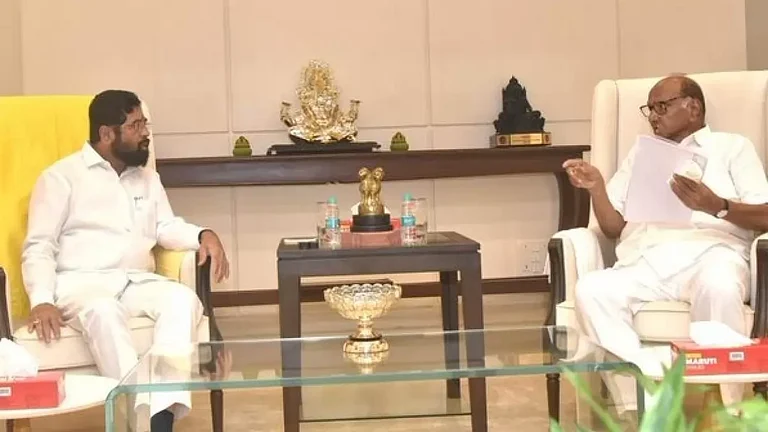
The rumours draw strength from a series of notable interactions. During a legislative session focused on the long-standing Maharashtra-Karnataka border dispute, Sharad Pawar made an unscheduled visit to Deputy Chief Minister Eknath Shinde’s office. Shinde interrupted an ongoing Cabinet meeting to receive him personally. Separately, senior NCP (SP) leader Jayant Patil held a meeting with BJP Rajya Sabha MP Vinod Tawde. MLC Eknath Khadse also met Tawde and subsequently engaged with Shiv Sena (UBT) chief Uddhav Thackeray.
Optics from the Pawar family’s engagement with industrialist Gautam Adani in Baramati in late December 2025 added to the narrative. Adani arrived to inaugurate the Sharadchandra Pawar Centre of Excellence in Artificial Intelligence at an institution run by the Pawar family. He was accompanied in a vehicle driven by NCP (SP) MLA Rohit Pawar, with Supriya Sule, Sunetra Pawar, and Ajit Pawar present for the welcome. This event, building on Adani’s earlier 2022 inauguration of a Science and Technology park in the same area, was noted for its cross-faction family coordination.
Advertisement
Broader context includes the 2023 NCP vertical split, in which Ajit Pawar took the majority of legislators and joined the NDA. NCP (SP) retains eight Lok Sabha MPs and 10 assembly MLAs, numbers that hold weight for legislative support on issues such as potential delimitation exercises. The recent defection of six Shiv Sena (UBT) Lok Sabha MPs to the Eknath Shinde led group, citing smoother access to government schemes and approvals, has been cited as a parallel development influencing calculations within NCP (SP).
Daily meetings among legislators and informal discussions have sustained momentum, with some MLAs expressing dissatisfaction over the party’s occasional abstentions on government matters or limited opposition intensity.
What Sharad Pawar Has Actually Said
Sharad Pawar has maintained public restraint and has not convened any formal high-level meeting of the NCP (SP) to deliberate the party’s long-term political strategy as of mid July 2026. On the question of reunification between the two NCP factions, particularly following shifts involving Ajit Pawar, he observed in February 2026 that it seems the process will now be discontinued.
Advertisement
Senior sources within NCP (SP) have repeatedly told Outlook India that Pawar will not extend support to the BJP by aligning with Ajit Pawar’s group. The party’s office bearers have instructed cadre that alliances remain possible with all parties barring the BJP. In January 2025, Pawar endorsed INDIA bloc partner AAP ahead of Delhi elections and pushed back against remarks from Union Home Minister Amit Shah regarding the politics of betrayal.
Pawar has described the INDIA bloc’s primary utility as operating at the national level, especially amid differences among constituents. He called for a high-level meeting of INDIA allies in June 2026 to review challenges and strengthen coordination without focusing immediately on state-specific electoral pacts. Supriya Sule has refrained from categorical statements endorsing or rejecting closer NDA ties, preserving flexibility. NCP (SP) state president Shashikant Shinde explicitly denied any formal proposal for a merger with Congress when speculation arose.
These positions reflect emphasis on national opposition frameworks alongside state-level pragmatism, without announcing any departure from existing alliances.
Advertisement
Why the MVA Remains Concerned
Partners in the Maha Vikas Aghadi have voiced growing apprehension over the ambiguity. Shiv Sena (UBT) leader Sanjay Raut publicly criticised Pawar’s meeting with Eknath Shinde, arguing that engaging under the roof of the leader who had overthrown the earlier MVA government undermined the alliance’s credibility. Raut noted that such actions hurt the broader opposition narrative, even while acknowledging internal party matters for the NCP (SP).
Congress leaders, including former Maharashtra Congress president Nana Patole, highlighted discomfort with NCP (SP)’s relatively subdued response to controversies such as the land deal involving Parth Pawar. Patole suggested this approach represented a missed opportunity to demand accountability from Deputy CM Ajit Pawar and build momentum ahead of civic polls. Some Congress voices internally assessed the Baramati Adani event as placing the MVA in a difficult position by softening attacks on policies perceived as favouring large corporates.
The MVA worries about numerical erosion and organisational impact. With defections already occurring in allied parties and the NCP (SP) holding influential parliamentary and assembly seats, any softening could strengthen the NDA’s position on key legislation. Coordination for municipal corporation elections, including the high-stakes Brihanmumbai Municipal Corporation (BMC) polls scheduled around January 2026, has become more complex amid the uncertainty. Public statements from Congress have reaffirmed belief in Pawar’s commitment to secular and progressive politics, while privately stressing the need for clarity.
Advertisement
Pressure tactics attributed to the ruling side and the administrative challenges for opposition legislators further compound alliance concerns.
Developments Inside NCP (SP)
The NCP (Sharad Pawar) faction shows clear internal divisions. Legislators have reported ongoing daily discussions, with a substantial portion estimated by some leaders at half the MLAs inclined toward NDA engagement primarily for governance deliverables rather than ideological shifts. Frustrations centre on perceived inconsistency in the party’s legislative behaviour, such as selective abstentions, prompting calls for a decisive stand to better serve constituencies.
Jayant Patil has shared in informal settings that many colleagues see value in joining the ruling alliance. While family-level interactions across the divided NCP persist, as evidenced by joint events, senior NCP (SP) figures continue to rule out support for the BJP through Ajit Pawar. Attempts by the Ajit faction to attract SP legislators, including proposals involving breakaway MPs, have surfaced but faced resistance.
Sharad Pawar’s increased hands-on role in guiding the faction post 2024 has influenced internal conversations around succession, strategy, and maintaining organisational strength against ruling-side inducements. Merger rumours with Congress were firmly rejected, with the party affirming its independent identity. The faction’s smaller size relative to other Maharashtra players has heightened focus on leveraging its MPs and MLAs effectively in a polarised environment.
Possibilities of Further Realignment in Maharashtra
The state has experienced several major realignments in recent years, including the 2019 formation of the MVA, the dramatic 2022 2023 splits in both Shiv Sena and NCP, and subsequent adjustments following assembly elections. Any move by NCP (SP) would follow this precedent of fluid alliances driven by electoral math, governance needs, and leadership calculations.
Contributing elements include the appeal of ruling alliance resources for smaller parties, the NDA’s interest in consolidating numbers ahead of legislative priorities, and the dynamics of local body polls where cross-voting or seat adjustments could prove advantageous. At the same time, Pawar’s decades-long positioning, public rejections of BJP support via the rival faction, and emphasis on national opposition frameworks serve as restraining factors.
As of July 2026, developments remain in the realm of speculation fuelled by meetings and internal feedback rather than formal announcements. Civic polls, assembly sessions, and INDIA bloc deliberations are anticipated to serve as testing grounds. NCP (SP) leaders continue to balance constituency demands with alliance commitments, leaving the door open for evolution based on emerging political realities.
Published At: