Rakesh earns Rs 11,000 a month. “Break it down,” he says. Rs 3,500 goes in rent. Water costs another Rs 20 a day. Between Rs 2,000 and Rs 3,000 is spent on his children’s education. He sends Rs 1,000 back home in Gwalior to support a family of seven. What remains stretches thin across food, gas, and everything else life demands.
Arithmetic Of Survival: Between Protests And Pay Cuts, Noida’s Workers Struggle To Survive
The contractual labourers in Noida are navigating a tricky situation—while they are still angry about low wages, they also fear that raising the issue would mean losing little that they earn

Every rupee is calculated. He walks to work to save Rs 10–15, leaves early to avoid spending on transport. In the market, choice gives way to compulsion: vegetables are picked not by preference but by price, often the cheapest available, while milk and curd have long disappeared from the household. He gestures toward his meal: a plate half full, now two days old, flies hovering over it, set beside an empty five kg LPG gas cylinder. “I have been eating this for two days now. Tell me, how do I run a family? How do I educate my children?”
There is no answer. Only a pause that lingers.
Any disruption—a fever, an accident, a family emergency— pushes him into borrowing. His wages, he says, barely cover food, leaving no cushion for crisis. “And once we take a loan, more problems come, and the debt keeps piling up. How will we ever repay it?” Over the years, the loans have stacked up to at least Rs 50,000. After 15 years of work, he says, there is nothing saved, not even Rs 1,000 in his account.
Rakesh stitches garments in a factory in Noida. He didn’t go to work for two days—one day lost to a protest he says he didn’t even know about, adding that he would have joined had he known, and another to fear: that the police might pick him up, as they did with other workers.
At roughly Rs 366 a day, those two days off have already cost him more than he can afford. That Rs 366 is the difference between eating and borrowing. Between survival and debt, not just for Rakesh but for many factory workers like him across the country.

Rented rooms of the factory workers which costs Rs3,500. Vikram Sharma
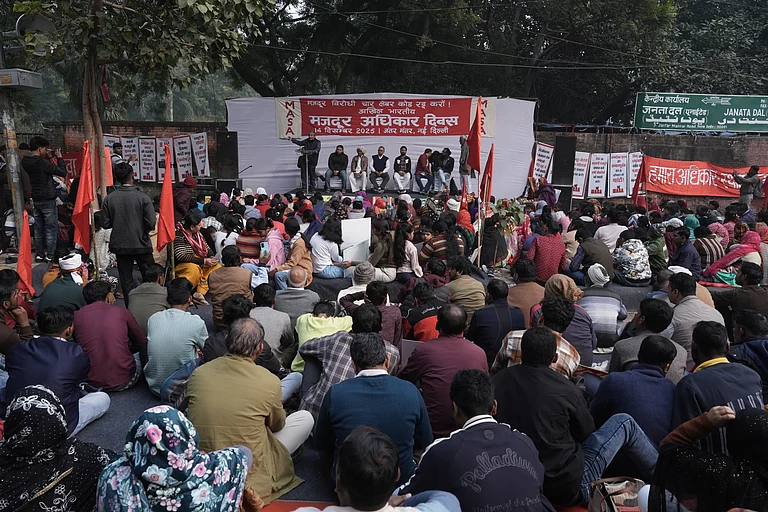
On April 9, hundreds of contractual workers gathered near the NSEZ Metro station in Noida, standing under the harsh sun with a single demand: a minimum wage of Rs 20,000 a month. By April 13, the protests had spread across the industrial belt, bringing traffic to a halt and tensions to a boil. In Sector 84, vehicles were set on fire; two were gutted. There were reports of stone pelting, vandalised police property, even a damaged police vehicle. Tear gas filled the air as police tried to disperse the crowds.
Advertisement
What began as a demand for wages quickly turned into a crackdown. Over 300 people were arrested and seven FIRs registered in connection with the protests, according to Gautam Buddha Nagar Police Commissioner Laxmi Singh. The Uttar Pradesh government later said that at least 66 “key individuals” were formally arrested, claiming that 45 of them were not factory workers but “external elements” who had incited violence.
But on the ground, among workers like Rakesh, the lines are far less clear—blurred between protest and fear, between speaking up and being picked up. “I have a basic button phone. They expect us to conspire?” asks Rakesh. “We’re only asking for our basic rights, for the wages we’ve earned. We are not Naxals. We are workers.”

First floor of the building where workers live in rented rooms in Noida. Vikram Sharma
In a narrow lane of Noida’s Sector 57, more than ten factory workers share a single floor of a three-storey building. A dim corridor cuts through it, with small rooms lined on either side. Just outside, a stagnant drain runs along the edge, its stench seeping in, breeding mosquitoes. Inside, the rooms are cramped—barely enough space for a bed, a few utensils, and a small stove. There is no ventilation, no cross breeze. Only heat, dampness, and the constant hum of mosquitoes. Two washrooms serve everyone on the floor. “This is what we pay Rs 3,500 for,” says Kaleem, another factory worker, originally from UP.
Advertisement
Across factories in Noida’s industrial sectors, what emerges is not just low pay, but a system of work that steadily erodes both wages and dignity. Rakesh, who does stitching, says even the legally mandated minimum wage remains out of reach. “On paper they show one thing, in hand we get something else,” he says, describing payslips that inflate figures while actual payments fall short. Overtime, which by law should be paid at double the hourly rate, is routinely undercut. “We work extra hours, but they give only single,” he says.
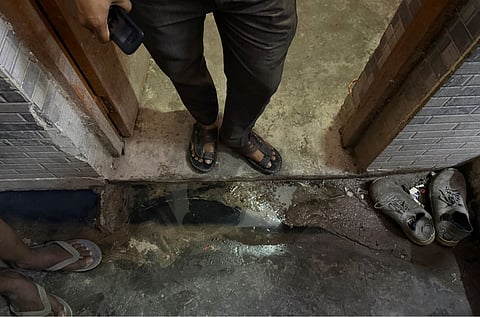
Rakesh, one of the factory workers, stands on the edge of his room, holding a button phone Mrinalini Dhyani
Kaleem, who has spent two decades working as a tailor, moving between factories, describes 12-hour workdays where even rest is monetised against the worker. “Lunch is 45 minutes, but they cut one full hour,” he says. “Even if you are 10 minutes late, they deduct one hour.” Breaks for tea and meals are bundled together and docked from wages, shrinking already meagre earnings.
Advertisement
There is little to no concept of paid leave—no sick days, no earned leave—and absence, even for illness, simply means a cut in salary. More critically, workers say they remain outside any formal safety net. “No PF, nothing,” Rakesh says. Kaleem and other workers standing next to him in the dim corridor, agree. “They say it is being cut, but we never see any proof.” Payments are often made in cash, recorded in registers rather than formal systems, leaving workers without documentation of employment or access to benefits.

Advocate Raghav Gupta explains that this allows factories to bypass compliance entirely—workers are underreported during audits, attendance is manipulated, and contributions like PF or ESI are either not deposited or never formally initiated. Gupta also notes that while the newer labour code sought to strengthen worker welfare by increasing the proportion of basic salary, thereby raising PF contributions, many factories circumvent this entirely by keeping workers off the books. “They are working every day,” he says, “but in the eyes of the system, they are not employees at all.”
Advertisement
For migrant workers, many of whom take up jobs under the vague label of “helper”, this means long shifts, arbitrary deductions, unpaid overtime, and no access to the social protections that the law ostensibly guarantees. In effect, long hours, underpaid overtime, arbitrary deductions, and the absence of social security combine to create what one worker sums up simply: “We are working, but we are not counted.”
If stagnant wages have long kept these families on the edge, the LPG crisis has pushed them further over it, turning an already fragile existence into one constantly on the brink. For families like Lalita’s, the rising cost and erratic availability of LPG has begun to dictate not just what they eat, but how they live together. “For two days we didn’t cook,” she says. “Children ate from neighbours. We ate outside.” When a refill does come, it costs Rs 1,500 or more for a small cylinder—an amount that eats directly into rent and school fees. The result is a series of quiet, painful adjustments. Lalita and her husband both work in the garment factory in Noida, earning Rs 20,000 together, yet only one of their children is able to attend school in Noida. Another child has been sent back to the village, partly because of costs, partly because sustaining a household without reliable cooking fuel has become impossible.
In nearby rooms, other workers describe similar compromises: children moving back and forth between city and village, meals skipped or stretched over days, dependence on neighbours during shortages. One woman speaks of her nine-year-old daughter occasionally working in other people’s homes—“What can we do? It is compulsion.”

What unfolded in Noida was not an isolated eruption—it was the latest link in a chain that had been building across the industrial belt of north India. Thousands of contractual workers in Haryana gathered earlier this month, clashing with police while demanding higher minimum wages and better conditions. The Haryana government’s subsequent decision to raise minimum wages by nearly 35 per cent became a trigger point, creating visible wage disparities within the same companies operating across regions. Workers in Noida, many employed by the same firms, began demanding parity, leading to protests that quickly escalated.
Most of these workers are migrants, drawn to cities in search of better jobs and higher incomes. But as development economist K.P. Kannan notes, this movement is often driven by the absence of viable opportunities in rural areas. A stronger focus on rural development, particularly agriculture and non-farm employment, could have reduced their vulnerability.
“These workers do not have any asset worth its name as a fall back whenever they are unemployed,” he says, underlining how precarious their lives remain. This lack of security, he adds, is routinely exploited by employers, who offer regular work but “with low wages but no security of employment or non-wage benefits.”
Kannan is also sharply critical of the broader policy direction. “Today’s politics is hardly interested in any worthwhile rural development that could have benefitted the vast mass of working poor in this country,” he says. Instead, he argues, the emphasis has been on a model of “exclusive growth focused on employer interests and largely tuned to the rich and middle class in urban areas,” leaving the working poor on the margins despite being “a potential source of aggregate demand for a more broad-based growth.”
He further points out that labour movements have weakened considerably under the pressure of neoliberal economic reforms, both domestically and globally. “It is therefore no wonder that such uprisings by workers have become a recurrent phenomenon,” he says, framing current protests as part of a larger structural issue rather than isolated incidents.internationally. It is therefore no wonder that such uprisings by workers have become a recurrent phenomenon. “ he said.
Arrests followed—but in fragments, without clarity. Workers speak of people being picked up, but rarely with certainty about who or how many. That uncertainty extends even to those trying to assist them legally.
Lawyers working on the case say FIRs in Noida have been difficult to access, with petitions being moved just to obtain copies, even as detentions reportedly ran into the hundreds. In contrast, in Manesar, where similar protests had broken out, around 60 workers were arrested, with serious charges like attempt to murder and grievous hurt invoked, raising concerns that a similar legal framing could be applied in Noida as well.
As unrest intensified—with arrests, tear gas, and clashes, the agitation began to ripple outward again, with fresh demonstrations reported in Gurgaon and Faridabad, where workers are demanding an increase in wages across the NCR.
Alongside the crackdown came a familiar shift in narrative. Even as workers insisted their demands were rooted in wages, inflation and survival—“this is about the stomach”—the protests began to be described in terms of “outside influence”, with insinuations of Naxal links and conspiracy.
For Akash Bhattacharya, a national councillor of the All India Central Council of Trade Unions (AICCTU), this is a well-worn playbook. “It’s a dog whistle to delegitimise dissent,” he says, pointing out that such labels are often deployed to shift attention away from structural issues like wage suppression and labour informalisation. Gupta adds that workers, most of whom are informal and undocumented, are least equipped to contest such charges. “They don’t even want to go to court for Rs 10,000–15,000 disputes,” he says, underscoring how inaccessible the legal system remains for them.
For Shiv Kumar, who has himself been arrested in the past during labour and farmers’ protests, this pattern of criminalisation is part of a larger strategy. “This is psychological warfare,” he says. “Anyone who raises their voice—workers, farmers, students—is labelled, so that exploitation can continue quietly.” He points to recent notices and FIRs, including those served to activists, as part of a broader climate where even lawful protest is met with surveillance and intimidation.
What emerged was not just a local protest, but a spreading wave of labour unrest, moving factory to factory, city to city, held together by a single demand: equal pay for equal work in a region where the cost of living is rising faster than wages.
The UP government’s announcement of a 21 per cent wage hike after the protest has done little to reassure workers on the ground. As Bhattacharya explains, the problem is not just the quantum but the implimentation and the framework itself. “Minimum wage is the bare minimum. A fair wage is what allows a dignified life and a living wage goes beyond that, enabling real upward mobility,” he says.

Poster of revised wages outside one of the very few factories in sector 57 Vikram Sharma
By that measure, he argues, the hike is a bare minimum and falls far short of a fair wage, let alone a living wage. For workers like Rakesh and Lalita, whose monthly earnings hover around Rs 10,000–14,000, the gap between wages and survival remains stark. The daily arithmetic of Rs 366 still decides whether a family eats or borrows.
Various industrial pockets of Noida remain heavily guarded. Inside, work has resumed, but uneasily. In several units, shattered glass is still visible, a reminder of the unrest that broke through these spaces just days ago. At a few factory gates, revised wage charts have been pasted, but most remain unchanged. Workers have returned, but without clarity. “There is no conversation about the hike. But I am back. I don’t have an option. My salary will be cut,” says Sanjeev Kumar.
Published At: