Russia deployed its Tu-214PU airborne command aircraft to Tehran as US-Iran military exchanges intensified
The specialised aircraft serves as a secure flying command post for Russia's senior political and military leadership
The deployment has fuelled speculation over high-level Russia-Iran coordination amid the regional crisis
The move comes as Pakistan pushes diplomatic efforts to preserve the faltering ceasefire framework
Russia Dispatches Airborne Command Aircraft To Iran Amid US Strikes
Russia has deployed one of its most secure airborne command aircraft to Tehran, according to flight tracking data, as the United States and Iran exchange heavy strikes and diplomatic efforts to contain the conflict face growing strain

Summary
Russia has sent one of its most secure airborne command aircraft to Tehran, as the United States and Iran exchange heavy strikes across the Gulf and diplomatic efforts to contain the conflict face growing strain.
The Tupolev Tu-214PU, a specialised variant of the Tu-214 passenger aircraft that serves as a flying command post for the Kremlin, landed at Tehran's Imam Khomeini International Airport on Monday after departing from Moscow's Vnukovo Airport, according to Flightradar24 data. The aircraft, operated by Russia's Rossiya Special Flight Squadron, which transports the country's top political and military leadership, is equipped with encrypted communications, secure data links and systems that allow officials to coordinate government and military operations during a crisis.
Designed as an airborne command post with hardened communications and secure command-and-control systems, the Tu-214PU is often described as Russia's equivalent of a "doomsday" aircraft. Unlike standard VIP aircraft, it is designed to function even in high-threat environments, ensuring continuity of command during emergencies.
Deployment Amid Escalating Conflict
The arrival of the aircraft in Tehran has been viewed as a significant geopolitical signal, suggesting executive-level engagement between Moscow and Tehran at a time of mounting regional instability. The deployment has prompted speculation that discussions could involve military-technical cooperation, intelligence sharing or contingency planning as Iran faces sustained military pressure from the United States and its allies.
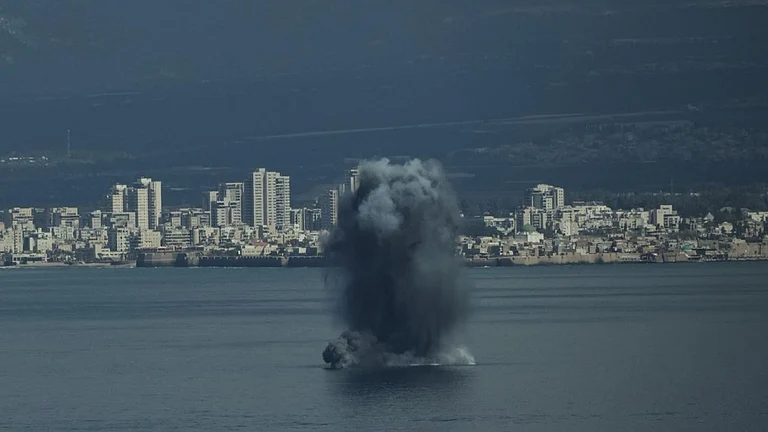
The aircraft's arrival came as the United States and Iran exchanged some of the heaviest missile and drone attacks of the war, with Tehran striking US military facilities across Gulf states and declaring it had once again closed the Strait of Hormuz. US Central Command said American forces struck 140 Iranian military targets on Saturday, bringing the total to more than 300 targets hit over three nights, targeting missile and drone sites, naval assets and ammunition depots.
Iran's Islamic Revolutionary Guard Corps said it had struck a second vessel in the Strait of Hormuz and targeted a US radar installation in Kuwait, a command-and-control centre in Jordan, US aircraft carrier support facilities in Oman, and a jet maintenance centre and command facility in Qatar. Qatar said three people, including a child, were injured by falling shrapnel.
Advertisement
Pakistan's Diplomatic Intervention
Pakistan has stepped in diplomatically following the renewed military clashes. Deputy Prime Minister Ishaq Dar spoke by telephone with Iranian Foreign Minister Abbas Araghchi to discuss the rapidly evolving regional crisis. Dar urged all parties to exercise restraint and pursue immediate de-escalation, saying dialogue and diplomacy remain "the only viable path."
The call came as the Islamabad MoU, a 60-day ceasefire plan brokered by Pakistan and signed on June 17, faces severe strain. The agreement, which aimed to allow unrestricted commercial shipping through the Strait of Hormuz, provide relief from sanctions and initiate discussions on Iran's nuclear programme and ballistic missiles, has been jeopardised by recent US air strikes, reimposed restrictions on Iranian oil exports and new Gulf military activity.
Published At: