Pakistan gains diplomatic prominence through its role in US-Iran mediation.
Economic challenges persist despite improved international standing and goodwill.
Analysts say structural reforms will determine Pakistan’s long-term gains.
Outlook Explains | Pakistan Went From IMF Patient To US-Iran Peace Broker. Can It Cash In?
That moment — a US vice president publicly embracing Pakistan's army chief at one of the most consequential peace summits of the decade — shows how dramatically Islamabad's international standing has shifted in a matter of months
Summary
At a luxury resort overlooking Switzerland's Lake Lucerne last weekend, US Vice President JD Vance spotted Field Marshal Asim Munir across the room and walked up to him. "This guy. What's up, man?" Vance said, pulling him into a hug.
Later, speaking to journalists gathered at Buergenstock, Vance went further. "I have joked that I have two very, very important people in my life, an Indian and a Pakistani," he said.
"The Indian is my wife, and the Pakistani is Field Marshal Munir. And I've probably talked to Field Marshal Munir more than I've talked to anybody else over the last three months."
That moment — a US vice president publicly embracing Pakistan's army chief at one of the most consequential peace summits of the decade — shows how dramatically Islamabad's international standing has shifted in a matter of months. The question now is whether Pakistan can actually convert that goodwill into something lasting.
Economy Badly Needs This to Work
Pakistan’s ground zero situation is telling enough to understand what this deal mean for it.
Pakistan's economy has been on IMF life support for years — the current arrangement being its 25th since joining the Fund in 1950. The debt-to-GDP ratio sits at between 70% and 80% as of 2026, with debt servicing at times consuming up to two-thirds of government spending. The country's GDP per capita remains one of the lowest in the world.
The West Asia war made things materially worse. FocusEconomics reported that while Pakistan's GDP growth rose to a three-quarter high of 4.0% in January-March 2026, it was driven largely by a 10% drop in imports as oil and gas inbound shipments collapsed due to the Strait of Hormuz closure — which is "hardly a sign of economic health." Manufacturing output fell in April and recovered only weakly in May, inflation went back into double digits, and the government was forced to implement power cuts and a four-day working week.
Advertisement
The IMF's third review of Pakistan's Extended Fund Facility, completed on in May, acknowledged that GDP growth had accelerated and the current account was broadly balanced in the first nine months of FY26, but warned that "the impact of the war in the Middle East clouds Pakistan's near-term outlook."
Dawn's reporting on the annual economic survey noted that CPI inflation for July-April FY2026 was 6.2%, up from 4.7% the year before, and that the current account surplus had shrunk sharply to just $72 million compared to $1.7 billion in the same period the previous year.
The World Bank, in its Pakistan assessment, observed "periods of rapid growth have been short-lived, and dependent on unsustainable debt accumulation or other external inflows."
This is the economy that Pakistan is now trying to reposition through diplomacy. The peace deal is not just a foreign policy achievement. For Islamabad, it is also a possible economic escape route.
Advertisement
What Pakistan Actually Did
The diplomatic architecture that produced the Islamabad Memorandum of Understanding (MoU), as the provisional US-Iran deal is formally known, was built quietly over months, according to Al Hurra's account of the negotiations. Field Marshal Munir laid the groundwork in late March, drawing on ties he had built with both Trump and Iranian security counterparts.
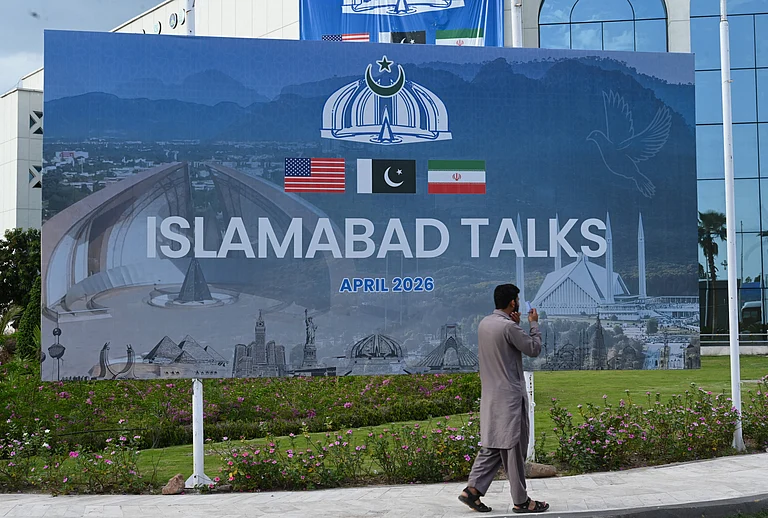
The first public signal of Pakistan's initiative came when Prime Minister Shehbaz Sharif spoke on March 24. On April 8, Islamabad brokered a ceasefire between Washington and Tehran after 40 days of continuous fighting. Three days later, Pakistan facilitated the highest-level direct talks between Iran and the US in 47 years — a 21-hour negotiation between a US delegation led by Vance and Iranian Parliament Speaker Mohammad Baqer Qalibaf. Those talks ultimately collapsed, but kept the door open and prevented a resumption of full-scale war.
Qatar entered the picture around that time and began supplementing Pakistan's efforts. As the Financial Times reported, veteran Qatari mediators Ali al-Thawadi and Hamad al-Kubaisi travelled to Tehran and met with US officials. "The Qataris quietly did most of the heavy lifting to bridge the two sides," one Western diplomat told the FT, while also acknowledging Pakistan's earlier role in brokering the process.
Advertisement
The MOU, as it stands, formally ends the war, extends the ceasefire including on the Lebanon front, and reopens the Strait of Hormuz. Tehran has restated its commitment not to develop nuclear weapons and permitted renewed international oversight of its nuclear programme. Washington has agreed to relax restrictions on Iranian oil exports and refrain from new sanctions during the ongoing talks.
The talks in Switzerland concluded with both sides agreeing to a roadmap for a final deal within 60 days. But it remains deal remains fragile. The MOU is already under strain, with Iran saying on Saturday it had closed the Strait of Hormuz while US Central Command said shipping was proceeding normally.
The Perception Shift & Limits
Farwa Aamer, director of South Asia Initiatives at the Asia Society Policy Institute in New York, told DW that Pakistan was able to "effectively leverage its relations with Tehran and growing closeness to Washington but also its network of regional partners like Qatar, Saudi Arabia, and Turkey," giving it more diplomatic weight going into the mediation role. Elizabeth Threlkeld, South Asia director at the Stimson Center in Washington, told DW that Pakistan's "patient diplomacy was critical in getting the US-Iran deal across the finish line," and lauded Islamabad for balancing ties with the US and Iran while keeping Gulf partners and China on board simultaneously.
Advertisement
Michael Kugelman, senior fellow for South Asia at the Atlantic Council, told DW that Munir and Sharif had both travelled to Iran in May 2025, weeks before the conflict with Israel erupted. Trump has since repeatedly praised Munir as a "great fighter," "an exceptional human being" and "my favourite field marshal."
But not everyone in Washington is applauding. "Qatar and Pakistan have long histories of harbouring terrorists, and right now they seem far more invested in propping up Iran's decades-long terror campaign than achieving a meaningful peace," Republican Senator Rick Scott posted on X.
Senator Tim Sheehy told Fox News that "Pakistan hid bin Laden for a decade. They funded Ayatollah through ISI insurances." Senator Lindsey Graham, a close Trump ally, had gone further in May, saying Pakistan "as a mediator is more than problematic," and citing a CBS report claiming Pakistan had allowed Iranian military aircraft to be parked at its airfields. Graham told a Senate hearing "I don't trust Pakistan as far as I can throw them."
This diversion is itself an accurate reflection of how complicated Pakistan's position remains.
History Suggests Caution but This Time Might Be Different
Many analysts are drawing comparisons to Pakistan's post-9/11 moment, when alignment with Washington helped secure debt rescheduling from more than a dozen bilateral creditors, renewed IMF support, and US assistance. Pakistan failed to convert that advantage into lasting structural progress.
Khurram Husain, an economic commentator quoted by Reuters, said the current situation mirrors that period but with one crucial difference — in 2001, Pakistan was drawn into "a long ruinous war in which Pakistan had to play a frontline role," while this time "Pakistan is playing the role of a peacemaker." That distinction means its leverage comes from being useful to multiple sides simultaneously — Washington, Tehran, Gulf states, Turkey and China — rather than being beholden to any single power.
Former Pakistani finance minister Miftah Ismail told the agency that while the diplomatic role had enhanced Pakistan's international prestige, "our house is in such disorder that foreigners can't really help us unless we help ourselves."
Pakistan is targeting GDP growth of 4.0% and inflation of 8.2% for the coming fiscal year, compared with 3.7% projected growth in FY2026. The IMF's own projections, as cited on its Pakistan country page, put 2026 real GDP growth at 3.6% and inflation at 7.2%. Neither figure reflects an economy with meaningful reserves to absorb another shock.
Adeel Malik, associate professor of development economics at Oxford University also noted that that "if structural reforms are not implemented, the country is poised for an implosion in coming decades."
The diplomatic window is genuinely open. Whether Islamabad walks through it with structural reform or simply banks the goodwill and waits for the next crisis is, as every analyst quoted above seems to agree, entirely up to Pakistan itself.
Published At: