Katie Zacharia left her White House press secretary role on October 16, less than a week after beginning work.
Her 14-minute debut briefing drew criticism over her delivery and the limited number of journalists allowed to ask questions.
Questions about her legal credentials intensified before Trump publicly advised her to reconsider the job.
Katie Zacharia’s Five-Day Stint: What Went Wrong At The White House?
Katie Zacharia’s brief tenure ended after a criticised White House briefing and questions over her legal credentials.

Summary
Katie Zacharia’s tenure as White House press secretary ended on October 16, less than a week after she began work, following criticism of her first briefing and questions about her legal credentials. Hours before her departure was reported, US President Donald Trump had publicly advised her to reconsider the job.
Zacharia was appointed on October 9 to succeed Karoline Leavitt and began work on October 12. Her first briefing, held the following day, lasted just 14 minutes. Within days, questions about her professional background had become a distraction, while criticism of her performance raised doubts about her readiness for one of the White House’s most visible communications roles.
Her departure comes weeks before the November midterm elections, when the administration is seeking to promote its record and help Republicans retain control of Congress. It also raises questions about the administration’s choice of spokesperson and the demands of a role that requires both defending the president’s agenda and answering difficult questions from reporters.


A Briefing That Failed To Establish Her Authority
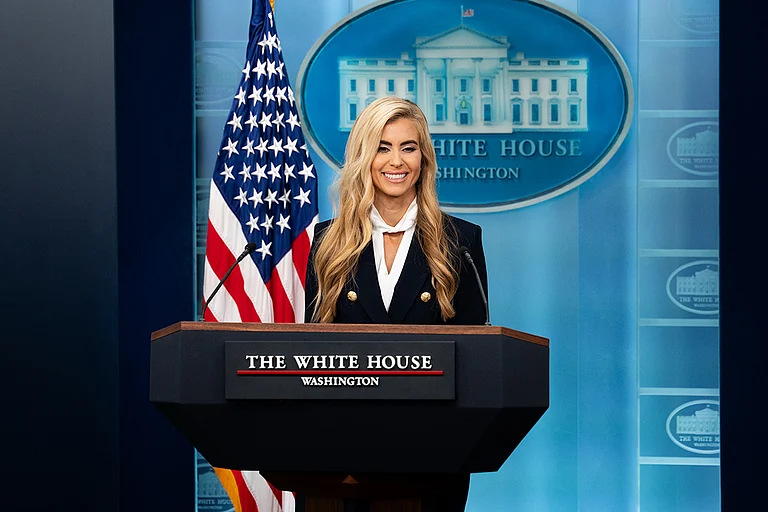
Zacharia’s first briefing was dominated by prepared remarks praising Trump and his administration. She spoke about immigration, tariffs, energy production and the president’s policy agenda before taking questions from journalists representing just three outlets: Breitbart News, Fox News and the Daily Mail.
The limited questioning drew criticism, as did her delivery. She relied heavily on her script, stumbled over parts of her remarks and appeared uncomfortable when discussing her background. The Associated Press reported that she confused “my husband” with “my president” and paused while referring to the Department of War. She took questions from journalists at Breitbart News, Fox News and the Daily Mail, offering little opportunity for sustained scrutiny.
Zacharia ended the briefing by telling reporters they could put further questions to Trump as he left for his campaign trip. In a Fox News interview on October 15, she said she had very little preparation time for her debut.
Advertisement
Trump described her performance as “very good”, according to Reuters. The briefing nevertheless did little to establish her ability to handle the daily demands of the role.
The role requires the press secretary to explain administration policy, defend decisions and respond to questions the president may not address directly. Zacharia’s first briefing offered little indication of how she would handle that responsibility.
Questions Over Her Legal Credentials
The scrutiny of Zacharia’s performance was soon accompanied by questions about her professional background. When announcing her appointment, Trump described her as an attorney. She holds a law degree from Pepperdine University, but questions emerged over whether she had passed a bar examination or was licensed to practise law in the United States.
A law degree does not, by itself, authorise someone to practise law in the United States; admission to a state bar is generally required. Although the press secretary’s role does not require a law licence, questions about Zacharia’s credentials became a distraction after Trump described her as an attorney.
Advertisement
Zacharia had worked in communications for Trump Media & Technology Group, which operates Truth Social, and appeared as a conservative commentator on television. She said she had practised international transactional law in China. Reuters reported that she worked as an associate at Zhong Lun Law Firm in Beijing from 2011 to 2013 but could not find records showing she was admitted to practise law in any US state or the District of Columbia. Reuters also reported that Chinese law restricts the practice of law to Chinese nationals, although foreign staff can advise and consult on legal matters.
In a Fox News interview on October 15, Zacharia acknowledged that she had not passed the bar examination. The Washington Post identified it as the California bar.
The controversy shifted attention from the administration’s policies to Zacharia’s professional background. Her legal experience and her eligibility to practise in the United States were separate questions, but the distinction became central to scrutiny of her appointment.
Advertisement
Trump’s Intervention And The End Of Her Tenure
Zacharia did not hold another formal briefing after her October 13 debut. She accompanied Trump on a campaign trip that included a rally in Alaska on October 13 and stops in Arizona and Montana on October 14. Her tenure ended on October 16.
Speaking to reporters on October 16, Trump said he had advised Zacharia to reconsider the job. “If I were you, I’d reconsider,” he said, adding that he wanted her to be happy.
Reuters subsequently reported, citing two White House officials, that Zacharia had been “let go” and was “transitioning out” of the position. The report followed Trump’s public suggestion that she reconsider the job.
The departure recalled the turnover among senior communications officials during Trump’s first administration. Anthony Scaramucci, who served as communications director for 10 days in 2017, noted the comparison in a post on X after Zacharia’s departure.
Advertisement
Trump said he was in no rush to appoint a replacement, leaving the administration without a principal spokesperson.
For the White House, the immediate task is to find a spokesperson who can defend Trump’s agenda without allowing questions about the messenger to overshadow the administration’s message.
Published At: