US forces completed their withdrawal from Iraq's Irbil Air Base
Iraq declared a four-day "Sovereignty Days" holiday to celebrate
Iran claims victory, and Iraq aims to boost stability
As US Exits Iraq, Iran-Backed Militias Look To Expand Influence
US troops completed their withdrawal from Iraq on Wednesday, Iran aligned proxies celebrate it as victory

Summary
After more than two decades of US military presence in Iraq, American forces completed their withdrawal from the country on Wednesday. The exit marks the end of a military mission that began with the 2003 invasion and was later revived to fight the Islamic State. The withdrawal comes as Iraq seeks to assert greater control over its security while Iran-backed groups and the lingering threat from ISIS shape the country's next phase.
Iraq has declared a four-day national holiday to mark the ‘Sovereignty Days’. Iraqi Prime Minister Ali al-Zaidi said the end of the coalition's mission marked "Iraq's transition to a phase in which it assumes full responsibility for its security and stability", according to the BBC.

In a statement released by the Pentagon, its spokesperson Sean Parnell said that U.S. forces and equipment had completed an “orderly departure” from the air base in Irbil, which is located in northern Iraq, a semi-autonomous Kurdish region. In his statement on Truth Social, Trump hailed the withdrawal, saying he “had a choice to stay or to leave, and felt, without question, that it was time for America to go home!
Iraq in recent years has tried to maintain a balanced relationship with the US and the neighbouring Iran. The relationship with the US was under pressure when Iranian commander Qasem Soleimani was killed in 2020 in a strike near Baghdad airport by US forces. Groups aligned with Iran carried out attacks on US bases, which were responded to by US retaliation. People in Iraq never liked foreign the war on their soil.

History of US forces in Iraq
US forces entered Iraq in two phases. First, they entered Iraq on March 23, 2003, claiming that Saddam Hussein was possessing ‘weapons of mass destruction’. The war caused thousands of deaths. Saddam was thrown out of the government and eventually hanged in 2006. No weapons of mass destruction were ever found. This, however, resulted in insurgency in the country, and sectarian violence spread across the country and caused thousands of deaths.
Advertisement
In December 2011, the Obama administration decided to withdraw US forces from Iraq. But just three years later, they returned to the country at the Iraqi government’s invitation as part of the international campaign against Islamic State. AP has reported that 4,419 US troops died during the operation, including combat and non-combat deaths.
Who Will Fill The Power Vacuum In The Region?
US departure from Iraq is seen as part of their plan to safeguard their bases from Iranian missiles. However, this departure must not be seen as a complete withdrawal of the US from Iraq’s security affairs. US will still work on training and security cooperation with Iraq.
The exit of US forces amid the ongoing war between the United States and Iran is seen by Baghdad as a sign of their increasing strength and sovereignty. Videos of Iraqi nationals celebrating the exit surfaced on social media. Iranian groups are also celebrating the exit as their victory, but the region dominated by the Kurds is concerned about the developments.
Advertisement
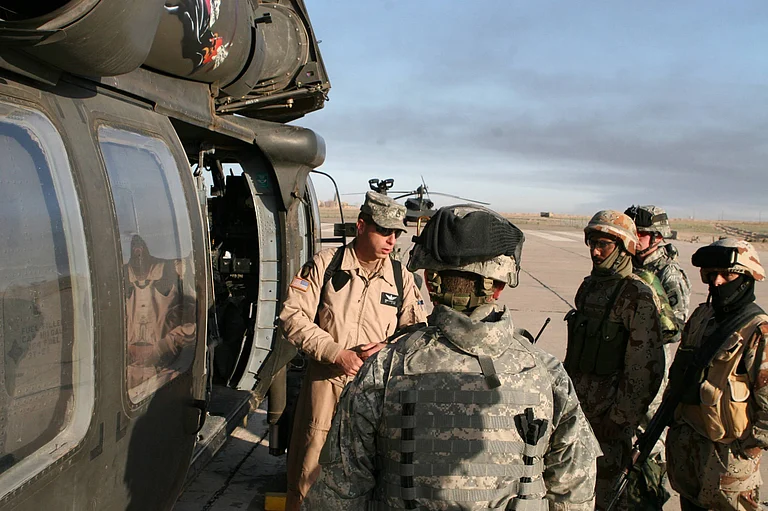
Few Iraqi security officials who are part of the government told Reuters that the US withdrawal from Iraq could be a chance for Islamic State fighters to get a new opening. They said that the group still maintains a sleeper-cell network even though it was defeated a decade ago.
Iran is weighing this exit as a victory of their ‘axis of resistance,’ which says its ultimate aim is to force American forces to leave the entire Middle East. Militia’s alinged with Iran have justified their independent arsenals through the presence of foreign forces on their home soil. It would be interesting to see their next move as the previous logic no longer exists.
Al Jazeera reported that Baghdad had initially declared September 30 as the deadline by which all armed groups in Iraq would have to surrender their weapons. Many armed groups rejected the deadline. Now Baghdad has pushed the deadline to June 2027.
Advertisement
With the departure, Washington must be feeling a sigh of relief as their forces are no longer in range of Iranian proxies, whereas Zaidi gains the upper hand in the country's political scenario, as he can claim to be the one who commanded US forces out. Iraqi government can now focus on oil, trade and development.
Published At:
Tags