Music maestro Bappi Lahiri passed away in 2022 at 69.
This year is his 74th birth anniversary.
The legendary composer embraced maximalism to the hilt.
Bappi Lahiri Birth Anniversary : Beyond The Gold Chains, Disco Beats; Inside The Disco King's Maximalist World
As we mark Bappi Lahiri's birth anniversary today, we revisit his global crossovers, his taste for excess and a remarkable legal tiff where he took on the biggest and won

Summary
On what would have been his 74th birthday on November 27, Bappi Lahiri remains one of Indian cinema’s most electrifying cultural icons. Born Alokesh Lahiri in 1952 into a family of Bengali classical musicians, he rewired Bollywood’s sonic DNA by replacing traditional orchestration with pulsing synthesizers, drum machines, and catchy disco basslines. Yet slotting "Bappi Da" merely as the "Disco King" is to undermine the depth and density of his talent. Beneath the cascading layers of lucky gold chains, oversized designer sunglasses, and sequined velvet jackets shone a formidable tabla prodigy who could switch effortlessly from insanely energetic dance anthems like "I Am a Disco Dancer" to soothing, evocative ghazals and timeless Kishore Kumar ballads.
Across a sprawling five-decade career spanning over 5,000 songs, Lahiri created an indelible persona that turned heads from Mumbai studios to Moscow stadiums and Los Angeles courts. Whether breaking Guinness World Records for his relentless output, winning landmark copyright battles against hip-hop heavyweights, or lending his baritone to Hollywood crossovers, he operated as a singular force. As fans remember the wildly successful maestro on his birth anniversary, a look back at the fascinating facts, prized collections, and eccentric anecdotes behind Bappi Lahiri offers a glimpse of how a classically trained prodigy became an enduring symbol of unapologetic swagger and musical innovation.
Bappi Lahiri IMDB
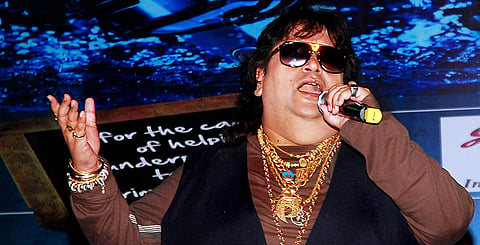
Bappi Lahiri's Sunglass Collection
Alongside his precious metals, Lahiri was an obsessive collector of bespoke fashion and high-end accessories. He boasted a massive wardrobe of custom-made, heavily embroidered jackets, sequined coats, and vibrant velvet blazers, often pairing a simple black T-shirt or traditional kurta with an opulent jacket to let the gold stand out. His oversized, tinted sunglasses, ranging from gold-rimmed aviators to custom-tinted lenses, became so intrinsic to his identity that he rarely removed them indoors or at night. He joked that his eyes were camera-shy without them. Wearing sunnies at night is a fad now but he's among those who popularised it. He never stuck to one type of sunglasses. They kept changing.
Lahiri gathered an extensive luxury collection sourced from fashion capitals around the world. He had an affinity for high-end European designer frames, most notably Louis Vuitton, once famously brushing away imitators by pointing out that his signature glares were authentic Louis Vuitton pieces costing upwards of ₹1.5 lakh. Other brands he wore included Gucci, Cartier, and Ray-Ban. He treated eyewear not merely as sun protection, but as a permanent, theatrical shield of rockstar mystique.
Advertisement

Gold As ID Proof
Bappi Lahiri’s gold chains weren't just a fashion statement. They even doubled, funnily, as his official ID. In an interview with ETimes, Lahiri recalled being stopped at a London airport by an official who looked at his passport, stared at him skeptically, and asked if he was truly the famous composer. When Lahiri said yes, the officer still didn't believe him because his winter coat was buttoned up. Lahiri had to dramatically unbutton his coat and flash his signature gold chains before the officer finally waved him through.
The Composer's Luxury Fleet Of Cars
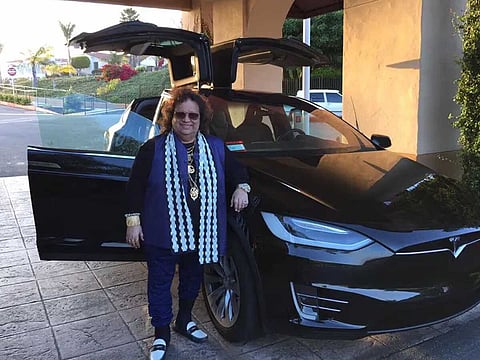
Much like his wardrobe and jaw-dropping vault of gold, Bappi Lahiri’s garage had the same passion for luxury. Over the years, the composer curated an impressive fleet of high-end vehicles. These featured an all-electric Tesla Model X, making him one of the earliest adopters of the futuristic gull-wing SUV in Indian film circles, alongside German mainstays like a BMW and an Audi. He had as many as five cars. Whether arriving at Mumbai recording studios or red-carpet premieres, Lahiri leaned into a larger-than-life, endlessly dramatic entrance. He swore by maximalism till his death.
Advertisement
Bappi Lahiri's Cars X
Bappi Lahiri Took On Hollywood's Mightiest
Lahiri’s global footprint wasn't always smooth sailing, leading to one of the music industry's most famous international legal battles. In 2003, after discovering that American hip-hop mogul Dr. Dre and R&B singer Truth Hurts had sampled his 1981 Lata Mangeshkar track "Kaliyon Ka Chaman" without permission for their chart-topping single "Addictive," Lahiri took them to court in Los Angeles.
Refusing to buckle under the coercive might of Hollywood heavyweight lawyers, he won a landmark copyright battle that forced Universal Music Group to halt sales of the record until his name was formally added to the credits. A federal judge from Los Angeles barred the CD from further sales till it credited Bappi Lahiri. Released in 2002, "Addictive" was one of the highest-selling CD, with sales of about 600,000 copies. Later, he made peace with it after he was credited by Dr. Dre. Lahiri had offers from Whitney Houston and Jackson Five.
Advertisement

Singing For Vishal-Shekhar
Despite his reputation as a prolific playback singer, Lahiri had a binding rule for over three decades. He refused to sing for any music director other than himself. He finally called off that streak in 2006 when composer duo Vishal–Shekhar persuaded him to lend his distinct vocals to "Bambai Nagariya" for Taxi No. 9211, a gamble that instantly revitalized his appeal for a younger generation. The song became a bona fide chartbuster, spurring Lahiri to regularly lend his voice to younger composers afterwards, including A.R. Rahman (Guru) and a second blockbuster reunion with Vishal–Shekhar and Luthria for "Ooh La La" in The Dirty Picture.
Dubbing For Elton John
In the final decade of his career, Lahiri’s instantly recognizable baritone and tongue-in-cheek self-awareness made him a ripe choice for Hollywood’s localized pop-culture crossovers. In 2016, Disney pulled off a masterstroke of meta-casting by recruiting him to voice and sing "Shona" for Tamatoa, a flamboyant, gold-hoarding giant crab, in the Hindi dub of Moana, a wink at his own gilded persona that Lahiri welcomed with glee. Just a year later, Lahiri did the Hindi dub for Elton John, his favourite, in Kingsman: The Golden Circle.
Advertisement
He told the media in 2017, "People back in India keep saying Elton and I not only resemble one another, but are also similar in many other ways. We are both singers and composers and we both like to dress and perform flamboyantly. When I was asked to dub for his first Hollywood film where he has a guest appearance I was delighted."
Lahiri died on February 15, 2022, at the age of 69 in Mumbai.
Published At: