Mike Morrison woke up one June drawn to the sound of bagpipes and found his quiet Boston suburb of Wakefield had a group of Scots for company. Their first act was to hand him a beer when he went to say hello. Two days later, it was barbecues and more beer, and Morrison had been co-opted as a member of Scotland’s Tartan Army.
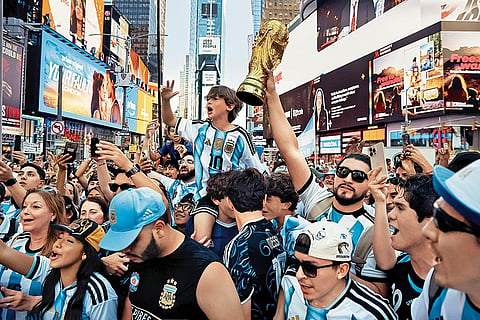
Times Square turned oranje (orange) when thousands of Dutch supporters flooded into Manhattan’s most famous landmark, singing team songs and mesmerising New Yorkers with their trademark “Go left, left, left… Go right, right, right” dance that had locals swaying to the pulsing rhythm.
In another part of Boston, Norwegian fans wearing Viking helmets and national flags turned a railway station escalator into an impromptu rowing lane with beating drums and booming chants of “Reu, Reu”. In support, members of Parliament in Oslo interrupted a session to flex some nautical muscle of their own.
The size of Texas barbecue helpings have stunned visiting Japanese and English supporters in Dallas, who can’t get enough of the grilled goodies put down in front of them with bowls of gravy and Ranch dressing.
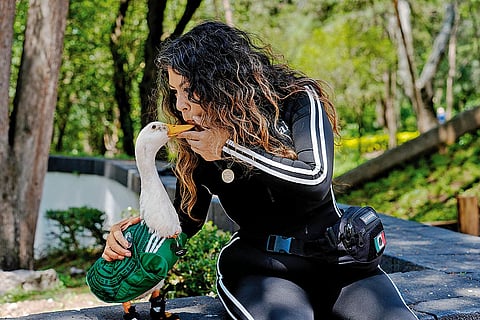
Unwilling to be left behind, fans of Team Mexico have enlisted the services of Merlin, a two-year-old duck, as their mascot. Merlin has joined the celebrations and parades clad in a miniature team jersey and socks as an “event ambassador”. Dawn the Duck is doing the same for Scottish supporters in Providence, Rhode Island.
World Cup 2026 Spirit: How Global Fans Are Redefining America
Lately criticised for its politics of fear and division, immigration raids and forced deportations, the US finds itself smiling again at the good-natured antics of the thousands of visiting supporters for the ongoing football World Cup

The ongoing football World Cup has turned America into a giant party. A nation lately used to dealing with the politics of fear and division, immigration raids and forced deportations finds itself smiling again at the good-natured antics of the thousands of visiting supporters who have descended on their country from around the world. The fact that Team USA has won both their preliminary matches doesn’t hurt either, beating Paraguay 4-1 and Australia 2-0 to qualify for the second phase of the tournament.
Gone are fears of travel bans, denied visas and unfriendly welcomes at immigration counters. Instead, Americans seem to have temporarily become Scots, Norwegians, Spaniards, Brazilians, Japanese, or what have you, at the largest and longest edition of the World Cup. Forty-eight teams are in the fray, divided into 12 groups with 104 matches scheduled between June 11 and July 19. Even Iran, currently locked in hostilities with the US, has been welcomed, though their team has had to fly in and out for matches in Los Angeles and Seattle literally within hours each time.
Adding to the smiles are the millions of dollars pouring into the purses of the hosts—the US, Canada and Mexico. Bars in Boston ran dry on the very first day, catering to thousands of thirsty Scots and Norwegians. Small businesses of all kinds, eateries and hospitality ventures are earning handsomely. Brands like Buc-ee's, Starbucks, Dietz & Watson and more are creating lifelong customers among visiting supporters as are American classics like cheesesteaks, subs, hot dogs, buffalo wings and hoagies.
Accommodation aggregator Airbnb, an official World Cup supporter, estimates the tournament is on its way to becoming the biggest hosting event in its history, outperforming the previous high numbers recorded at the Paris Olympic Games two years ago. The tournament is expected to contribute $17 billion to the American economy and create close to 200,000 jobs. Canada and Mexico too are benefiting, though proportionate to the number of matches they are hosting.
Novel Outreach
Beyond the numbers, there is a significant ongoing role-reversal. For decades, America was the superpower of soft power, exporting its lore and heritage around the world particularly through music and Hollywood’s cinematic output. Since the first group of overseas supporters arrived, however, it has been a different story and both mainstream and social media are filled with narratives of Americans taking to foreign cultures with gusto.
Little wonder therefore that from Boston on the eastern seaboard to Los Angeles on the West Coast, and from Dallas in the south to Seattle in the north, doors are being thrown open and lifelong friendships forged. Says a smiling Bostonian woman about the Tartan Army’s effervescent presence: “Nine months from now, there are going to be quite a few babies born here. These Scottish men with their kilts, songs and bagpipes are sweeping girls off their feet.”
Chris Sinclair, owner of The Anchor, a noted Boston waterfront pub, adds, “I’ve never been around so much positive energy. We ran out of beer on Sunday and we’ve had to triple our usual orders on Tuesday and Thursday. I had expected it to be busy, but not this much fun. We’ve been open for eight years and this is the highlight of the business.”
Nor has it just been just drinking, partying and fun. Japan’s supporters have earned admiration for their habit of carrying large plastic bags into the stadium and scrupulously cleaning up every bit of litter after a game. “It is respect for the game, the players, our host country and also for the stadium,” said a Japanese fan. Other travelling fans have taken note and begun doing the same, earning praise and admiration from local residents in their turn.
A city worker cleaning up after a Tartan Army party in a Boston park said around 2,000 fans had been drinking and making merry there, but had left the area so clean that he didn’t even need help tidying up. “I didn’t have much to do after they left. Everything was cleaned up and bagged,” he said.
One Scotland supporter summed it up: “It’s about respect. Party hard. Bring the atmosphere. Make pals with the locals. Leave no mess behind.”
Football Nuggets
But what’s the World Cup without the football and the hundreds of stories that are to be discovered within? Just days into the tournament, there has been plenty to share and write about. Unfancied teams have belied expectations to carve out results against superior and experienced opponents; statistical landmarks are under threat; and human interest stories have exploded.
Cape Verde—a small group of islands off Africa’s west coast with a total population of half a million souls—made history by holding former champions Spain to a goalless draw in Group H on their tournament debut and then doubled the joy by drawing 2-2 with two-time champions Uruguay. Caribbean nation Curacao, the smallest nation to ever participate in the World Cup, also earned a point from their goalless draw against Ecuador in Group E.
Lionel Messi has scored 123 times for Argentina and he is likely to set a new all-time record by the time the tournament ends.
Cape Verde’s goalkeeper, Josimar José Évora Dias or Vozinha (“Little Granny” in Portuguese), wept after keeping a clean sheet against Spain on his World Cup debut at the age of 40 because his grandparents who had raised him had passed away, and his mother had not managed a visa because of immigration regulations needing a $15,000 bond to enter the US.
“I cried because I grew up with my grandparents and, unfortunately, they were not here; they died a few years ago, and they did everything for me and my life. Also, my mum couldn’t manage to be here because of the visa. We didn’t manage the money for the visa on time, but I would like her to be here.”
Social media, which is following every twist and turn of the tournament and putting traditional news operations in the shade by the scope and variety of its coverage, played a part in setting that right. After Vozinha’s story got out, earning him millions of followers on Instagram in no time, his mother Ana Candida Evora was granted the US visa free of charge.
Messi Mania
After Argentina captain Lionel Messi scored a hat-trick against Algeria in his record-breaking sixth World Cup appearance and walked off the field to a standing ovation, team coach Lionel Scaloni had tears in his eyes. “I cried because it’s Messi’s last World Cup, it’s coming to an end, and every time I think about it, I start to cry. It’s a privilege to watch this guy play,” he said later.
Messi’s treble drew him level on 16 goals with Germany’s Miroslav Klose as the highest scorers in World Cup history, and then added two more against Austria, making it more than likely that he will set a new all-time record by the time the tournament ends. The Algeria game was the Argentine superstar’s 200th international match and he has now scored 123 times for his country. Amazingly, the Kansas City game against Algeria fell on the same day he had made his World Cup debut in France 20 years ago.
As it happens at every World Cup, a new crop of stars have emerged, including Morocco’s 17-year-old Ayyoub Bouaddi, Johan Manzambi of Switzerland, who, at the age of 20, became the youngest World Cup debutant to score more than one goal in the game against Bosnia, Spain’s 18-year-old sensation Lamine Yamal and Alex Freeman, 21, of USA, whose father is a Super Bowl (American football’s biggest championship) winner.
And in all of this, what of India and its 1.4 billion population, whose national team was eliminated in the very first round of the World Cup qualifiers in 2023? As they have done in the years since 1950—when the team qualified for the tournament but could not travel to Brazil due to lack of funds—Indians have had to make do with cheering from the sidelines, the most popular being Argentina and Brazil.
Indian companies and businesses have gotten involved too, looking to make the most of the World Cup’s massive popularity via sponsorships and promotions. Zee Entertainment is the domestic broadcast rights holders this time, reportedly at a steep $35 million and have brought on board the likes of Mondelez, Diageo, Pernod Ricard and Apple as presenting sponsors. Others are leveraging the tournament to push their brands and products in various innovative ways.
In terms of on-field presence, four players of Indian origin are at the 2026 World Cup—New Zealand’s attacking midfielder Sarpreet Singh, Australian winger Nishan Velupillay, Qatar’s 19-year-old Tahsin Mohammed Jamshid, and French-born DR Congo midfielder Samuel Moutoussamy.
(Views expressed are personal)
Rahul Banerji has been an active journalist for over 40 years and was Sports Editor of The Statesman and the Asian Age Delhi editions
Tags