Mohammed Siraj was left out of India's playing XI for the 1st Test against New Zealand in Wellington
Fans and pundits alike slammed the team management, questioning the rationale behind Siraj's exclusion
Is Siraj the missing piece of the puzzle India is trying to solve? Here is a closer look
India's Pace Puzzle Has A Missing Piece: Why Was Mohammed Siraj Left Out?
Why was Mohammad Siraj not picked? That’s the question every Indian cricket fan is asking at the moment

Summary
What is a puzzle and how does anyone solve it? A puzzle is a collection of pieces that, when put together in the right order, form a complete picture. Every piece has a purpose and even if most of them fall perfectly into place, the absence of one crucial piece can leave the entire picture incomplete.
A cricket team is no different. Picking a playing XI is much like solving a puzzle. Every player has a role, every combination has a purpose and the captain and team management must identify the right pieces to make the strongest possible unit.
Sometimes, however, a selection call that looks right on paper can leave a glaring hole on the field. India may have discovered exactly that against New Zealand.
Why was Mohammad Siraj not picked? That’s the question every Indian cricket fan is asking at the moment. India took on New Zealand at the Basin Reserve this morning, and it was a no-brainer that the visitors would field a pace-heavy attack to counter the Kiwis.

Jasprit Bumrah was back in whites as the leader of the pack, while Anshul Kamboj and Akash Deep found spots in the XI, partly on the back of their batting abilities. But what really caught everyone by surprise was India opting for Prasidh Krishna over Siraj.
Siraj is currently India’s highest wicket-taker in the current World Test Championship (WTC) cycle, with 43 dismissals to his name. His last best performance away from home was a nine-wicket match haul at the Oval last year, aiding India in winning the final Test of the England tour by six runs.
Siraj was so mesmerising that Shubman Gill called him a ‘captain’s dream’. However, reality hit hard at the toss on Thursday morning in Wellington when people back in India woke up to the news that the Indian skipper had to make the ‘tough decision’ of benching Siraj for the first Test.
Advertisement
In trying to complete its pace-bowling puzzle, the team management put its money on Krishna, who has visibly struggled to find his rhythm on spicy overseas wickets.
The story began in 2023, when he managed just one wicket each in two Tests of his series in South Africa. Although he tried redeeming himself in the lone Test he played against Australia in Sydney with a six-wicket haul, the England tour exposed him again when he was given a tad longer rope in the five-match series.
After conceding 220 runs in the first Test at Headingley (including 3/128 at 6.40 runs per over in the first innings), Krishna admitted he struggled to find his length and adjust to the ground’s slope.
The next game in Birmingham was even worse when he leaked runs at an economy of over five in the first innings and managed just one wicket, in the second. The underwhelming show culminated in him getting axed for the next two Tests before he returned with an eight-wicket haul, playing second fiddle to Siraj at the Oval.
Advertisement

However, New Zealand is a different ball game altogether. Pitches here are softer underneath, with a thick layer of live grass on top.
Pacers must pitch the ball fuller to make that live grass work. Once the Kookaburra ball softens, after 25-26 overs, and the sun dries out the green grass, the pitch becomes easy to bat on.
That often leads to a temptation among bowlers that nothing is happening, pushing them towards the short-ball plan rather than sticking to hitting the length a little longer.
To switch to the short-ball plan, the key requirement is high pace. Bumrah & Co created opportunities in the first half of the day’s play by hitting the right areas and extracting five wickets in a little more than the first session.
Advertisement
But once the Henry Nicholls-Glenn Phillips partnership took over, the Indian attack looked like it was running out of fuel and functioning on fumes. That’s where the inexperience in the bowling department was exposed and the absence of Siraj was felt.
Prasidh leaned heavily on digging the ball into the middle of the pitch. While Jasprit Bumrah (3/52) and Akash Deep (1/33) kept the batters tied down on a fuller fourth-stump channel, Prasidh’s opening 10 overs went for 40 runs.
Although a few bouncers hurried the batters, even catching Henry Nicholls on the left glove in the 76th over, most sat up comfortably enough for Nicholls and Phillips to get boundaries.
Would Siraj have made a difference in those middle phases? What extra or different would he have done? Those aren’t mere questions but an attempt to digest Siraj’s absence.
He has been the heavy-lifter when Bumrah missed out. But today, when the situation was reversed, the Indian bowling attack fumbled despite a terrific start against New Zealand at the Basin Reserve.
Advertisement
In his 48 Tests, Siraj has picked up 144 wickets, with 108 of those coming in away matches. Keeping someone with Siraj’s experience out of the playing XI provides anything but stability. In a bowling attack that needed someone to hold things together once the initial burst faded, Siraj could well have been the missing piece.
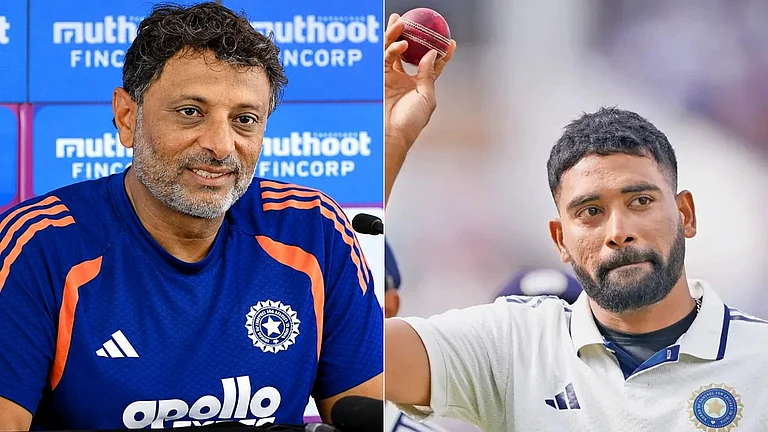
India captain Shubman Gill had indicated before the match that the team would play four fast bowlers ‘for sure’. He also suggested that Anshul Kamboj and Akash Deep or Nitish Reddy could make the cut because of their batting abilities.
However, that reasoning does little to explain Siraj’s omission. If the idea was to field the strongest possible pace attack for conditions in New Zealand, Siraj’s experience and proven ability overseas should have made him one of the first names on the team sheet.
The captain is surely missing his ‘dream’ bowler, especially when these two Tests against New Zealand are essential to fulfill his wish for tossing the coin in the World Test Championship final in 2027.
The first day turned out to be a toil for India after the hosts raced from 70/5 to 243/5, riding on an unbeaten 173-run stand between Henry Nicholls and Glenn Phillips.
A puzzle can look almost complete, but one missing piece can change the entire picture. India had five New Zealand wickets in the bag and the perfect start to the Test.
But as Nicholls and Phillips put together a formidable partnership, the visitors were left searching for answers. Whether Siraj would have changed the course of the day is a question that will remain unanswered. What is clear, though, is that India’s selection puzzle looked a lot less complete without him.
Published At: