Protests and campaigns invoking ‘corporate jihad’ gain ground after the Nashik TCS case, despite lack of evidence supporting organised conversion claims.
Muslim employees report rising workplace hostility, while experts warn of hiring bias
Activists say the narrative is curbing women’s freedom across communities—through surveillance, moral policing, and pressure on education, jobs, and relationships.
TCS Nashik Case: Controlling Women In The Name Of 'Corporate Jihad'?
From saffron rallies to social media rhetoric, Islamophobia is being used to control women and their autonomy.

Summary
Wearing saffron sarees, dupattas and carrying posters against alleged ‘corporate jihad’ around hundred women gathered at Indira Nagar in Nashik for a protest march to the Collector's office on April 16. This wasn’t any ordinary protest march for the cause of women’s safety: it was high on Islamophobic rhetoric. Women who participated in these protests, expressed their anguish, raising Islamophobic slogans in the wake of the TCS case in Nashik in which women were allegedly sexually abused by the Muslim men employees, who also allegedly hurt religious sentiments.
This saffron protest march in Nashik isn’t an isolated instance of rising Islamophobia. Shruti Boraste, a young professional, was recently dropped off at her residence in Nashik by an Uber Bike last week. The rider refused to take the trip charges from her as a part of the initiative 'Safety of Hindu Women’.
“When I asked him about money, the young man said, ‘I have a good job, I don’t do this for money.' He said he was part of an initiative where his group provided free and safe rides to Hindu women,” says Boraste. “He also told me to not take a ride on Uber or other apps if a Muslim driver is assigned,” adds Boraste.
The Uber bike hailing app isn’t officially carrying out any such initiative, it is a voluntary initiative where a group of Hindu young men from Nashik started using this platform, sparing money from their own pocket to ensure the ‘safety of Hindu women’.
Nashik, the city of Lord Rama according to mythology, is preparing to host the Sinhastha Kumbhmela, a Hindu religious gathering which will begin from October 31, 2026. Preparations include building of makeshift accommodation, ensuring cleanliness, makeover of the city and elaborate security arrangements. Even as the city waits to host the grand religious gathering, young women from both Hindu and Muslim communities are feeling suffocated owing to the intense surveillance by family members.
A couple of young women Outlook spoke in Nashik, who are in interfaith relationships, said they felt scared, restricted and constantly under surveillance these days: not only by the family members but by the community as well.
Advertisement
Where does ‘corporate Jihad’ fit in an atmosphere of growing surveillance of women? Why are men volunteering to ‘save’ Hindu women? How does the saffronisation of the TCS case threaten to spiral into a larger impact including women’s employment and agency? Outlook did a deep dive to address these questions.
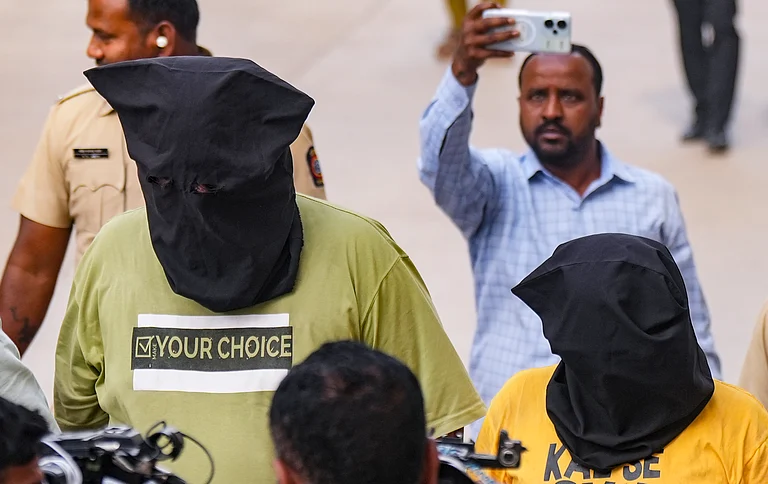
Our recent ground report from Nashik uncovered how serious allegations of sexual harassment at workplace and religious sentiments being hurt were being turned into a ‘conversion plot’ without evidence. While the police investigation is underway and arrests have been made, Nida Khan, one of the accused, is reportedly absconding. Her anticipatory bail hearing was completed on April 27, and the Nashik district and sessions court has reserved the verdict for May 2, 2026.
Beyond the rhetoric
To understand this oft-repeated ‘corporate jihad’ rhetoric on posters, social media, WhatsApp groups and media reports, we spoke to at least half a dozen employees from the corporate sector who work in Nashik, Pune and Mumbai. None of them had heard this term before the TCS case. All of them emphasised on the liberal environment in the corporate sector, where employees pay attention to their projects, technological advancement and personal growth.
Advertisement
“The things that unfolded in the TCS case and the allegations made are shocking. I haven’t seen any such incident in my 20-year corporate career. Corporate employees focus on their professional duties, technology and personal growth. No space is given for any kinds of religious or political preaching.” says Pavanjit, leader of the IT employee's forum, a union of approximately 20,000 workers in the IT sector.
Their union is addressing many issues faced by corporate employees, but an issue like the TCS case never reached them, adds Pavanjit. “The TCS case will now impact the hiring process, especially Muslim candidates. Even if people claim the hiring process is inclusive, there could be prejudices in the minds of people who are hiring,” adds Pavanjit.

On the other hand, a corporate employee in Nashik alleged there were instances where women from poor or marginalised families were given jobs and exploited by Muslim men. Upon asking if he had seen any particular incident at his workplace or something which he knew about, he refused to cite any instance.
Advertisement
Shirin Khan, an IT engineer who works in Pune has faced hostility of another kind at her workplace. “People carry certain stereotyped images of Muslim employees. They subtly taunt us about our dietary preferences. The behaviour of non-Muslim co-workers isn’t welcoming and inclusive. Therefore, I maintain cordial work relations with them and avoid mingling with them.” says Khan.
Other experts in and HR professionals Outlook spoke to, concur with Khan and Pavanjit.
“I have worked in talent acquisitions-human resource field in Nashik for eight years and in my experience, the environment for Dalits, Muslims is culturally adverse. Generally, employees are wished on festivals and companies provide budgets to celebrate all Hindu festivals but not for Ambedkar Jayanti or Eid. Carrying non-vegetarian food for lunch is not welcomed. Insensitive remarks are made against Dalit and Muslim employees who are already cornered and vulnerable at workplaces. I personally had to fight to ensure inclusion and diversity,” says Saee Azad, a former HR professional. “HR policies are on paper, but are not properly implemented across most of the companies in Nashik.” adds Azad.
Advertisement

Ripple effect
As an aftermath of the Nashik TCS case, many Muslim employees who work in the corporate sector said they are facing harassment and bullying at the workplace. This takes the form of hateful reels, derogatory jokes and Islamophobic comments.
“After this TCS case, many at my workplace crack jokes, make bizarre statements, comment on this issue with so much of authority, which makes me uncomfortable in the office,” says Afrin, who works as CA in a private firm in Mumbai.
"Why is the single case is being used to paint an entire community in a negative light?” asks Afrin.
'Corporate Jihad' narrative that controls Women
Two women employees who filed FIRs against sexual harassment at workplace and hurting religious sentiments, quit a week before the FIRs were filed, Indian Express reported. Since the case started making headlines, many messages and Facebook posts started going viral that warn against 'corporate jihad' and claim protection of the Hindu religion is more important than education and jobs for Hindu women. “Muslim men lure Hindu women at corporate firms; therefore Hindu women should not take up corporate jobs,” is a much-forwarded WhatsApp message.
Women who participated in a protest bike rally organised by Nashik BJP MLA Devyani Farande, echoed similar thoughts while asserting the need for self-defence classes for Hindu women. The speakers who addressed the rally, including Farande, delivered hate speeches and made unverified claims about 180 love jihad cases in Maharashtra. There is no such data available in the public domain by Maharashtra's ministry of home affairs or the NCRB.
“Saffron protest rallies and Islamophobic rhetoric are ultimately harming women from both religions. Nowhere has MLA Farande highlighted the issue of women’s safety but she talks about Hindu women’s safety. We have observed a pattern where BJP leaders like Farande propagate the divisive ‘Hindu-Muslim’ angle,” says Talha Shaikh, a CPI activist based in Nashik. “There are much bigger problems in Nashik such as felling of trees for Kumbh, but the BJP is saffronising the case to distract people from the real issues.”
Not just Hindu women, but Muslim women too are also being put under surveillance and being restricted in terms of job choices and social interactions by family and community members.
Activists in Nashik say the propaganda around the TCS case is an attempt to control women and their autonomy. “Independent women especially are surveilled. If they are found to have an interfaith relationship, their ‘counselling’ is done by patriarchal volunteers from both the communities,” adds Shaikh.
The corporate jihad narrative is being peddled at the cost of women’s employment. Many right-wing forums are advocating sending women to girls only colleges. While citing the Shraddha Walkar case; for 'saving Hindu women, the narrative of 'Love Jihad' is also resurfacing on social media and public discussions.
Explains Pune-based independent journalist Halima Kureshi, who has extensively reported on the corporate sector. “Women in the corporate sector of any religion or caste are extremely empowered. Their economic growth gives them agency to make life choices. I have seen many women employees, especially in IT earning good packages, and helping their families which have no option but to accept their daughter’s life choices including - choice of a life partner. This is one of the important reasons why such ‘corporate jihad' narratives want to take away that agency from women.”
Published At:
Tags