The national song must now also be played at civilian awards ceremonies, like the Padma awards
The Modi government projects the directive as part of a tribute to the enduring legacy of Vande Mataram
Since the early 20th century, sections of Indian Muslims objected to certain verses of the song
Standing For ‘Vande Mataram’ A Must Now, For BJP Govt, It Comes Before National Anthem
According to the protocol rules issued by the Union Home Ministry all persons must stand when 'Vande Mataram' is played. Earlier that protocol was reserved only for the national anthem.

Summary
The national song, must be played before the national anthem at all government events and in all schools, said a directive issued by the Modi government on Wednesday morning.
According to the protocol rules issued by the Union Home Ministry all persons must stand when 'Vande Mataram' is played. Earlier that protocol was reserved only for the national anthem.
The national song must now also be played at civilian awards ceremonies, like the Padma awards, and all other events attended by the President, during their arrival and departure. It will also be played in public spaces like cinema halls, though standing up is not mandatory in this instance. And all six stanzas, including the controversial stanza with reference to goddess Durga, will be played.
The Modi government projects the directive as part of a tribute to the enduring legacy of Vande Mataram, written by Bankim Chandra Chattopadhyay in 1875 and later accorded the status of national song. The Sanskrit phrase “Vande Mataram” translates as “I bow to thee, Mother”.
Written as a hymn and included in Bankim’s novel Anandamath, it weaves together nationalism, devotion, spirituality and identity. But the song has never been politically or culturally neutral.
The Uncomfortable History
What the ruling party appears comfortable with is the problematic legacy embedded in Anandamath. According to writer Ziya Us Salam, Bankim referred to Muslims in the novel as “bearded degenerates” and portrayed them as enemies, despite the Sanyasi Rebellion — on which the book was loosely based — involving Hindu and Muslim participation.
Through the character Jnanananda, the novel contains passages that openly call for violence against Muslims and the “purification” of the land. These are not incidental lines; they reflect a worldview that casts Muslims as outsiders to the nation.
That such aspects do not trouble the BJP is unsurprising. Cultural nationalism under the Modi government has repeatedly been deployed as an electoral language when political arithmetic becomes difficult.
A Stick to Beat Muslims With?
The controversy around Vande Mataram is neither recent nor manufactured. From the early 20th century, sections of Indian Muslims objected to certain verses of the song because of their religious imagery, even as many Muslims participated in the freedom struggle where the song was sung. This tension is well documented and remains unresolved.
Advertisement
The first two verses of Vande Mataram make abstract references to the mother and the motherland, without religious connotation. However, later verses explicitly invoke Hindu goddesses.
The third stanza, as published in Anandamath, reads:
Thou art Goddess Durga , Lady and Queen,
With her hands that strike and her swords of sheen,
Thou art Goddess Kamala (Lakshmi)… and Goddess Vani (Saraswati).
This is precisely why the founders of the Republic chose to limit official use to the first two verses. The discomfort was acknowledged, not denied.
Yet today, the song is repeatedly weaponized against Muslims, portrayed as a test of loyalty, despite their objection being theological rather than national. It becomes a stick to beat a minority with, not a bridge to unity.
Bengal and the Politics of Timing
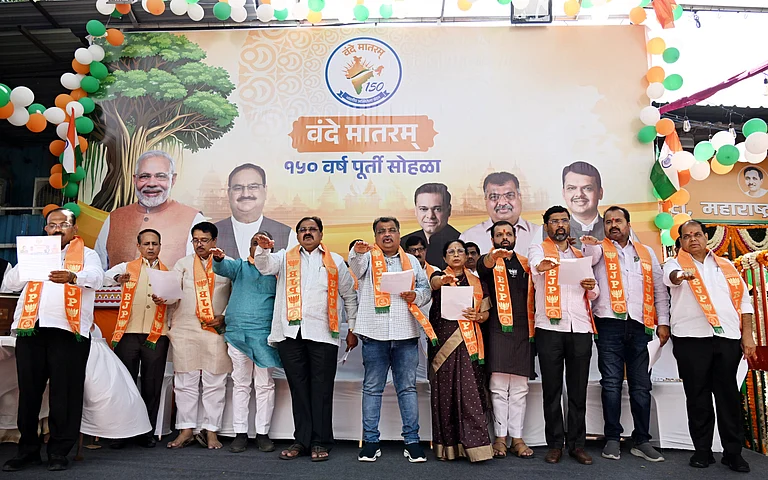
Seen in this light, the Modi government’s decision to foreground the 150th anniversary just ahead of elections in West Bengal is revealing. The song was written by a Bengali icon. Invoking Vande Mataram in Bengal is not abstract nationalism; it is an attempt to claim cultural ownership in a state where the BJP has historically struggled to establish roots.
Advertisement
Governments mark anniversaries all the time. But choosing to do so loudly, ceremonially and politically on the eve of a high-stakes election suggests design, not coincidence. As many commentators noted during the last Bengal elections, even Prime Minister Modi’s cultivated resemblance to Tagore ( PM Modi let his beard grow) became part of this symbolic contest.
This, ultimately, is not about a song. It is about how history is repurposed — and who it is meant to include, and exclude.
Published At: