The rustication of the Students’ Union and ‘out-of-bounds’ orders led students to organise encampments and class boycotts in defence of due process and democratic rights.
Through Out of Bounds – Classroom teach-ins, students and faculty reimagined protest as public pedagogy, linking learning with resistance and constitutional praxis.
Peaceful marches were met with violence, police action, and arrests, exposing the role of state power and counter-resistance in curbing student dissent.
Pedagogical Resistance at Jawaharlal Nehru University
At Jawaharlal Nehru University, students transformed repression into resistance by creating an encampment centred on public learning, constitutional values, and democratic dissent

Summary
Jawaharlal Nehru University’s student community has faced severe repression, marked by the suspension of UGC Equity Guidelines, the rustication of the entire Students’ Union office bearers, and casteist remarks allegedly made by the Vice-Chancellor, Prof Santishree Dhulipudi Pandit.
In an order dated February 2, the JNU administration rusticated the Students’ Union office bearers along with other students and declared them ‘out of bounds’. When students attempted to submit a representation, the Vice-Chancellor reportedly refused to meet them. Subsequently, she appeared on a podcast and made derogatory casteist remarks. These actions triggered protests across the campus.
In protest against the rustication and ‘out-of-bounds’ order, the student community, led by its duly elected Students’ Union, called for an encampment and a boycott of classes until the order was revoked. This act of civil disobedience reaffirmed students’ commitment to democratic values and due process. The administration, however, violated these principles by rusticating a duly elected Union and declaring it ‘out of bounds’. Through pamphlets and leaflets, students raised a clear question: how can a Union elected through a fair and transparent process be rusticated and barred from campus?
Continuing its commitment to constitutional practice, JNU students, through their ‘out-of-bounds’ Students’ Union, organised a series of initiatives titled Out of Bounds – Classroom: Open University Teach-Ins Outside the Formal Boundaries of Classrooms. These unique efforts can be described as forms of pedagogical resistance. The initiative invited academics and public intellectuals to deliver lectures on key issues shaping Indian society and politics.

These teach-ins reflected the shared commitment of the JNU community, students and faculty alike, to social engagement and public pedagogy. The lectures drew large audiences and featured academics such as Nivedita Menon, Soumyabrata Choudhury, Ajay Gudavarthy, Amir Ali, Jayati Ghosh, Anand Kumar and Prabhat Patnaik, as well as public intellectuals like Yogendra Yadav.
The lectures were accompanied by a panel discussion titled “Dignity, Not ‘Victimhood’: UGC Equity Guidelines and the Battle for Institutional Justice”. Together, the lectures and discussions continued JNU’s long tradition of public pedagogy while advancing a distinctly pedagogical form of resistance. By engaging with issues of academic and social importance, the encampment became a site of meta-lucidity. José Medina, in The Epistemology of Resistance, defines meta-lucidity as “living up to one’s epistemic responsibilities under conditions of oppression”, a spirit fully embodied by the Out of Bounds – Classroom lectures.
Advertisement
While undergoing state repression and incessant fiscal crunches, the students of the Jawaharlal Nehru University chose to ‘live up to’ their ‘epistemic responsibilities’ and gather to construct a site of mobilisation, struggle and resistance. These novel forms of resistance, coupled with commitment to learning and public pedagogy, limit the logistical and fraternal constraints which traditional protests succumb to. The aim of this encampment might, on the face of it, be to build pressure on the admin to revoke the rustication order. Still, it also provides students with an opportunity to sit, learn, and assert their demands together in an atmosphere circumscribed and protected by the spirit of critical pedagogy, negating the argument of ‘wasting the time of students’ or ‘responsibility of a student is to learn and not protest!’.

The encampment also reflects B. R. Ambedkar’s idea of public pedagogy, which viewed Parliament as a pedagogical space for mutual learning, particularly for dominant groups to understand the lives of the marginalised ‘Other’. As an informal and ‘out-of-bounds’ site of learning, the encampment moved beyond the caste and class moralities often embedded in classrooms shaped by socially stratified curricula.
Advertisement
Instead, it created a space where students and faculty could meet on equal terms to discuss issues of social importance, breaking traditional hierarchies. With no centrally imposed curriculum, state or otherwise, dominant hegemonies were challenged in favour of learning grounded in equity and fraternity. This was evident in the panel discussion on dignity, equity and the recent UGC guidelines, where panellists examined both the guidelines and the Supreme Court order, highlighting structural anomalies within India’s judiciary.
The guidelines were placed within a historical context, enabling participants to recognise contradictions in judicial practice. This commitment to praxis is both pedagogical and constitutional. As pedagogy, it reflects an effort to uphold epistemic responsibilities in the face of oppression; as constitutional practice, it calls for a popular rethinking of constitutional principles. Together, pedagogy and constitutionalism open up critical discussions on Indian society and polity, as well as the transformative possibilities offered by the Constitution.
Advertisement
However, this meta-lucid resistance was met with counter-resistance from members of the Akhil Bharatiya Vidyarthi Parishad (ABVP) in the form of violence and stone-pelting. ABVP is widely known for using violence to achieve two aims: first, to intimidate and suppress dissent, often with the backing of state machinery, thereby discouraging mobilisation and depoliticising campus spaces; and second, to delegitimise student movements by later portraying itself as the victim of violence and invoking claims of “red terror”. This pattern mirrors what Amir Aziz describes as “Humein pe hamla karke, humein ko hamlawar batana” (“attacking us and then blaming us”), in his poem Sab Yaad Rakha Jaega, written after the Jamia violence carried out by personnel of the Delhi Police.
Recently, the members of ABVP pelted stones at a peaceful and peaceable march organised by the Students’ Union against the VC’s casteist remarks, hurting the students and infrastructure of the university, which the administration is bound to protect. The convenient action (and inaction) of administration against popularly elected office bearers and inaction on ABVP’s conduct reveals the functioning of the state. Thus, JNU not only teaches through classes or encampments, but also by exposing the spectacle of the state in its microcosm.
Advertisement
The extent of ABVP’s anti-people politics was further evident during another peaceful march, The Long March to the Ministry of Education, organised by the Students’ Union to submit representations supporting the UGC Equity Guidelines and demanding the long-pending Rohith Act, both repeatedly sidelined by state institutions. The March, convened on the afternoon of February 26, was met with heavy police and paramilitary deployment.
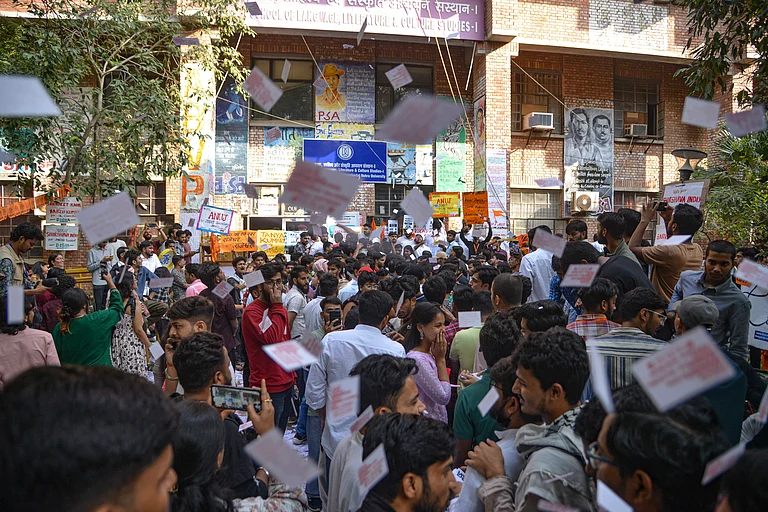
While the students moved peacefully and peaceably on campus towards the main gates, they were obstructed by barricades and armed personnel. However, the office bearers and other students still tried to give their demands to the personnel, to convince them to vacate and allow the march to be conducted peacefully.
The scene appeared premeditated and inevitable. Personnel from the state armed and prepared, ultimately unleashed violence on students, many of whom were beaten and detained at the campus’s North Gate. The march and the subsequent scuffle led to an FIR at the Vasant Kunj North Police Station against the students leading the march and to the subsequent production of the students in the Patiala House Court, Delhi. The judge granted bail to all the students; however, they have not yet been released at the time of writing this article.
These resistances and counter-resistances speak to the state of Indian democracy and provide substantial grounds for understanding the various techniques and strategies people undertake to assert their demands, battle oppression, and still fulfill their democratic responsibilities. The University, led by its students, remains true to its commitment to democracy even in the face of external pressures and internal attacks. The effects of pedagogical-constitutional resistance among university students persist longer than the physical site of the encampment, awaiting the return of its students.
Published At: