Jharkhand began the first phase of SIR and BLOs now face unrealistic targets, threats of suspension, and show-cause notices.
Large-scale mismatch between the 2024 voter list and the 2003 roll, coupled with changing instructions and lack of training, has increased the BLOs workload.
Adivasi and seasonal migrant voters are the most vulnerable, with growing fears of wrongful deletion.
Of Targets And Threats: How Jharkhand’s SIR Is Crushing BLOs
Jharkhand’s Special Intensive Revision (SIR) exercise has triggered widespread anxiety among both Booth Level Officers (BLOs) and voters, with BLOs facing intense pressure, shifting guidelines and unrealistic deadlines, voters whose names do not appear in the 2003 electoral roll remain confused and fearful of deletion.

Summary
“Please do not ask about the pressure, sir. During video call meetings, the Deputy Commissioner openly warns us that if we fail to meet the target, we will be suspended from service.”
These words belong to a Booth Level Officer (BLO) from Sahibganj, currently engaged in Jharkhand’s Special Intensive Revision (SIR) exercise.
Speaking on condition of anonymity, the BLO further states, “We are asked to work day and night. Ten days’ work is expected to be completed in five days. There is a fixed percentage target to be achieved within a specified time. If we fail, we are threatened to be suspended. When we try to match names with the 2003 electoral roll, a large number of voters simply do not exist in that list. Initially, we were told to link the son’s and daughter’s names with their father’s records. Then, a few days later, instructions changed that married daughters should not be added. When we ask block officials what to do about voters whose names appear in the 2024 list but not in the 2003 roll, we are casually told to ‘leave them out.’”
According to the Jharkhand Chief Electoral Office, the state is currently undertaking the first phase of SIR, which is also known as ancestral mapping. This consists of matching the present 2024 voter list with the electoral roll of 2003.
Jharkhand has approximately 2.65 crore registered voters as per the 2024 list. By December 2, ancestral mapping of 1.61 crore voters had been completed. The state has nearly 30,000 polling booths, each with a separate 2024 voter list, which BLOs are required to match with the 2003 rolls.
The BLO from Sahibganj mentioned earlier is given responsibility for a booth with nearly 1,200 voters. Each of these names must be traced back to the 2003 roll. For voters who are added after 2003, BLOs are required to establish parental linkage, which is often without clear instructions.
Despite this, there is a significant mismatch. Many voters aged between 60 and 70 years appear in the 2024 list but are missing from the 2003 roll altogether – making verification nearly impossible. BLOs say this has become one of the biggest operational challenges of the exercise.
Advertisement
During Bihar’s SIR process, several BLOs had publicly stated that they were under extreme pressure to meet unrealistic deadlines. Jharkhand’s BLOs now report facing similar conditions, with an alleged unofficial mandate to complete at least 80 percent mapping of the allotted target.
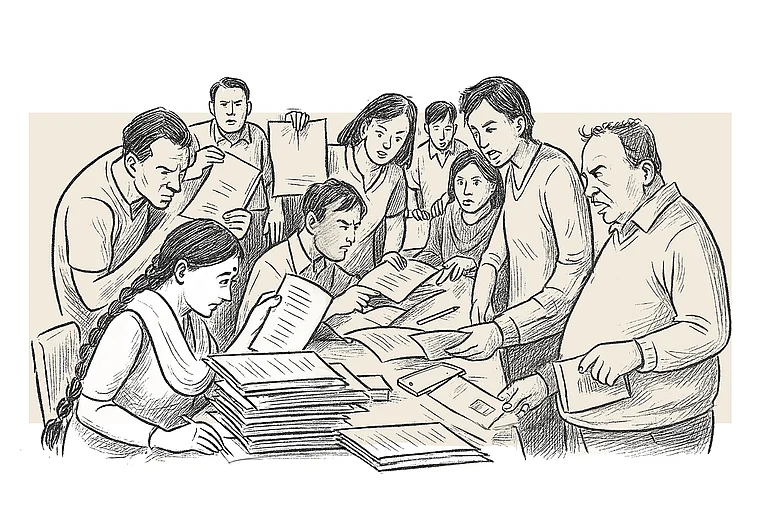
Outlook spoke with several BLOs across the state. A female BLO from East Singhbhum described her situation as particularly difficult. Recently transferred from another district, she had no prior experience as a BLO. “When I told senior officials that I had never done BLO work before, they refused to listen. Now I have no option but to continue. I am unfamiliar with the voters in my booth. Many families have members registered in different booths, such as fathers in one, sons in another, despite rules requiring them to be in the same booth.”
Some media reports indicate that disciplinary action has already begun. BLOs who completed less than 10 percent mapping have been issued show-cause notices and also warnings of further action if their explanations are not satisfactory.
Advertisement
Across the country, the SIR campaign has placed huge pressure on BLOs. Continuous field verification, fixed deadlines, and the fear of show-cause notices have coincided with disturbing reports of BLO deaths and suicides from different states.
According to media reports, around 30 BLOs have died in the past month – some by suicide, some by heart attacks and other conditions which bereaved families claim were from SIR stress.
Election Commission is yet to acknowledge the latter, and even in cases with suicide notes, no compensation has been announced. The issue has been raised consistently by opposition parties in both Parliament and state legislatures.
The opposition has demanded extending or partially suspending the SIR timeline, giving compensation to families of deceased BLOs, and conducting a detailed review of the methodology used in the SIR process. BLO unions have called for reduced workload, proper training, and implementation of safety norms. Although the Supreme Court has directed states to immediately replace BLOs who are unable to work due to health or mental stress, the impact remains to be seen.
Advertisement
There is a climate of fear surrounding the BLOs across states. A BLO from Gumla district admitted that she feared punitive action if she failed to meet targets. “We believed that those who committed suicide were unable to complete their targets,” she said. “After our review meeting, we worked day and night to complete 85 per cent of the target. The pressure was too much. Watching news about BLO suicides made the anxiety worse.”
Asked whether action was explicitly threatened, she replied, “In meetings, officials did talk about action from higher authorities if targets weren’t met. Though we hope they won’t actually act on it.”
Jharkhand is one of India’s most tribal-dominated states and also witnesses one of the highest levels of seasonal migration. Due to lack of employment and declining rainfall, 12–15 lakh people migrate annually, 60–65 percent of them from Adivasi communities.
Simdega, where nearly 70 percent of the population is tribal, also sees large-scale migration after the harvest season. A female BLO from Simdega, an anganwadi worker, has described the burden of dual responsibilities. “Earlier, the pressure was never like this. Along with anganwadi duties, I now have to do voter mapping. The biggest problem is verifying married women. We are asked to trace their parental booth number and serial number from their natal villages.”
Advertisement
Jharkhand’s Chief Electoral Officer Ravi Kumar stated that SIR has begun in the state and that voter mapping is its first phase. According to him, SIR consists of three phases: pre-revision activities (mapping), enumeration, and claim-and-objection.
Explaining mapping, Kumar said that voters successfully mapped have a confirmed link to the 2003 roll. Sons and Daughters are then linked to these records. For voters whose names appear in 2024 but not in 2003, he said they will need to submit one of the 12 prescribed documents during the claim-and-objection phase, after which the Electoral Registration Officer (ERO) will conduct a hearing and issue an order.
However, on the ground, most voters are being told that SIR has not yet begun, and BLOs themselves admit they have not been informed about the next steps. A BLO from Ranchi said, “We have been told nothing beyond matching 2024 names with 2003. My sister, who is also a BLO, is missing from the 2003 list. When I informed a senior officer, he laughed.”
This confusion has serious effects. Voters whose names are missing from the 2003 roll may delay taking corrective steps, believing that SIR has not yet started. Many seasonal migrants may leave the state after harvest, trusting that they can solve the issue later, but only to find their names deleted.
With differing accounts among officers of higher and lower ranks, there seems to be a concerning gap between policy and practice. The unclear guidelines, changing instructions, and excessive targets have placed BLOs under extreme stress while leaving voters confused and vulnerable.
Published At: