Protesters welcomed Pradhan's resignation while debating the movement's future.
With immediate demands met, attention shifted to the protest's next phase.
Many participants said the movement changed how they viewed political participation.
‘No Such Thing As Being Apolitical’: From Celebrating Dharmendra Pradhan’s Resignation To Imagining A Political Future
With Dharmendra Pradhan's resignation, celebrations erupted at Jantar Mantar, but beneath the music and slogans, protesters debated the future of the movement, CJP's political ambitions and a generation's discovery of the value of political participation

Summary
The celebrations began almost as soon as the news broke. Slogans echoed through New Delhi's Jantar Mantar, drums drowned out the traffic, and chocolates and sweets flew through the air as protesters embraced one another after learning that Union Education Minister Dharmendra Pradhan had resigned on Saturday.
For a protest site that, for more than a month, had come to symbolise exhaustion, rain-soaked tents, police barricades and bruised students, the mood had transformed. Loud music, Inquilab Zindabad slogans, colourful placards and dancing protesters replaced the fatigue that had defined the movement for weeks. Many here believed one chapter had closed, and that a much larger political conversation may only just be beginning.
"This was one of our immediate demands, and it has now been fulfilled. It's an example of the power of the united struggle of ordinary people," said Raouf, a visually impaired protester who has been at the protest since its early days. "They thought the lathi-charge would scare people away. Instead, thousands returned the next day.”
For Kashish, who said she had appeared for the Delhi Police recruitment examination three times only to see it marred by paper leaks each time, the resignation felt like overdue justice. "I feel really good," she said. "We've got the resignation we wanted."
The celebrations came hours after Pradhan announced his resignation in a letter addressed to Prime Minister Narendra Modi. In the letter, he said he had accepted responsibility for the NEET-UG 2026 paper leak from the very beginning and had never distanced himself from the crisis.
He said the Centre had acted swiftly after irregularities surfaced in the May 3 examination by handing the investigation to the CBI, cancelling the examination, announcing a re-test and deciding to shift NEET to a Computer-Based Test (CBT) mode from next year.
Recalling his four-decade association with students and education, Pradhan said he remained committed to protecting the aspirations of India's youth and ensuring deserving students did not suffer because of examination mafias. Calling the developments of the past ten days "deeply painful", he said his resignation was not about personal prestige but about safeguarding students' futures and preventing further unrest.
Advertisement
"The situation that has emerged at Jantar Mantar and elsewhere in the country should not be exploited by anti-national forces... Keeping these considerations in mind, I have sent my resignation to the Hon'ble Prime Minister," he wrote.

‘Not Only CJP’s Protest’
Yet, even as music blared and sweets were distributed, another conversation unfolded across the protest site. It was less about Pradhan and more about the future of the movement itself. For many who had spent weeks at Jantar Mantar, the resignation was never meant to be the movement's final destination.
Noreen, who completed her Master's from Delhi University (DU) and now teaches children while running a community library, told Outlook India that the protest had grown much bigger than CJP itself.
"This wasn't only the CJP's protest," she said. "They initiated it, but many people had already been fighting this issue before that. Even here you'll meet many people who don't agree with CJP or with Abhijeet Dipke, but they're here because this is a students' issue and because students faced a crackdown."
Advertisement
She believes the next test lies ahead.
"If CJP becomes a political party, then we'll judge it by its manifesto and agenda. If those agendas don't match the interests of ordinary students and working people, people will question them too. They'll also have to be accountable."
Others were more sceptical. Suraj, from Disha Chhatra Sangathan, argued that unless CJP expanded beyond examination issues, it could not become a genuine political alternative.
"Workers across the country had protested just a month before this. Political prisoners have faced attacks. The Ken-Betwa movement was also taking place. None of these issues was part of CJP's campaign," he said, adding that the organisation still lacks clarity about its larger politics.
"What kind of society do they want to build? What's their economic programme? We don't know."
He also questioned demands made by some CJP leaders to invoke the Unlawful Activities (Prevention) Act (UAPA) against Election Commissioners. "We support strict action," he said, "but don't legitimise UAPA while doing so. If you oppose such laws, you should demand that they be repealed, not used against your opponents."
Advertisement
While welcoming Pradhan's resignation, another protester argued that paper leaks could not be addressed simply by replacing one minister. "The resignation was an immediate demand," he said. "But does one resignation stop paper leaks? No."
He blamed what he described as structural failures in the education system, including excessive outsourcing of examinations and the implementation of the National Education Policy.
"This movement doesn't end here," he said. "We'll continue taking these issues to students and people across Mukherjee Nagar, Old Rajinder Nagar and elsewhere."
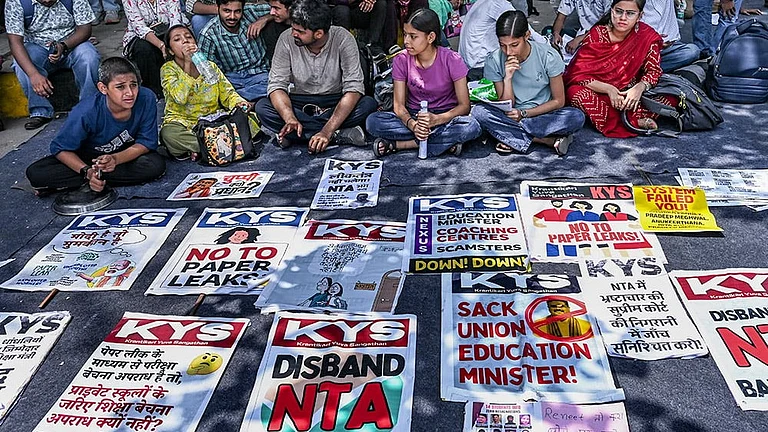
A Protest That Refused To End
What began on June 20 as a protest over the NEET-UG 2026 paper leak gradually evolved into one of the longest continuous student demonstrations witnessed at Jantar Mantar in recent years.
Led initially by the Cockroach Janta Party (CJP), the protest demanded Dharmendra Pradhan's resignation, cancellation of the compromised examination, a fresh test, a CBI investigation into the paper leak, accountability for those responsible, and justice for affected students.
Advertisement
Over the weeks, Jantar Mantar became home to students, teachers, activists and civil society groups. Protesters spent days and nights at the site through intense heat, heavy rains and humidity. Cultural performances, speeches, poetry readings and discussions became a daily feature of the sit-in as more organisations joined the movement.
The protest took a dramatic turn on July 20 when police stopped demonstrators as they marched towards Parliament. Students alleged a violent crackdown involving lathi-charge, tear gas and rubber bullets, leaving several protesters injured. Far from weakening the movement, many protesters say the violence expanded it. Larger crowds gathered at Jantar Mantar in the days that followed, with fresh groups of students arriving from across the country.
With the re-examination announced, the CBI probe underway, the decision to shift NEET to CBT mode from next year and Pradhan's resignation, protesters believe that the immediate demands around the NEET controversy have largely been achieved.
The Cockroach Janta Party (CJP), which spearheaded the agitation, described the resignation as a victory for constitutional democracy. In a post on X, the party said, "Today's victory is a powerful testament to the extraordinary foresight of Dr B.R. Ambedkar and the framers of our Constitution. Decades ago, Babasaheb envisioned a nation where power flowed directly from the people, and he engineered the framework to make that possible. Jai Samvidhan! Jai Bhim!"
Opposition leaders also hailed the development as the outcome of sustained public pressure. Congress leader Rahul Gandhi said, "Students are the future of India while Narendra Modi is the past, and the past can never fight the future."
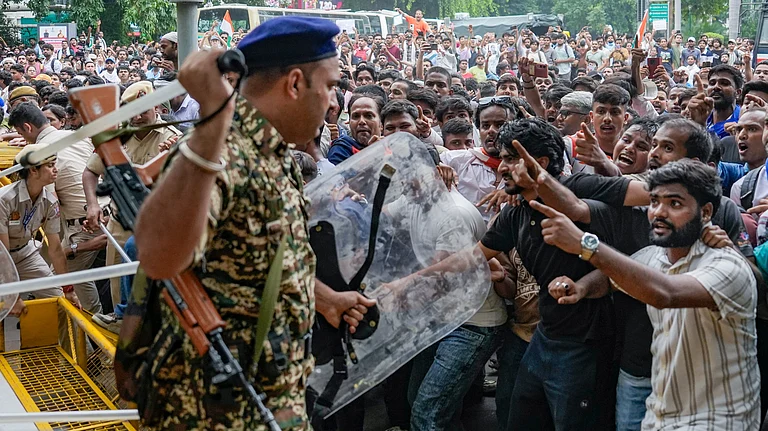
A Movement That Politicised A Generation?
Perhaps the strongest sentiment emerging from the protest was not about CJP or even Pradhan. It was about politics itself. Many young protesters repeatedly said that the movement had changed them. They believed the July 20 police action had “broken a culture of fear surrounding public dissent.”
Noreen rejected the idea that young people should remain "apolitical."
"There's really no such thing as being apolitical," she said. "What you eat, what you wear, where you go, whom you love, whom you marry, today politics shapes all of these things. So why shouldn't we shape politics?"
She pointed to universities that had warned students against participating in the demonstrations and argued that the protests had instead encouraged young people to think politically.
Around her, the celebrations showed little sign of ending and whether CJP eventually transforms into a political party, whether this coalition survives beyond the NEET issue, and whether the movement broadens into something larger remain unanswered questions.
"As long as we stay away from politics," she said, "politics will continue deciding our lives."
Published At: