In recent years each major heatwave claimed more than 1000 lives as per the IMD’s Heat Wave Annual report 2025
The meteorological department issues color-coded heatwave warnings along with the National Disaster Management Authority
If the maximum temperature crosses 47 celsius and deviation from normal temperature exceeds 6.4 celsius even on the second day, a severe heatwave is declared
IMD Heatwave Alert Explained: Why Temperatures Are Crossing 47°C Across India
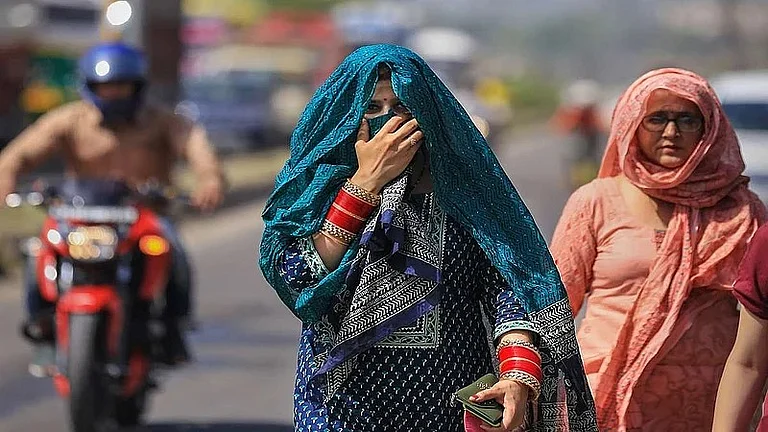
Many Indian cities are battling extreme heatwave conditions according to the IMD

Summary
With temperatures exceeding 47 celsius in many Indian cities, Indian Meteorological Department (IMD) recently declared that parts of North-West and Central India are likely to battle heatwave conditions this week.
In its Heat Wave Annual report 2025, IMD states that in recent years each major heatwave- in 1995, 2005, 2015, and 2016- has taken more than 1000 lives. In 2015, around 2300 lives were lost due to heatwaves.
Here’s everything to know about heatwaves
Why Do Heatwaves Occur?
According to the IMD, prolonged spells of abnormally high temperatures are attributed to persistence of a region of warm dry air and even wind flow patterns transporting hot air over such regions. High surface temperatures common in Indian summers favour such warm winds.
This naturally reduces moisture from the upper atmosphere further increasing heat. Sans moisture, clouds are not formed.
Over northwest India calm conditions or ‘Anti-cyclonic circulation’ prevail with westerly winds taking warm winds towards east and south.
How Is A Heatwave Defined?
While India has a pronounced summer season with temperatures peaking to uncomfortable levels, IMD has quantifiable parameters to declare heatwaves.
Consider for instance, at least two stations in the meteorological department’s sub-division recording maximum temperature over 40 celsius in the plain region and over 30 celsius in hilly regions on the first day.
This rise can mean maximum temperatures crossing 45 celsius and the departure from normal temperature being 4.5 celsius to 6.4 celsius. If these conditions persist on the second day also, a heatwave is declared. If the maximum temperature crosses 47 celsius and deviation from normal temperature exceeds 6.4 celsius even on the second day, a severe heatwave is declared.
For coastal areas, maximum temperature over 37 celsius and the departure from maximum temperature departure is 4.5 celsius is defined as a heatwave.
Advertisement
What Are IMD’s Colour-Coded Alerts?
Based on impacts, the meteorological department issues color-coded warnings along with the National Disaster Management Authority.
A green alert means normalcy, yellow means persistence of Heatwaves for two days.
An orange alert signals severe heatwaves for two days and heatwaves for four days or more. Extreme alert is signalled with a Red code stemming from persistence of heatwaves for more than two days, and heatwaves for more than six days.
How Does The El-Nino Affect Heatwaves?
El-Nino is part of a climatic phenomenon known as El-Nino Southern Oscillation or ENSO. El-Nino oscillates to La-Nina.
Put simply, the phenomenon refers to the cyclic warming and cooling of sea-surface temperatures in the central and eastern tropical Pacific Ocean. El-Nino has warmer temperatures meaning simply lesser rainfall for India. La-Nina, on the other hand, is associated with cooler temperatures bringing more rain to India.
With talks of El-Nino even strengthening further, the projected rainfall this year, as per IMD, is around 90 to 95 percent of long period average. Now, consider a research published by the meteorological department on the effect of oscillation over heatwaves. It states that during 10 of 17 El-Nino years, the number of heatwave days recorded an uptick.
Advertisement
Also, the study records that in such years, heatwaves extend both northward along the plains of Himalayas and southward over northwest and central India.

Impact On Health
Common symptoms during heatwaves include heat cramps, exhaustion and heat strokes. Heat cramps involve swelling and fainting accompanied by slight fever.
Exhaustion adds dizziness, headache, nausea, and vomiting. Heat Stroke can be fatal with body temperatures crossing 40 celsius accompanied with seizures or even coma.
Urban landscapes defined by concretisation lead to heat traps with elevated temperatures even during nighttime.
The predominance of warm winds in the daytime and its sustenance in the nighttime causes a comprehensive impact onto the biosphere as a whole. Take, for instance, agriculture witnessing Intensified water crisis, increased forest fires and reduced plant growth. Heat stress also impacts the growth rate of livestock and even weight gain. For fish, more heat means more acidification.
Advertisement
How Can Heatwaves Be Mitigated?
Generally, going out, especially around noon, is not recommended, accompanied by ample water intake. Oral Rehydration Solution or ORS is widely used to restore lost salts to the body.
State governments have, in recent times, come up with Heat Action Plans listing roles of various bodies. Noticeable, however, is the absence of heatwaves from the list of national emergencies in the country's disaster management framework. This means that states can only spend up to ten percent from their state disaster management fund if they categorise heatwaves as a state-specific disaster.
Multiple states in India are reeling under the grip of heatwave this year so far.
Published At: