The Congress and the BJP have sparred over references to the Manusmriti, an ancient Sanskrit text traditionally attributed to the sage Manu.
Critics say some verses reinforce caste hierarchy and restrict women's autonomy, while others argue the text should be viewed in its historical context.
The Manusmriti has long featured in debates on caste, social justice and constitutional values, including Dr BR Ambedkar's critique of the text.
Manusmriti Explained: Why An Ancient Text Still Shapes Modern Political Debates
Recent exchanges between the Congress and the BJP have once again brought the Manusmriti into the spotlight, renewing discussions on caste, gender, religion and the Constitution

Summary
The Manusmriti has once again entered the political spotlight following an exchange between the Congress and the BJP during the Rajya Sabha debate on the Anti-Paper Leak Bill. Congress President and Leader of the Opposition Mallikarjun Kharge accused the government of promoting "Manuvadi thinking" and incorporating elements of the ancient text into the education system.
He also alleged that students from lower-caste communities continue to face discrimination in educational institutions.
Interestingly, the Manusmriti has long featured in political and social discourse because of its prescriptions on social order. Critics argue that some of its verses reinforce caste and gender hierarchies, while others say the text shows the social norms of its time and should not be interpreted as contemporary law.
What Is The Manusmriti?
The Manusmriti, also known as Mānava-Dharmaśāstra or the Laws of Manu, Mānava-Dharmaśāstra or the Laws of Manu, is an ancient legal and social text in Hinduism. Composed between 2nd century BCE and 3rd century CE, it outlines religious duties, social codes, and the laws of kings. It is largely attributed to Sage Manu.
The Manusmriti covers a wide range of subjects, including the duties of different social groups and stages of life, relations between men and women, taxation, governance, marriage and the settlement of civil disputes.
The text outlines a hierarchical four-fold varna system, prescribing different duties and responsibilities for each social group. It places Brahmins at the top of the social order, while assigning Shudras the role of serving the other varnas. Some verses have also been criticised for prescribing unequal treatment of women and lower social groups.
Why Is The Text Controversial?
Critics say certain verses in the Manusmriti place Brahmins above the other varnas, prescribe different punishments for different social groups and place restrictions on women's autonomy. These interpretations are reflected in the English translation of the text by Patrick Olivelle and Suman Olivelle (2004).
The most famous critic of the text was Dr BR Ambedkar, who, on December 25, 1927, burnt burned the Manusmṛiti, which he saw as a source of gender and caste oppression.
Advertisement
On the other hand, Solicitor General Tushar Mehta said earlier that associating the Manusmriti with Hindu Law is a misconception. Hindu Rights Groups argue that the text as we see today is highly altered through the years.
Why Does It Keep Returning To Politics?
In the recent debate in the Parliament, Kharge alleged that Manusmriti promoted casteism in the field of education. JP Nadda, Minister of Health and Family Welfare shot back, saying that Kharge must avoid making such remarks.

Kharge alleged that recent changes to the education curriculum showed ideas associated with the Manusmriti and promoted caste-based discrimination. Amid protests in the House, Rajya Sabha Chairman C.P. Radhakrishnan directed that Kharge's remarks on the Manusmriti and the passages he quoted be expunged from the official record.
What Are The Congress And BJP Saying?
Kharge said that simply setting up fast track courts and increasing penalties will not solve the paper leak problem. He said that there should be systemic reforms for the issue.
Advertisement
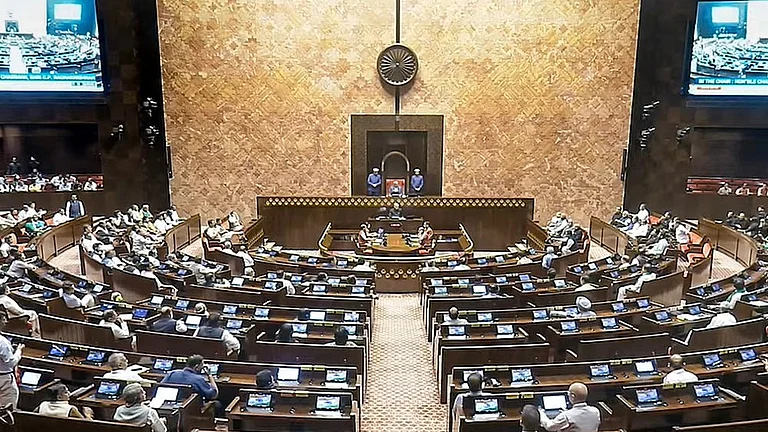
“Due to paper leak, how many innocent people were harmed… You have just changed the figures in the Public Examination Amendment Bill 2026 which has come here for discussion. In this bill, only the figures kept changing,” News 18 quoted him as saying.
Meanwhile, in a gazette notification issued on Friday, the Ministry of Law and Justice said that President Droupadi Murmu gave her assent to the Public Examinations (Prevention of Unfair Means) Amendment Bill, 2026, days after it was passed by both Houses of Parliament earlier this week.
Published At: