Three years have passed since violence erupted between the Meiteis and the Kuki, the Zomi and their kindred tribes on May 3, 2023 in Manipur. The state has been going through a massive humanitarian crisis over the years. While more than 260 people died in the mayhem, about more than 60,000 were internally displaced on both sides.
Manipur’s Pandora’s Box: Three Years of Ethnic Violence, Political Paralysis and Humanitarian Crisis
The state has been going through a massive humanitarian crisis over the years. While more than 260 people died in the mayhem, about more than 60,000 were internally displaced on both sides.

Since then, Manipur has been both physically and emotionally divided along community-ethnic lines. Security forces manned the district borders between the valley areas inhabited by the Meiteis and the hill tribal areas inhabited by the Kukis, the Zomis and their kindred tribes. Both sides do not venture into each other’s territory, and are prevented from and advised not to do so. The districts of Imphal East and West, Kakching, Jiribam, Churachandpur, Kangpokpi and Tengnoupal are severely affected by the violence.
Though a large chunk of the displaced population has moved out of relief camps, an equally large section, mostly those who have no alternative, are still languishing there.
As early as in June 2023, a peace committee was formed but it did not materialise. Even as the state Assembly was called, attendance was minimal.
After 19 months into the mayhem, Manipur came under President’s Rule from February 2025 to February 2026. Attempts to usher in normalcy during this period did not work out. For instance, inter-district public transport buses were sent out but no passengers were willing to travel, and somes buses were burnt in districts like Kangpokpi. Festivals such as the state Sangai Festival were held in Imphal. But the response was extremely poor. Another state festival, Shirui, was held in Ukhrul. The event went off better than the Imphal Sangai event, though it turned out to be only a festival of the Nagas (the Tangkhuls in particular), the bureaucrats and the Meiteis.
Over the years, violence between the two warring communities has decreased. But protests and shutdowns have been a regular affair, especially in Imphal. The Meiteis were against President’s Rule, and protests were held periodically across the valley areas, while the tribal hills were relatively quiet over President’s Rule. In fact, the Kuki, Zomi and kin prefer President’s Rule to a state government run from Imphal by the majority Meitei.
Early this year, the Bharatiya Janata Party (BJP) government in Delhi ended the 11-month-long President’s rule. The party also finally found a new chief minister and Yumnam Khemchand took over the chair on February 4. Though why it took so long to get a new chief minister in a state with a majority BJP government is surprising.
Two months into a new government, the state saw severe violent clashes between ethnic communities. While tension between Meiteis and Kukis, Zomis and kin continued, violent clashes between the Tangkhul Nagas and the Kukis erupted. The tension prevails with sporadic incidents of vandalism, burning of houses and killings being reported.
Advertisement
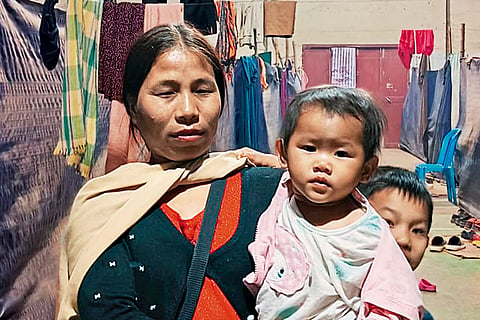
A large chunk of those affected by the violence is still languishing in relief camps | Photo Courtesy: Ninglun Hanghal
Elsewhere there has been a severe face-off between the Zeliangrong Nagas and the Kukis over a connecting road between Kangpokpi and Churachandpur.
Imphal also saw protests, demonstrations and shutdowns. The latest was due to the death of two children in Bishnupur and the perpetrators of the crime are still unknown.
For three years now, there has been no report of any arrest or news of progress in the investigation into the violence. For instance, no report on the progress of the gang-rape case or the nude parade of Kuki women has been released.
The Meiteis, who predominantly inhabit the valley areas and the state capital, seem to have directed their anger towards the government. Meitei civil society groups or the Meira Paibis—women’s groups—have called out the state government and blamed the Central BJP leaders for the crisis.
Meanwhile, the tribals in the hill districts are relatively silent, and fatigue is setting in among the Kuki, Zomi and kin.
Advertisement
Into the third year of the Manipur crisis, the Nagas in Manipur have come into the picture. Besides violence reported in Naga areas, shutdowns and bandhs have been imposed by them.
The Zomi areas are mourning the death of BJP MLA Vungzagin Valte, who succumbed to his injury after a Meitei mob attack in Imphal on May 4, 2023. Demanding the arrest of the culprits, the people and Zomi frontal organisations have kept his mortal remains in the district hospital morgue in Lamka, Churachandpur district, since this February.
Manipur is in chaos. The Meiteis, a more privileged community inhabiting the fertile plains, feel they are being subdued by the minorities. They directed their insecurity mostly at the Kukis and Zomis, calling them ‘illegal immigrants’ and ‘narco-terrorists’. The Meiteis did have issues with the Nagas in earlier years over ‘territorial limits’ in the peace talks. Territorial integrity is the key plank, and they would fight tooth and nail over it. For the Nagas, peace talks is the chorus; the National Socialist Council of Nagaland (IM) and the Government of India peace process. Though over the years the noise has more or less died down, it is central to their political mobilisation.
Advertisement
The Nagas and the Kukis have had a history of violent clashes, and relations are still volatile. There is overlapping of territorial control. Like the Meiteis, Nagas too call the Kukis ‘illegal settlers’ in their land.
On the other hand, the Kukis are proud of their history of the Anglo-Kuki War (1917-19). They feel they are indigenous and original settlers of/in Manipur as the Meiteis and the Nagas do. Moreover, the Kuki armed groups have consistently emphasised that their movement is not secession but for more autonomy.
Zomi is a federation of several smaller tribes. As a minority, there is insecurity about being subsumed in/of their identity and their very basic survival. Identity is one main reason and factor for mobilisation.
Another large minority population is the Pangals (Meitei Muslims). There have been several instances of riots and communal violence between the Pangals and the Meiteis. Often the Pangals are ‘suspect’ of illegal activity of various kinds, and of being illegal immigrants.
Advertisement
There are several other minorities as well in Manipur. The Nepalis, for instance, or the Marwaris and others. Though there has been no major violence or issues with these populations, there are undercurrents. The issue of ‘foreigners’ or ‘migrants’ often crops up. Tension between locals and non-locals is not absent.
In such a scenario, the 2023 violence has opened a Pandora’s box. Every community is unhappy. One points fingers at the ‘other’.
Ever since the crisis, there has been a huge outcry over the Prime Minister of India not visiting the state. Or not even speaking up. Finally, two years later, PM Narendra Modi came for a short visit. There is no major statement or takeaway from that visit, and the PM’s usual eloquence was missing. Union Home Minister Amit Shah also visited Manipur in the first month of the violence. He did not go back after that. All management of the violence in the state appears to be done from Delhi.
When President’s Rule was reluctantly imposed, the state Assembly was kept on suspension, opening doors for the possibility of forming a government and appointing a new CM. The BJP, both under the central leadership and in the state, did manage to form a new government. But by then, the damage done was severe. Unrest continues in the hills as well as in the valley.
CM Khemchand is trying to find ways to bridge ethnic and community relations. What is unfortunate and strikingly absent are the efforts of the 59 state legislators. In the new government, two deputy CMs were appointed. One is a Kuki woman, Nemcha Kipgen, and the other is Losii Dikho, a Mao Naga, along with Govindas Konthoujam as Home Minister. These three ministers are supposedly running the state under the CM. There are no other portfolios.
Several initiatives of restoring normalcy have been wasted. Moreover, civil society, or ethnic-based organisations, are not trying to build relations nor undertaking efforts to restore trust. Manipur is going through one of its worst moments. The inhabitants of the state must join hands to solve their problems. The state legislators seem to be waiting for the next election, while Delhi waits for Manipur to heal on its own (if it ever will).
(Views expressed are personal)
Ninglun Hanghal is an independent journalist based in Guwahati
Published At:
Tags