India’s 2025 treaty abeyance has widened operational freedom.
It does not yet enable large-scale storage or diversion.
The Court of Arbitration says the treaty remains in force.
India’s Indus Strategy Is Moving Beyond The Old Treaty
India’s Indus Waters Treaty abeyance has expanded room for work on western-river projects, but large-scale storage or diversion remains years away

Summary
Since April 2025, India has treated the 1960 Indus Waters Treaty as suspended. Pakistan disputes that this is legally possible, an international tribunal has now agreed with Pakistan, and India has rejected that ruling too.
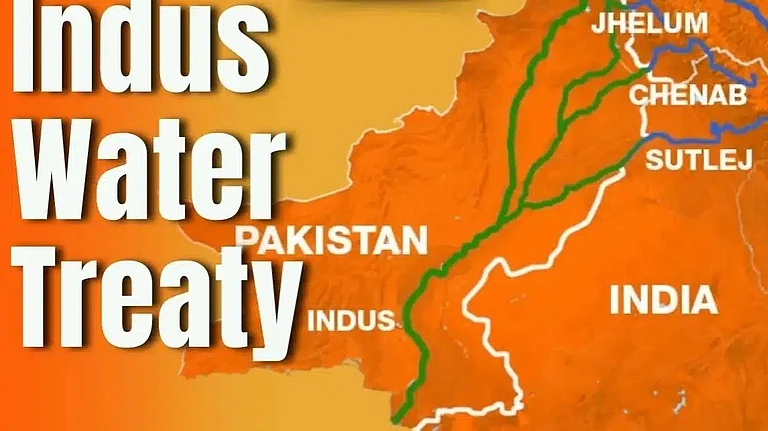
Underneath the legal argument, though, is a much more concrete question: what has actually changed on the ground for the Indus, Jhelum and Chenab, the three “western rivers” the treaty gave largely to Pakistan?
What The Treaty Allowed India To Do
Under the 1960 settlement, Pakistan got roughly 80% of the Indus system's waters through the three western rivers, while India kept the three eastern rivers — Sutlej, Beas and Ravi — for itself.
India wasn't shut out of the western rivers entirely: it could use them for limited irrigation, and for unlimited “non-consumptive” purposes such as hydropower, navigation and fish culture.
The catch was in the fine print. Annexure D let India build only “run-of-river” hydropower plants, with strict caps on live storage, reservoir design, spillway gates and outlet levels — engineering rules meant to stop India from ever gaining the ability to hold back or release large volumes of water at will.
What Abeyance Has Actually Changed
India put the treaty in abeyance on 23 April 2025, a day after the Pahalgam terror attack killed 26 people, most of them tourists. The most visible practical shift has been at existing dams.
Within days, authorities shut the sluice spillways at the Baglihar project on the Chenab, and desilting began at Baglihar, Salal and Kishanganga.
Under the treaty, this kind of flushing needed advance notice to, and effectively the tolerance of, Pakistan, which had objected to it for years; at Salal, it reportedly hadn't happened in years for that reason.
Officials have said flushing will now become a monthly routine during the monsoon season across all projects, something around 20 hydropower facilities in Jammu and Kashmir with a combined 3.5 gigawatts of capacity are expected to benefit from.
The government has also revived the Tulbul project, a barrage below Wular Lake on the Jhelum that was shelved in 1987 after Pakistan's objections. The Centre says it no longer needs Pakistan's consent to restart it, and a detailed project report is being prepared. Officials have also signalled that new hydroelectric projects on the western rivers are now “definitely” on the table.
Advertisement
What abeyance has not yet done is give India large-scale storage or diversion capability. The physical infrastructure for storing or rerouting a significant share of western river flows toward India's own basins doesn't exist yet, and building it — canals, new dams with real storage, link projects to the Ravi-Beas-Sutlej system — would take years and heavy investment even without treaty constraints.
So far, the practical changes are about control and maintenance of existing works, not a redirection of the rivers themselves.
The Court Of Arbitration's Ruling — And Why India Rejects It
Pakistan didn't simply accept the abeyance. Under a treaty-based arbitration Pakistan had initiated years earlier over the design of India's Kishenganga and Ratle projects, a Court of Arbitration at The Hague — administered by the Permanent Court of Arbitration but constituted separately under the treaty — kept issuing decisions through 2025 and 2026.
In June 2025 it ruled that India's abeyance declaration didn't strip it of jurisdiction. In August 2025 it interpreted disputed Annexure D provisions on outlets, spillways and pondage. In May 2026 it issued a further award tightening how India may calculate the storage capacity, or “pondage,” permitted at its run-of-river plants.
Advertisement
On 31 August 2026, the Court went further still, ruling that the treaty remains legally in force despite India's abeyance and issuing interim measures temporarily restricting construction work on the dam wall and power-intake structure at the Ratle project on the Chenab, pending a separate technical ruling from a Neutral Expert also working the case.
India has rejected every one of these rulings, calling the tribunal an illegally constituted body with no jurisdiction over it.
New Delhi's underlying argument is procedural as much as it is about the abeyance itself: it maintains Pakistan pursued the wrong dispute-resolution track under the treaty's Article IX, and that the technical questions at Kishenganga and Ratle belonged before the Neutral Expert process India had itself requested, not before this Court.
India stopped participating in the arbitration after April 2025 and has not filed a defence on the merits.
Advertisement
Pakistan's Objections
Pakistan's position is the mirror image: that the treaty explicitly allows termination only by a jointly ratified agreement, not a unilateral declaration, and that the Court's repeated rulings confirm the treaty remains binding regardless of what India calls its own decision.
Islamabad has separately raised alarm over specific Indian moves — the flushing operations, the revival of Tulbul, and construction activity at Ratle — as evidence that India is already acting outside the treaty's design limits on the ground, not just in its diplomatic posture.
Pakistan has also tried a parallel diplomatic track, with its water resources officials seeking to de-escalate even as the legal fight continues.

What This Means For The Rivers' Future
India continues to operate and modify its existing projects and plan new ones on the theory that it is no longer bound by the treaty's restrictions.
Advertisement
Pakistan continues to treat those same actions as treaty violations it can keep challenging through the Neutral Expert and Court of Arbitration processes, both of which remain active regardless of India's boycott.
For now, the practical reality on the Indus, Jhelum and Chenab is a gradual, contested expansion of Indian control over water already flowing through its territory rather than any dramatic redirection of the western rivers away from Pakistan.
Whether that changes depends less on the legal arguments than on whether India moves toward the kind of large storage and diversion infrastructure the treaty was designed specifically to prevent.
Published At: