The Ministry of Housing and Urban Affairs recently issued a two-week eviction notice to the Delhi Gymkhana Club, one of the oldest institutions in the capital. The Land and Development Office invoked Clause 4 of the original 1928 lease deed, citing the urgent need for defence infrastructure and public security in the sensitive Safdarjung Road zone. The club, spread over 27.3 acres, has until June 5 to hand over every building, structure, and fitting to the President. Since 2020, the Ministry of Corporate Affairs had been pursuing a management takeover through the National Company Law Apellate Tribunal (NCLAT), citing financial irregularities. The NCLAT upheld that takeover in October 2024. But the government has now gone further, from managing the club to reclaiming the land entirely.
Exclusive | Kiran Bedi On Delhi Gymkhana Club Notice: It Felt Like Being Evicted from Home
The celebrated IPS officer and former Governor of Puducherry on memories of the Delhi Gymkhana Club and what we lose when we erase institutions

While the matter is before the courts, Kiran Bedi, former Indian Police Service officer, India’s first woman to join the officer ranks of the police service, former Lieutenant Governor of Puducherry, was among the first to speak out publicly. She posted on X, calling the move “truly tragic” and urging that it be reconsidered. She tweeted: “This is unfortunate. It is truly tragic. (Hope the proposal is reconsidered) @arunjaitley got a new pool constructed during his life time. Some of the finest tennis matches have been played here. So much history, so many memories, and generations of sporting excellence are associated with this place. The Delhi Gymkhana Club is not just a property — it is part of our institutional and sporting heritage. Change may be necessary, but history and legacy deserve thoughtful preservation. We can plan to add something new there too…”
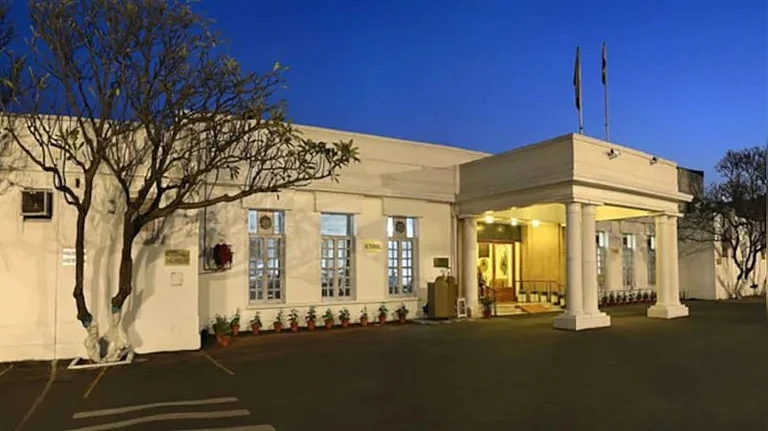
To critics, institutions like Delhi Gymkhana Club remain symbols of an older culture of privilege. But voices like Bedi question whether they are merely privileges, or also spaces of need for those who have served the country and rely on them as community hubs, to their needs in a healthy and socially engaging way.
In an interview with Outlook, she recalls her decades-long association with the club, tracing it to her teenage years as a competitive tennis player. She describes how those early visits shaped her bond with Delhi and eventually her professional life in the city. Excerpts:
What does the Delhi Gymkhana Club represent to you personally?
When I first heard about the eviction order, it felt like a loss of my home, a place where I had grown up playing from the age of 14, when I used to come from Amritsar to Delhi for competitive tennis tournaments.
Those visits made me fall in love with Delhi and made me aspire to one day work and live here. And that is exactly what happened. At the age of 24, on my first posting in Delhi as Assistant Superintendent of Police Chanakyapuri and Sub-Divisional Police Officer, the Gymkhana Club was part of my area.
The ambience of the club always made me proud of what India stood for in its capital city. It reflected both the history and modernity of India, along with its heritage. The club was visited by champions from around the world. I watched Wimbledon players there, Davis Cup matches, huge crowds, and the who’s who of Delhi.
Which memories from the club stand out most for you?
I saw legends like Ramanathan Krishnan, Jaidip Mukerjea, the Amritraj brothers, Nirupama Mankad, Susan Das, Udaya Kumar, Anu Peshawaria and many more.
The club had, and still has, some of the finest lawn tennis courts in Asia. At that time, all major international tennis matches were held there until the Delhi Lawn Tennis Association complex came up. Members of the diplomatic community also regularly came there to play.
It also has a hundred-year-old covered swimming pool where many senior citizens continue to swim daily to stay fit. Few places offer such a facility. The lawns became a second home for many elderly members who gathered there regularly to meet friends and remain socially connected.
The club also has wedding reception lawns that generated revenue and became a prestigious venue because of its location and accessibility. Even the Prime Minister has attended events there many times. There are squash courts that produced national champions, a gym, one of the finest libraries, and a reading room. These were the memories I was reliving when I tweeted.

What does the word “eviction” mean to you in the context of this institution?
So, when I used the word ‘eviction,’ it genuinely felt as though I was being evicted from a home that had shaped my growth and identity, suddenly, without notice, and no longer allowed back in. [The late former finance minister] Arun Jaitley also helped construct another open-air pool a few years ago, which benefited children enormously.
You describe it as both heritage and community space. Why does that distinction matter to you?
The club has always served a very large community of pensioners, senior citizens, and middle-class government families. Even the food and bakery facilities were reasonably priced and accessible for ordinary members wanting to host friends and family.
The club has strict admission rules and also provides dependent memberships through green cards. That is why the waiting list for new members has always remained limited, despite disappointment among those unable to get membership quickly.
How did you challenge the voting rights rule at the club in 1975?
I joined the club in 1975 as a lady member, when women had no voting rights. I challenged that discrimination, and eventually the rules were changed. Gender bias was removed. I also served on the club council many years ago.