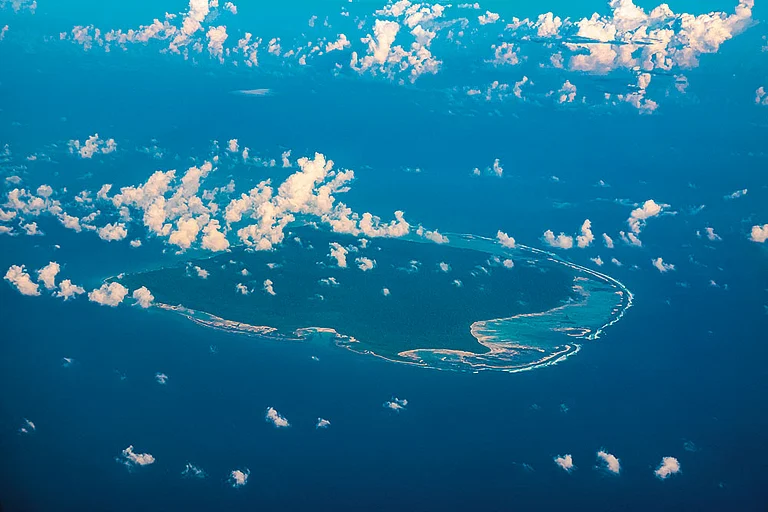
Andaman and Nicobar Islands are a vital strategic and economic asset for India. Intrepid sailors have for centuries berthed at these islands which are an irreplaceable geographic asset at the crossroads of global trade. They are uniquely positioned in the Indian Ocean, prompting their being labelled a natural and unsinkable aircraft carrier.
Andaman and Nicobar: India’s Unsinkable Aircraft Carrier and Strategic Shield Against China in the Indian Ocean
Neglecting military development in the Andaman and Nicobar Islands will be a heavy cost to bear for India

For India, the islands are a God-given gift. Seafaring nations have long recognised their importance and the Dutch, Danes, British and Japanese have, for varying durations, occupied it, but the British ruled it since the mid-19th century. In fact, as British rule in India drew to a close in 1947, officers of the Admiralty in London argued that the Andaman and Nicobar Islands were strategically important and should not be handed over to independent India but retained by the British. One argument maintained that the Indians would not realise it was theirs! Finally, the British viceroy ruled that all possessions should be handed over to the Indian government. The British Admiralty’s interest was simple: they understood that whoever controlled these islands would possess a commanding position over the eastern Indian Ocean and the maritime approaches to Southeast Asia.
Regrettably, due to various reasons, India has been slow to take advantage of the economic and strategic location of the Andaman and Nicobar Islands. With the rapidly changing international environment, including in India’s neighbourhood, and especially the increasingly competitive maritime environment, however, India has been compelled to develop the islands and optimise their strategic value. China’s rise and growing ambitions in the region have added impetus to India’s plans.
Chinese Ambitions
A rising China has altered the dynamics in the Indian Ocean. China’s People’s Liberation Army Navy (PLAN) has graduated from a coast-hugging brown water navy into a blue water ocean-going navy. It has stepped up shipbuilding and today possesses 372 surface warships—including four aircraft carriers—making it the second-largest navy in the world. It has the largest navy in Asia. PLAN ships are today sailing in all the oceans, including around the Arctic, and frequent the Indian Ocean. China’s global maritime ambition is evidenced by its involvement in the development, upgrading or management of over 96 ports around the world. A number of these are in Southeast Asia and along the African coast. The pattern reveals a special interest in the Indian Ocean. Since 2016, on the pretext of participating in anti-piracy operations off Aden, PLAN has maintained a near-permanent presence in the Indian Ocean. Furthermore, China has since this year shifted focus from constructing surface ships to submarines. They are trying to build modern silent submarines capable of staying submerged for long periods. PLAN submarines are increasingly being sighted in the Bay of Bengal, Arabian Sea and the Indian Ocean.
Advertisement
There are other important factors, not the least of which are China’s comprehensive strategic relations with Pakistan, which includes strengthening Pakistan’s navy. Under a major $5-billion defence agreement, China is building eight advanced Hangor-class diesel-electric attack submarines for the Pakistan navy—four in China and the remaining four are being assembled in Pakistan. Equipped with the silent air-independent propulsion stirling engine system, the submarine can stay submerged for 15-20 days without surfacing. The submarines, like other ships entering the Indian Ocean from China or Southeast Asia, need to pass through the Malacca Strait or the three other “choke points” namely, the Sunda Strait, the Lombok Strait and the Ombai-Wetar Strait. Submarines can transit all of them, but they are becoming increasingly difficult to detect.
Also, while international focus has remained fixed on China’s militarisation of the South China Sea, there has been a quieter but equally significant highly calculated shift southward. In addition to forging ties with Bangladesh and Sri Lanka, Beijing has been systematically altering the strategic balance in the Indian Ocean Region through a hybrid, “grey-zone” strategy designed to establish persistent intelligence, surveillance and reconnaissance dominance. Rather than deploy overt combat fleets during peacetime, China relies on state-backed civilian research vessels, such as the Xiang Yang Hong and Shi Yan series. These ships routinely loiter just outside India’s exclusive economic zone to map deep-sea topography, thermal profiles and acoustic environments. This data is essential for navigating PLAN nuclear-powered submarines undetected through regional waters. They also attempt to monitor missile launches by India off the eastern coast.
Advertisement
India can no longer afford to neglect the Andaman and Nicobar Islands. The islands have shifted from being viewed as a peripheral outpost to becoming India’s crucial forward defence line. Yet, major projects like the Great Nicobar Project (GNP) have predictably ignited debates on development versus conservation. India has to balance the protection of the environment with national security and ensure optimal use of its geographical advantage to protect its sovereign interests and counter regional powers.
Historical Neglect
Despite the Andaman and Nicobar Islands being one of the most strategically located island chains in the world, India has failed to exploit its full potential. The islands are underdeveloped, infrastructure is inadequate, civilian connectivity is minimal, tourism remains underexploited and significant portions of the islands lack modern facilities. This neglect is particularly unfortunate because development and security are not mutually exclusive, but in reality, they reinforce each other. A larger civilian population, robust economic activity, improved transport infrastructure and greater commercial investment would add to security. It will increase India’s permanent presence in the islands and strengthen resilience during crises.
Advertisement
Tourism is one of the most underutilised opportunities available to the islands, which possess pristine beaches, coral ecosystems and a unique cultural heritage. With proper environmental safeguards, sustainable high-end tourism could become a significant economic driver. Increased economic activity would help improve the quality of life for local communities whose livelihoods have been impacted by restrictions. Encouraging investments in eco-friendly resorts, water sports and inter-island ferries will boost tourism. Enhanced tourist infrastructure will also benefit the residents of the islands, especially the indigenous Nicobarese and Shompen communities, by giving them access to modern hospitals and better education.
The crown jewel of India’s updated maritime outlook is the GNP. Located at Galathea Bay, this massive undertaking features an international container transhipment terminal, a greenfield international airport, a reliable power plant and a strategic township. The project represents a mature national policy blending an understanding that economic power, environmental responsibility and hard military deterrence are deeply interdependent. Despite this, the project is being opposed and faces criticism from environmental advocacy groups. While ecological concerns must be respected, a data-driven examination reveals that the opposition relies on exaggerated claims that ignore the project’s built-in, legally binding conservation safeguards. These critics overlook that the defence requirements and the GNP leave more than 86 per cent of the archipelago’s pristine tropical ecosystem untouched. So the whole question of ecology being damaged appears to be an initiative to stall any defence projects.
Advertisement
India has been cautious and slow in constructing the vitally needed defence infrastructure on the Andaman and Nicobar Islands. It now needs to plan ahead and develop them as a humanitarian disaster relief base with airfields capable of taking large transport aircraft, bombers and fighters; electronic and satellite-based surveillance facilities; missile bases; and a naval base with submarines and warships. Neglecting military development in the Andaman and Nicobar Islands will be a heavy cost to bear for India!
(Views expressed are personal)
Jayadeva Ranade is former member of the National Security Advisory Board and president of the Centre For China Analysis And Strategy
Published At: