Venezuela lies along the boundary of the Caribbean and South American tectonic plates.
Stress builds up along major fault lines before being released as powerful earthquakes.
While megaquakes remain possible, scientists say recent tremors in Japan and California are unrelated to Venezuela's quake.
Why Do Earthquakes Happen In Venezuela? The Science Behind The Devastating Quakes
Venezuela sits on one of South America's most active tectonic boundaries, where constant movement between major plates makes powerful earthquakes a recurring threat.

Summary
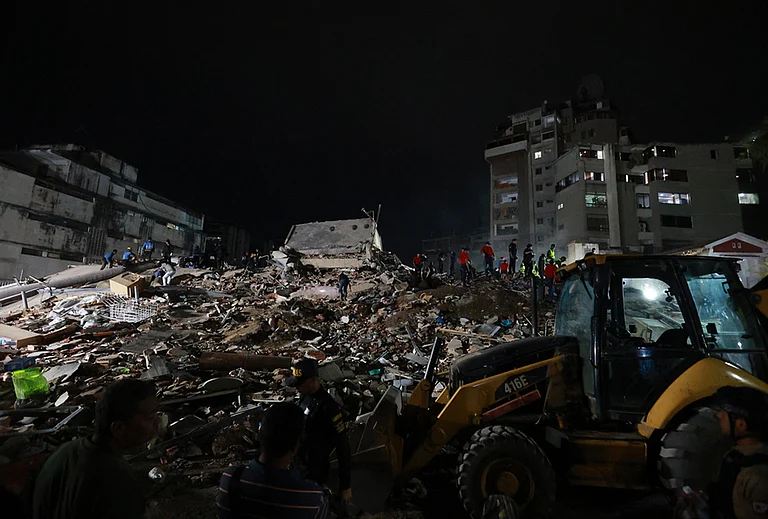
Venezuela has been rocked by twin earthquakes measuring magnitudes 7.2 and 7.5 that struck just 39 seconds apart, making them the strongest earthquakes the country has experienced in more than a century.
The government has declared a state of emergency as rescue operations continue across the country. According to estimates from the United States Geological Survey (USGS), the final death toll could range from 10,000 to 100,000. While tsunami warnings issued after the earthquake were later withdrawn, the destruction has been severe, particularly in La Guaira and the northern coastal states of Aragua, Carabobo and Falcón.
The disaster has once again drawn attention to Venezuela's location in one of the most seismically active regions of the Americas.
Which Tectonic Plates Meet In Venezuela?
Venezuela sits along the boundary between the Caribbean Plate and the South American Plate, one of the most active tectonic zones in South America. The Caribbean Plate moves eastward relative to the South American Plate at a rate of roughly two centimetres per year, continuously building stress within the Earth's crust.
Unlike some earthquake-prone regions that are dominated by a single fault, northern Venezuela is crisscrossed by several major strike-slip fault systems. Among the most significant are the Boconó Fault, which runs through the Venezuelan Andes, the San Sebastián Fault located offshore near Caracas, the El Pilar Fault in northeastern Venezuela, and the Morón Fault Zone along the central northern coast.
These faults are interconnected fractures that accommodate the movement between the two tectonic plates. As stress accumulates over time, the faults eventually rupture, releasing enormous amounts of energy in the form of earthquakes.
The Boconó Fault in particular has been responsible for several powerful earthquakes throughout the country's history.
Why The Caribbean Region Is Seismically Active
Scientists classify Venezuela as a high-risk seismic zone because of its complex tectonic setting. Northern Venezuela lies along a strike-slip plate boundary, meaning the Caribbean and South American plates move horizontally past each other rather than one plate diving beneath the other.
Advertisement
Although strike-slip boundaries are often associated with sideways motion, they are capable of generating powerful earthquakes when accumulated strain is suddenly released. The San Sebastián, El Pilar and Boconó fault systems do not move continuously. Instead, stress builds up over decades before being released in sudden ruptures.
The latest disaster was particularly unusual because it involved an earthquake doublet — a rare phenomenon in which two major earthquakes occur in quick succession. According to the USGS, the first quake struck at a shallow depth of 13 kilometres near the coastal town of Morón, about 168 kilometres west of Caracas. Less than a minute later, a stronger tremor followed.
Earthquake doublets are uncommon because they involve the rupture of multiple fault segments within a very short period. Such events often increase the likelihood of significant aftershocks as surrounding fault systems adjust to the sudden redistribution of stress.
Advertisement
The Deadliest Venezuelan Earthquakes
Venezuela, due to its unique tectonic location. has experienced several destructive earthquakes throughout its history.
Among the deadliest was the 1812 Caracas earthquake, estimated at a magnitude between 7.5 and 7.7. The disaster devastated Caracas and several other cities during Venezuela's War of Independence, severely disrupting administration and military operations. Historians regard it as one of the most consequential natural disasters in the country's history.
Nearly a century later, the 1900 earthquake struck along the same tectonic boundary, causing extensive damage in Caracas and nearby regions. It remains one of the best-documented earthquakes in Venezuela's early instrumental record.
In 1967, a magnitude 6.5 earthquake once again struck Caracas. More than 200 people were killed as several high-rise buildings were heavily damaged or collapsed. The disaster also prompted major changes in how Venezuelan authorities prepared for and responded to seismic hazards.
Could A Megaquake Happen?
The powerful earthquakes in Venezuela coincided with seismic activity elsewhere around the world, leading some observers to speculate about a possible connection.
Advertisement
On Thursday morning, a magnitude 6.9 earthquake struck off Japan's Iwate Prefecture at a depth of about 50 kilometres. The shaking reached an upper 6 on Japan's seven-point intensity scale in parts of the region, causing significant disruption. No tsunami warning was issued, and there were no immediate reports of fatalities.
A moderate earthquake also struck northern California on the same day, with a magnitude of 5.6 recorded near Redwood Valley in Mendocino County.
Scientists, however, stress that these earthquakes are unrelated. Japan lies along a subduction zone where the Pacific Plate is sinking beneath the plate carrying Japan, while California's earthquake was linked to faults within the San Andreas system. Venezuela's earthquakes occurred on an entirely different plate boundary. Seismic energy dissipates within the surrounding rock and cannot travel across oceans to trigger major earthquakes thousands of kilometres away.
For now, experts are focused on the aftershock sequence in Venezuela. USGS forecasts indicate a high likelihood of continued seismic activity in the coming days. In the first 24 hours after the main earthquake, scientists expect dozens of aftershocks of magnitude 4 or greater, with a high probability that at least one could exceed magnitude 5.
Advertisement
Although aftershock activity is expected to gradually decline over the coming weeks and months, Venezuela faces a long road to recovery as it grapples with one of the most devastating natural disasters in its modern history.
Published At:
Tags