The author obsessively follows news of war in Iran while being far away from his loved ones.
Through memories of his mother and a child named Ali, he tries to hold on to images of normal life amid destruction.
Despite fear of total devastation, he clings to a fragile hope that life will survive and he will reunite with them.
War From An Ocean Away
In the many endings that I picture, my mother and Ali end up stranded on roads, separated in different cities, looking for their belongings in the rubble, or chewing some meagre bread to quell their hunger

Summary
The first thing I do every morning as soon as I open my eyes is grope for my phone. In its thick black case, it sits on the cheaply-made white nightstand which stains easily. I unlock it and, with heavy eyelids, I open a browser to check the news on at least three different news websites.
What I am most worried about in the morning is any big event that might have happened in my sleep: infrastructure targeted, attacks on oil refineries, bridges blown to pieces, or the news that America has started a ground invasion in Iran. I usually get out of bed after a few minutes and teeter toward my toothbrush.
Today is the 39th day since Israel and America attacked Iran. As I take a shower, I think about how things have progressively escalated. On February 28, the war started when Israel conducted an unprecedented series of attacks on Tehran, killing the Iranian supreme leader Ali Khamenei along with several high-ranking officials. Iran responded by firing missiles at Israel and American bases in Bahrain and other Persian Gulf countries.
After the shower, as soon as I pull my T-shirt over my head, I tap on my phone to check for any developments. Sometimes a few pictures have been posted, a column of white smoke from a neighbourhood or the news that a general has been killed when I was sleeping.
I prepare my breakfast and, as I eat, I read more news on my phone, which rests flat on the table next to the tub of cheese. I get dressed and step out of the apartment.
As if obeying the commands of a force beyond me, my hand pulls my phone out of my pocket right after I press the elevator button. I open X as I go down: Israel has bombed a synagogue in Tehran; an air strike has hit the train track near Karaj; and a post from a mother in Iran: “Do you know what it feels like to hang whistles around your neck and your child’s neck before you go to sleep? If not, then don’t tell me war is the best thing.”
Advertisement
These images swirl in my head as I walk two blocks through downtown. There are usually few people or cars around early in the morning. This is a college town and the students keep themselves busy partying late into the night. Mornings are not for them.
I check my phone again on the campus, then every few minutes during work in my office, and even sometimes in the classroom while I teach.
For 39 days, the war has seeped into every minute of my life from an ocean away. Video after video, photo after photo, explosions and ruined buildings have marred my image of my city. A city of nine million, Tehran keeps turning into a ghost town in my head: rubble everywhere, nothing remaining of buildings but chewed up skeletons and cars smashed under the weight of fallen trees.
But I know these images are wrong. Life is resilient. It finds its way. So, up until today, I have tried to dilute the onslaught of photos and videos of destruction with memory and imagination.
Advertisement
I spent my childhood during the Iran-Iraq war. For eight years, I went to school, watched TV, celebrated Nowruz, and played with my friends on the streets. Grown-ups fought on the warfronts and lost limbs and died, but they also cooked and laughed and threw weddings. I was also in Tehran during the 12-day war in the summer of 2025. I heard the bombs and saw the struck buildings and was afraid for my life, but I also drank good coffee in cafes, ambled in fancy bookstores, and bought tiny hand-made ceramic salt shakers for my colleagues in the US.
Since the beginning of this recent war, I have tried to glean any information I can about the everyday life in my country. The internet blackout has made this difficult. I cannot even contact my friends and family. My mother calls every other day using the special international call package she has purchased from Iranian phone companies. When she does, though, I ask her what life is like.
Advertisement
She has stayed in as much as possible. Multiple spots within walking distance of her home were struck in the first days of the war. Together with my stepfather and brother, she left Tehran, but returned after two weeks when it was obvious to everyone that there is not an imminent end in sight. How long could she impose herself onto her host even if that host was nice and accommodating?
In their seventies and eighties, my mother and stepfather have become playmates for the three-year-old son of their neighbour downstairs. I will call him Ali. Every time she calls, my mother tells me little Ali’s stories with the excitement of a grandmother. Ali is the grandchild she does not have. She tells me how Ali came up to her apartment early in the morning, horsed around, played with water in her tiny balcony, and explored every corner of the apartment for hours. She tells me how Ali occasionally falls silent in the middle of playing, turns his ears toward the window, and listens as if to a distant sound. “Was it a strike, auntie?” he asks my mother. A few nights ago, when Tehran was experiencing heavy bombardment, Ali asked my mother to go down to his room and stay with him by his bed. “Are you up?” he kept asking my mother and she would assure him that she was. After some time, my mother said, “Ali, dear, I’m too sleepy, I need to go to my bed,” Ali almost jumped out of his bed: “No, don’t!”
Advertisement
I saw the boy last summer. He was thin, extremely shy, and overflowing with life. He hid behind his mother’s leg when he saw me and would not come in to play with my mother when I was in the apartment. After a few days, though, he dared to take a peek before he cautiously tiptoed in. And some days later, he finally accepted me as a playmate. Sitting on the floor, I kept rolling a stuffed plush ball to him standing on his excited feet, waiting to kick the ball in my direction with all the force he could muster.
It is with these images that I have tried to preserve my Tehran in my head. Even if scared, Ali is still playing. My mother still says her prayers on time. The prices have increased, but people still buy fruit in the market.
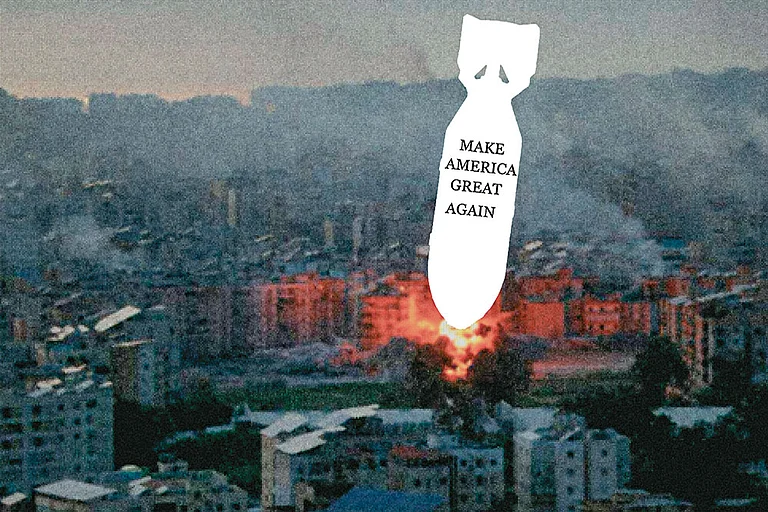
Today, though, I am giving in to the weight of the news. In a speech yesterday, the president of the United States threatened that “[t]he entire country could be taken out in one night, and that night could be tomorrow night”. And as though that was not strong enough, he wrote today that “[a] whole civilization will die tonight, never to be brought back again”.

The deadline he has given Iran is 8:00 PM today. Come the hour, he will blow up every bridge and power plant if Iran does not surrender, open the Strait of Hormuz which it has blocked, and strike a deal that Trump finds acceptable. Ali’s face cannot help me today. My mental images are grim. He is clutching at his mother’s sleeve in the darkness. My mother shakes her head not knowing what to do with the food that is melting in her freezer. The texture of the society is unravelling: hunger, shortage of food, a war-torn country.
I wave these dark phantoms away from me, but they return like a persistent cloud of flies. I am staring at my computer, paralysed. I cannot work or focus. In these final hours before all hell breaks loose, I remind myself that the future is hard to predict, at least for me.
Maybe, just maybe, the story of this war will not culminate in more devastation. In the many endings that I picture, my mother and Ali end up stranded on roads, separated in different cities, looking for their belongings in the rubble, or chewing some meagre bread to quell their hunger. But there is also a tiny one which defies Trump’s promise of death and destruction.
In this ending, I will fly back to Tehran, ring the bell of my mother’s apartment and take the elevator to the fourth floor. As always, my mother makes too much noise at seeing me, hugs me and brings me a lot of fruit. Then little Ali will knock on the door, and holding his plastic gun in his hand, checks me out and decides whether or not to step in as my mother urges him to. “Come on in. Look, this is Uncle Ali. You remember him, don’t you? He’s come on an airplane. He wants to play with you.”
Against all odds, I like to hold on to this ending. I do not know how it could materialise, but I want to cling to it because others are too hopeless and cruel, because I refuse to believe that my country will die tonight, this story has to be sung in odes, not elegies.
(Views expressed are personal)
Ali Araghi is a writer and translator. He is the author of The Immortals Of Tehran. He teaches creative writing at the Pennsylvania State University, USA
Published At:
Tags