Extradition of Sheikh Hasina remains a major contention between India and Bangladesh.
India confirms that any request from Dhaka will be processed in accordance with law.
New Delhi aims to maintain stable relations with Bangladesh.
Sheltering Sheikh Hasina Was India’s Duty As A Neighbour: High Commissioner
Indian High commissioner Dinesh Trivedi asserted that it was India's duty to give shelter to Sheikh Hasina

Summary
India’s High Commissioner to Bangladesh, Dinesh Trivedi has said that as a neighbour, it was India’s duty to give shelter to former Bangladesh Prime Minister Sheikh Hasina after she fled her country in August 2024.
Trivedi was addressing queries regarding the ongoing extradition discussion of Sheikh Hasina at the Bay of Bengal Conversation, an annual conclave organised by the Dhaka-based Centre for Governance Studies.

He said, India “hardly had any choice” as “then, she (Hasina) was still the prime minister of Bangladesh". “It was our duty as a neighbour to accept the reality of life, because situations are such where at times you are not prepared for it," he said.
He further clarified that the Awami League leader was not brought to India by the Indian Air Force or Army from Bangladesh.
On the time frame of Hasina’s return, he said, “Nobody can give you a time frame (over Hasina's return)," "Again and again, the government of India has replied to this that there is a process, and the process is legal, and it is well structured," he added, according to the Hindu.
Trivedi termed the circumstances in Bangladesh as "tragic" and asserted that such a situation should never be repeated anywhere in the world.
What Happened In Bangladesh?
Bangladesh saw a change in power after Sheikh Hasina’s government was toppled in August 2024. Muhammad Yunus then took charge of an interim administration on August 8 and ran the country for the following 18 months.
Sheikh Hasina, 79, has been living in India since fleeing Dhaka after her government collapsed in August 2024 amid a massive anti-government agitation. She was first airlifted from her residence in Bangladesh by a military helicopter on August 5, 2024, and later she flew to India on a Bangladeshi military plane.
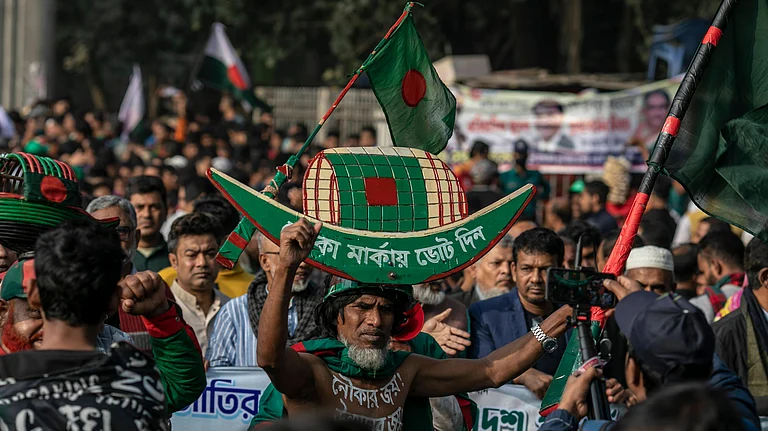
Tariq Rahman's Bangladesh Nationalist Party (BNP) government took office after the February 12 elections. The Awami League could not contest that vote, and the new government backed the ban on Hasina's party. Hasina was tried in absentia in November 2025; she was sentenced to death for alleged killings of protestors.
Advertisement
The BNP government has repeatedly renewed its demand for Hasina's extradition after taking power. India’s external affairs ministry has maintained time and again that Bangladesh’s request to extradite Hasina is being examined under established procedures. Ms. Hasina, on August 5, 2026, announced that she would return to Bangladesh by December 2026.
India extended an invitation to Rahman for last month’s BRICS Summit. It also had a separate bilateral invitation on the table since February. Rahman turned down the BRICS invitation. The issue of Hasina’s extradition has strained India-Bangladesh relations and has also affected Rahman's proposed visit to New Delhi.
Published At: