Netanyahu’s bloc is projected to win 53 seats, short of a majority.
Eisenkot’s opposition faces hurdles in securing Arab party support.
A unity government or another election could be the outcome.
Netanyahu vs Eisenkot: Who Can Form Israel’s Next Government?
Israel’s election has left Netanyahu and opposition leader Gadi Eisenkot short of a majority, with Arab parties potentially holding the key to government formation

Summary
With nearly 90 per cent of votes counted, Israel’s election has produced no clear winner, as neither major political bloc has secured the 61 seats needed to form a government.
Israel’s Central Elections Committee reported that more than five million votes had been counted by 9 pm on Wednesday, according to Al Jazeera.
Preliminary figures put Prime Minister Benjamin Netanyahu’s bloc at 53 seats in the 120-member Knesset, while the opposition alliance led by Gadi Eisenkot was projected to win 48 seats.
The Joint List and Ra’am, two Arab political parties, are projected to win a combined 19 seats, potentially marking a record for Arab representation in Israel’s parliament.
The final results may be announced as early as Thursday evening, but the outcome is unlikely to give either major bloc a clear path to power.
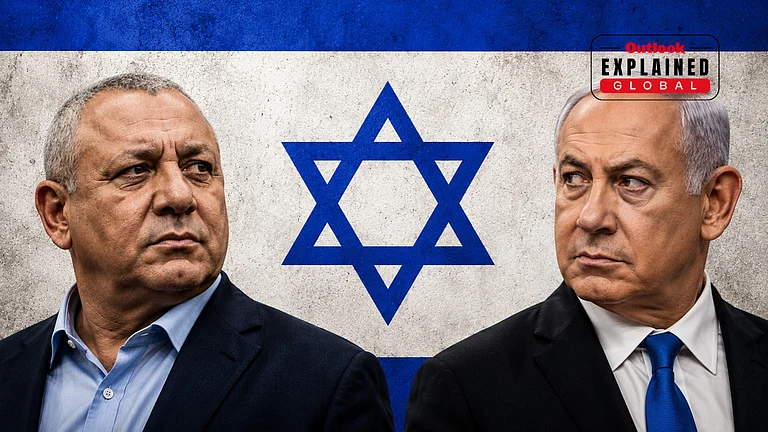
Can Netanyahu Form A Government On His Own?
Benjamin Netanyahu’s Likud party is projected to emerge as the largest party in Israel’s election, with an estimated 26 seats in the 120-member Knesset. However, this is not enough to form a government on its own. Netanyahu’s broader political bloc is projected to win 53 seats, short of the 61 needed for a parliamentary majority.
Netanyahu may therefore need to negotiate with other parties or consider a national unity government with opposition groups. If these talks fail, Israel could face another election.

Can Eisenkot Form Government?
Gadi Eisenkot, Netanyahu’s main challenger, is projected to secure 21 seats. However, he would need the support of the two Arab parties, Ra’am and the Joint List, to reach the 61 seats required for a majority. The two parties are expected to win a combined 19 seats, potentially a record.
Advertisement
However, two of Eisenkot’s right-wing allies have opposed joining a government that includes the Arab parties. They have also rejected a minority government that depends on the parties’ support from outside the coalition. This makes it difficult for Eisenkot to form any government as of now.
Despite the uncertain election outcome, Eisenkot has expressed confidence that he can bring political change to Israel.
In a post on X on Wednesday, he said his opposition alliance was concentrating on the “heavy task entrusted to us – bringing change to Israel and establishing a Zionist mobilisation government”.
He added, “This is the will of the people who expressed no confidence in the government of October 7th and the shirking, and in the bloc of shirkers in general. A bloc that is at the low point of two decades.”
What Role Can Arab Parties Play In Government Formation?
Arab parties could play a decisive role in determining who forms Israel’s next government. The Joint List and Ra’am are projected to win a combined 19 seats in the 120-member Knesset, potentially giving them significant influence in a closely contested election.
Advertisement
However, cooperation remains politically difficult. Some opposition allies oppose including Arab parties in a coalition or relying on their support from outside the government. Ra’am previously joined Israel’s governing coalition from 2021 to 2022, showing that such cooperation is possible.
What Could Be The Likeliest Scenario?
Although Benjamin Netanyahu has lost support and faces challenges in forming a government, Ofer Shelah, a former Israeli lawmaker and senior research fellow at the Institute for National Security Studies, said the opposition was unlikely to take power anytime soon.
“The two really viable options are either a national unity government under Netanyahu or another election cycle,” Shelah told CNN. He said a unity government led by Netanyahu was the more likely outcome.
Shelah said an opposition coalition led by former military chief Gadi Eisenkot had initially appeared possible after the exit polls were released. However, the political picture changed overnight.
Haaretz editor-in-chief Aluf Benn said Gadi Eisenkot faced a tough decision, describing the situation as “a very tense situation” and “a big dilemma” for the opposition leader.
Advertisement
Eisenkot has previously ruled out joining a government led by Benjamin Netanyahu. However, pressure to prevent another election could force him to reconsider that stance, Benn told CNN.
Benn added that political leaders would wait for the final election results before deciding whether any combination of parties could secure enough support.
What Will Happen After Results Are Announced?
After the final results are declared, Israeli President Isaac Herzog will choose which political leader should get the first opportunity to form the next government.
That leader will need to reach agreements with other parties to secure a majority in the Knesset. The negotiations could last several weeks and may still fail to produce a government.
Published At: