Can India build artificial intelligence (AI) models that compete with ChatGPT? Will the country’s millions of techies lose jobs as AI’s ability to code improves by leaps and bounds? Is that ridiculous video of a celebrity or a politician real or a fake created by AI?
Cover Story | AI in Education: The Future of Schools and the Burden of the Indian State
India’s AI education ambitions are colliding with the stark reality of missing digital infrastructure, undertrained teachers and AI tools blind to children’s cultural context

Many such questions are increasingly a part of everyday conversations in India. They are being raised and debated in boardrooms, living rooms and even political rallies. And why not? Pick up any survey or report on global AI usage—and India almost always seems to come out tops.
Yet, there is a facet of AI that mostly goes unnoticed: is India doing enough to prepare its school kids for the AI age? Of course, there are no easy answers.
At the AI extravaganza that India hosted earlier this year where global chief executive officers (CEOs)and political leaders like OpenAI’s Sam Altman and French President Emmanuel Macron were in attendance, a teenager from Gurgaon won accolades for his AI innovation. Pranet Khetan, a student of Shiv Nadar School, created a matchbox-sized AI device that converts slurred speech into clear words—which could be a boon for stroke patients or those with conditions like Parkinson’s and cerebral palsy.
About an hour’s drive away from where Khetan lives, another teenager named Afreen has heard a lot about ChatGPT but is not yet certain about how to use it for her studies. She goes to a government school that teaches children from Azadpur, one of Delhi’s largest slums.
Between Pranet and Afreen lies an emerging fault line that could shape India’s economic future as profoundly as the digital divide did a generation ago. On one side are children who are learning to build AI and use it as a force multiplier for creativity and problem-solving. On the other are millions who barely know about its existence. With AI rapidly becoming a foundational skill, much like literacy, numeracy and the internet before it, experts warn that the emerging divide could snowball into a bigger crisis.
“If we fail to provide access to computing and AI, millions of children will grow up without the skills needed to navigate an AI-driven world and our demographic dividend will turn into a demographic liability,” says Santosh Mehrotra, a development economist and co-author of India Out of Work: Rethinking India’s Growth Strategy.
Advertisement
Mehrotra’s fear is real. India has around 25 crore school-going children who make up over a fifth of the country’s population. The country’s aspiration of capitalising on its youth to get rich over the next couple of decades will rest on the shoulders of its kids. Yet, they aren’t being provided with the wherewithal to make that dream come true.
The data is telling. Although India has become the biggest consumer of mobile data in the world in per capita terms, even today over a third of schools lack basic digital access, according to government data. Only 63 per cent have functional computers and 67 per cent have internet connectivity.
A Gaping Hole
In 1999, renowned educational theorist Sugata Mitra and his team at NIIT, a skilling company, drilled a hole in their office’s boundary wall adjoining a slum in Delhi’s Kalkaji, and set up a desktop computer, a touchpad and an internet connection.
Advertisement
In no time, curious children from the slum figured out how to operate the machine and navigate the internet. Within six months, they had learned to download games, music and videos. They even came up with their own terminology—damru (a musical instrument) for the hourglass symbol and sui (needle) for the mouse cursor. This ‘hole-in-the-wall’ experiment was replicated in other cities, demonstrating that just the infrastructure could prompt children to learn on their own.
It’s been 27 years since that experiment was first conducted. Yet, access to computing infrastructure is still a distant dream for many.
Picture this. In a government school in north Delhi, having an enrolment capacity of 1,150 students, the computer laboratory has just 12 ageing, largely dysfunctional computers. Internet-based learning remains out of reach because of the weak MTNL connection, says the school’s principal. To compensate, teachers contribute Rs 1,100 from their own salaries every month to pay for a private internet connection. The computer teacher’s main role is to help teachers with technical issues.
Advertisement
Such scenes are a paradox for a country that supplies CEOs to the world’s biggest tech companies and is one of the largest exporter of software services. Experts say that the reason is a chronic under-investment in school education by the state, compared to higher education. As a result, India has created some of the finest science and technology institutions like the Indian Institutes of Technology (IIT), Indian Institute of Science and Tata Institute of Fundamental Research, but faltered in providing adequate educational infrastructure to its school students.
“In the first 30 years after Independence, the country built a double-cylinder education structure, with the top cylinder representing higher education and the bottom one representing schooling,” says Arvind Virmani, developmental economist, who is also a former NITI Aayog member and is a former chief economic adviser (see page 38).
In contrast to India’s policy, China focussed on primary education and vocational training in the period after the cultural revolution. A World Bank report from 1996 highlights that its priority was “more spending in basic education than in higher level”, which ultimately helped it become the world’s factory in the following decades.
Advertisement
Virmani contends that India’s “unstable structure’ of a smaller base of school education spending and a big top of higher education must be corrected. “Learning starts at the bottom of the pyramid,” he argues.
Meanwhile, there is also a geographical divide in computing infrastructure. As per the Ministry of Education report encompassing the Unified District Information System for Education (UDISE) survey data, nearly all schools in prosperous states like Delhi, Punjab and Kerala are equipped with functional computers whereas less than a third of schools in states including Bihar, West Bengal and Chhattisgarh have similar facilities.
“Policymakers should incentivise industry partners to invest in regions that are not well served,” says Victor Lee, the Khosla Family Professor in the Graduate School of Education at Stanford University. “We need to ensure equitable access, which may require infrastructural investments and investing in public spaces—where key ideas about AI—are made available,” he adds (see page 30).
In early 2026, a Parliamentary Standing Committee urged the Centre to take “concrete, time-bound steps” to raise public expenditure on education to 6 per cent of the gross domestic product (GDP) by 2030, the target envisioned in the National Education Policy which emphasises AI education in schools. It noted that combined spending by the Centre and states currently stands at 4.06 per cent of GDP, well short the goal.
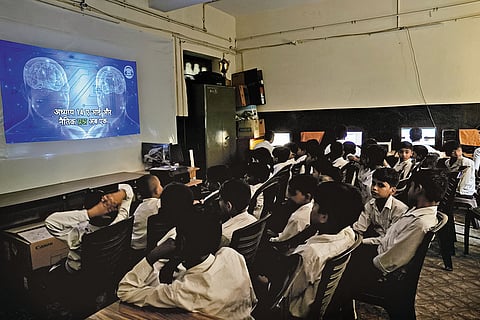
Inclusive Model: Children in a government school in Delhi attending an AI session | Photo: Tribhuvan Tiwari
Questions of Pedagogy
As AI fever gripped the world, Microsoft founder Bill Gates landed in India in the summer of 2024. Days later, a video of a candid conversation between him and Prime Minister Narendra Modi went viral. In the clip, Modi was seen joking that “In our country, we call our mother ‘Ai (pronounced as aayee)’. Now I say that when a child is born, he says ‘Ai’ as well as AI as children have become so advanced”.
It was an early signal of the government’s thinking on AI education for kids. By the next year, India became one of the first countries to kickstart a policy effort to integrate AI into school education. In April, the government announced that a curriculum to teach AI and computational thinking in Classes 3-8 was ready. “It set off a familiar debate: is this too much, too early, for classrooms as varied as ours?” asks Karthik Raman, a professor at IIT Madras who has helped design the syllabus (see page 48).
The core logic of designing the syllabus was to build computational-thinking skills first—like pattern recognition and algorithmic thinking—since these are the same cognitive foundations that underlie how AI works, then layer AI literacy on top rather than jumping straight to coding. “Having helped design this curriculum and interacted with the teachers implementing it, I can see that there are challenges and constraints ahead of us—but the children are not the constraint,” says Raman.
What Are The Constraints?
Apart from infrastructure woes, many in the education ecosystem believe that a significant challenge for India’s ambitions to teach its children AI will be bringing the country’s one crore school teachers up to speed.
A 2025 nationwide survey by the Centre for Teacher Accreditation found that nearly three in four teachers already use AI in their work. Their most common application is lesson planning, while more than a quarter use it to generate classroom activities. But the survey also uncovered a striking contradiction. Teachers appear far more confident about AI than they are knowledgeable about it. Only 57 per cent could correctly answer a basic question designed to test a common misconception about AI. Yet, two-thirds rated their own AI expertise at six or above on a 10-point scale, with the average self-score at a healthy seven.
Rukmini Banerji, the former chief of education sector NGO Pratham, says that teacher training in India is sporadic and largely one-size-fits-all. “It doesn’t equip teachers to handle the specific composition of their own classrooms. If AI can support teachers with differentiated instruction, that could be one way to change the status quo,” she says (see page 34). She points out that yet another challenge in AI education would be the barrier of language. “The potential of using AI for learning across languages is still largely undiscovered, particularly for young children,” she says.
If India wants to squeeze out the most of its demographic dividend in the AI age, it must invest across the entire educational stack.
In many Indian states, English is introduced early in primary grades, but teachers are often not comfortable teaching it, and children may have little exposure to English in their environment. Now there is an added layer of complexity as most AI learning tools are still primarily in English.
“The technology has to work in the language students learn in and that requires serious planning and research,” adds R.K. Sharma, a professor who taught AI at Delhi’s Jamia Millia Islamia.
Future Tense
When HC Verma started teaching physics from a popular American textbook, he realised that there was a problem. Students were not able to relate to the concepts as the examples in the book often cited things that were far removed from their everyday experience—such as elevators in skyscrapers, baseball and ice hockey.
That’s when Verma, a former professor at IIT Kanpur, decided to write a textbook for Indian students with examples of monkeys climbing ropes, children playing marbles and bicycles. His book has become a classic for Indian students across generations.
Language is not the only context. Decades of research in educational psychology suggests that learning is more effective when new concepts are anchored in familiar cultural contexts. And that is exactly where a big risk looms for Indian kids.
The western AI models today are steeped in the cultural context of the West. As a result, the chatbots and educational tools built on top of them also retain that bias. The examples an AI model chooses, the assumptions it treats as normal, the historical episodes it foregrounds, the humour it employs and the values it implicitly reinforces all emerge from the data on which it was trained.
“If India does not think about the risk from AI and the databases on which it is trained, there is a risk that all our default responses and narratives will be those generated by these externally controlled algorithms,” Sanjeev Sanyal, a member of the Prime Minister’s Economic Advisory Council told Outlook Business last year.
When Thomas Babington Macaulay created India’s first formal education policy during British rule, he explicitly stated the objective: to create “a class of persons, Indian in blood and colour, but English in tastes, opinions, morals and intellect”. Two centuries later, the country’s education system, public life and economy are still shedding the imprints of his desire.
The debate on building sovereign AI models and applications often rests on the planks of national security and economic competitiveness. India’s policymakers, entrepreneurs and investors need to understand that education—the cognitive environment that the country’s children grow up in—is as important a dimension.
AI education is no longer a futuristic ambition. Countries cracking the AI game now will shape the terms of the next global economic order.
There’s a lot to be done. If India wants to squeeze out the most of its demographic dividend in the AI age, it must invest across the entire educational stack: computing infrastructure in schools, teacher capability and AI models that reflect Indian languages, curricula and cultural contexts.
Afreen, who studies in Class 8, says she wants to grow up to be a doctor. Meanwhile, a recent Stanford-Harvard study proclaims that physicians of the future will be AI supervisors.
Will India be able to give Afreen all that she needs to fulfil her dream?
(With inputs from Parth Singh)
(This story appeared in Outlook magazine’s August 3 issue, 'The AI Divide', which focuses on how India's AI education ambitions are colliding with the reality of inadequate digital infrastructure, undertrained teachers and AI tools that are not built around Indian students' cultural context)
Published At: