Ayodhya, Epicentre of a Divide is a handsomely produced book.
Through Prashant Panjiar’s photos—a few taken during the early Ram Janmabhoomi movement, and the rest shot in the later years of the Babri Masjid demolition—the book tells a story of an archetypal dusty town of Uttar Pradesh, due to the turn of events, mutating into a kitschy ‘New India’ subaltern temple town.
Panjiar, like many other news photographers, was present in Ayodhya on December 6, 1992. He was lucky and was the only photographer that day to capture the priceless image of the Babri Masjid domes coming down.
Review of Prashant Panjiar’s ‘Ayodhya, Epicentre Of A Divide’
One should not forget what happened in Ayodhya. Panjiar’s book, and all other previous and future books, are important reflections of what we are than who we are

Summary
Did December 6, 1992, change India forever? Or did May 26, 2014? Was the secular manifesto woven at the time of our Republic’s birth eventually proved too tenuous to withstand the majoritarian might? Or does our resilience, drawn from the antiquity of our culture, hold our heterogeneity from becoming a singular narrative of indigeneity? The former spells doom, in the latter, there still is some hope!
Ayodhya, Epicentre of a Divide (Speaking Tiger), by photographer Prashant Panjiar, is a handsomely produced book. Through Panjiar’s photographs—a few taken during the early Ram Janmabhoomi movement, and the rest shot in the later years of the Babri Masjid demolition—the book tells a story of an archetypal dusty town of Uttar Pradesh, due to the turn of events, mutating into a kitschy ‘New India’ subaltern temple town.
The book's brilliant cover—a wall of burnt sienna-coloured bricks with the words ‘Shri Ram’ cast in them—is emblematic of the movement's early years, which left devastation in its wake that still sends a chill down the spine. Gopika Chowfla’s quiet book design style is nostalgic for the times when graphic designers told stories employing minimalism as the most effective language. Naveen Printers—a modest facility compared to some big industry names, and which is fast becoming a go-to place to produce keepsake books—has yet again done a splendid job.
Panjiar, like many other news photographers, was present in Ayodhya on December 6, 1992. The entire news industry anticipated that something big might happen that day. Media people, mostly from print media at that time, were all there in Ayodhya. The perpetrators of the demolition knew this full well and wanted to black out the raid on the Babri Masjid to the world. But they had no way of identifying the media in the crowd except for those with a camera slung around their neck. The photographers could easily be singled out. Their cameras were broken and some of them were brutally assaulted. Panjiar was lucky and was the only photographer that day to capture the priceless image of the Babri domes coming down. India Today, where he was employed at the time, had cleverly embedded him with Lal Krishna Advani. Panjiar, standing on stage with Advani, could continue clicking because the karyakartas mistook him for one among them.
Advertisement
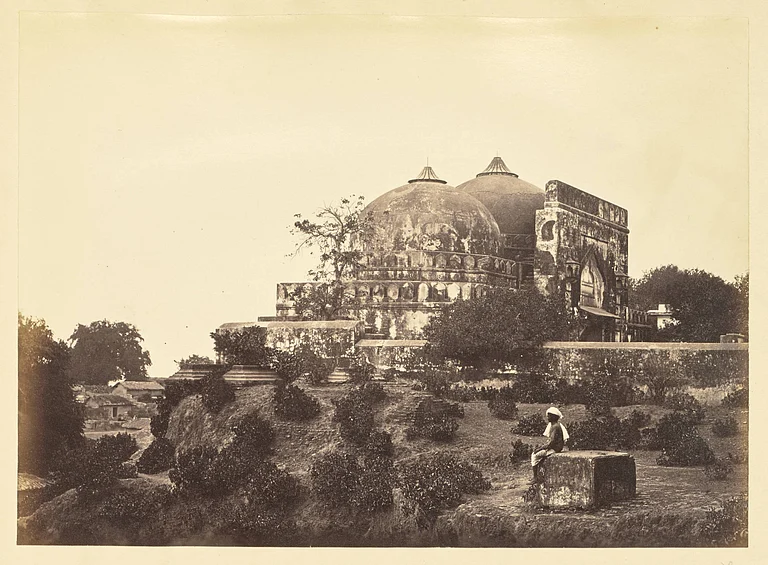
Before we progress with the review, here’s a harmless piece of industry gossip intended to provide some comic relief for this dark subject.
At the time, India Today was a fortnightly magazine. The publishing pace of today, compared to that era, is like comparing the time it took for journeys by ship with modern air travel. The magazine's actual date of hitting the stands, the 15th of the month for that fortnight, was moved up by a couple of days to catch the news while it was hot. To do that, the editorial office had to release the forms—16 or 32 magazine pages comprise a form—to the printing press a few days early. By the time Panjiar’s film roles arrived and were processed, the form carrying that fortnight’s cover story on the Babri demolition had been already released. The next best option for the demolition pictures to appear was to catch the magazine's regional-language edition, which was put to bed a few days later.
Advertisement
India Today, where I did a short stint during those months, used to be a very top-heavy organisation. There were just too many industry dudes prowling around. Turf wars between these editorial czars often mowed down the undergrowth. In this case, one of the big boys, along with his lackeys, tried to spike the publication of the demolition pictures in the regional-language edition, citing the absurd logic that the magazine would look silly if the flagship English edition didn’t have these exclusive photos while the language editions printed them. Panjiar wasn't the boss of the photography department, but he wasn't an undergrowth in the organisation either. The pictures ultimately appeared in the regional-language issues of that fortnight.
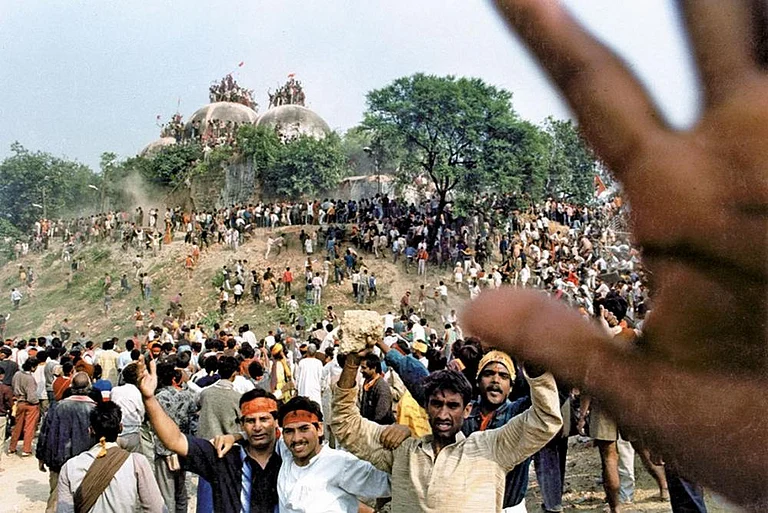
News photography is all about catching that one moment in 125th of a second, as the camera shutter opens and closes. A news photographer’s challenge is not so much about their reflexes or anticipation in capturing that moment. The biggest challenge—or one may well say—limitation, is that in order to take the picture, the photographer must be physically present where the moment took place, unlike, say, a writer or an illustrator. A photograph tells the story through the moment it has captured. The viewer has to know beforehand, or be told, the moment's context. A photograph is a rear-view image; it cannot be utopian or dystopian. That is the nature of the craft.
Advertisement
I have no quarrel with Panjiar's masterfully shot, evocative picture of Ayodhya, but telling the story of the ‘Epicentre of a Divide’ through one person’s camera lens is not physically possible. Several events before and after the demolition were captured on celluloid and digital formats, without which the story remains only partially told
Valay Singh’s accompanying essay at the end of the book cites the first trigger for the Ram Janmabhoomi-Babri Masjid dispute as the 1855 clash between Hindu Bairagis and Naga Sadhus belonging to the Vaishnava akharas and the Muslims of Ayodhya. Although it now appears from one of the many impolitic interviews by former Chief Justice of India D.Y. Chandrachud that, when the learned judge let go of the perpetrators of the criminal act of the Babri demolition, he felt empathy for the injustice done 500 years ago by a Mughal general.
Events shape our lives, and society moves on. Ayodhya has become a temple town, attracting a huge flow of pilgrimage tourism that contributes to the local population's economic well-being. One cannot grudge that. But one should also not forget what happened in Ayodhya. Panjiar’s book, and all other previous and future books, are important reflections of what we are than who we are.
Advertisement
(Bishwadeep Moitra is an independent writer and co-founder of the social enterprise Silaiwali)
Published At: