Ramayana released on November 5.
Nitesh Tiwari directed the epic adaptation.
Starring Ranbir Kapoor, Yash and Sai Pallavo, the VFX-heavy spectacle has divided audiences.
Ramayana’s VFX Verdict : Epic Scale Meets Digital Friction
The discourse around Nitesh Tiwari's Ramayana has been inseparable from the merits and weaknesses of its heavy VFX work

Summary
Backed by a ginormous ₹4,000 crore budget, heavy-hitting star power, and sprawling technical ambition, Nitesh Tiwari’s Ramayana: Part One has emerged a lightning rod for intense industry and fan scrutiny. The English trailer immediately suggested the film’s global ambitions by touting the "visual artists behind The Odyssey, Dune, and Interstellar", a deliberate nod to DNEG, the powerhouse VFX studio responsible for the visual effects in both Denis Villeneuve’s Dune franchise and Christopher Nolan’s Interstellar.
The VFX pedigree was flaunted in the run up to release. DNEG says it has won eight Academy Awards for Best Visual Effects since 2011, including awards for films such as Dune: Part Two, Tenet, Interstellar and Inception. So, expectations were suitably massive.
Audience Response To Ramayana's VFX Spectacle
Among general audiences, reactions swerved significantly between the pre-release promotional cycle and the theatrical debut. When the initial trailers dropped in mid-2026, social media was flooded with scepticism. Viewers accustomed to Hollywood franchises like The Lord of the Rings griped that the promotional clips looked overly glossy, flat, and unforgivably artificial. The backlash rose so sharply during the film's US promotional tour that, Ranbir Kapoor had to publicly push back against what he termed "CG critics" judging unfinished, compressed trailers on smartphone screens. Namit Malhotra, DNEG CEO, insisted the visuals were engineered specifically for IMAX 3D.

The visual effects register brightest in sequences that seamlessly intertwine the epic scale, motion, and geography. Audiences and critics singled out Ravana’s climactic clash with the mythical eagle Jatayu during Sita’s abduction as the film's highlight. A lot of praise was lavished also on the intricate design of Ravana's airborne chariot, Pushpak Vimaan.
However, creature design proved more polarizing. Khar-Dushan and Kumbhkaran were dismissed as distractingly artificial, echoing audience complaints that the asuras looked like a generic, indistinguishable puddle. The excess of digital effects often results in an indistinct bright blur. You can see tonnes of money have been spent, but a clarity in vision and a vivid sense of worldbuilding seem missing. This jars especially in the crowd scenes, like in the Swayamvar scene as scores of spectators laugh at the spectators.
Comparsions With Adipurush
Inevitably, every frame of the film was judged against the long shadow of Om Raut’s Adipurush (2023), a film whose notoriously rushed, video-game-like CGI and modern street-slang dialogue alienated audiences and nearly tanked big-budget mythological adaptations in India. Visually and tonally, Tiwari’s film was widely seen as a course correction. Whereas Adipurush relied on murky, dark-tinted environments, Gothic architecture, and a stylized, almost animated aesthetic that left characters severed from their surroundings, Ramayana opted for bright, saturated daylight palettes and photorealistic world-building crafted across 9,500 VFX shots over a 600-day post-production schedule.
Advertisement
Ramayana offers a more traditional take, a safer version. Yash’s Ravana, clad in traditional golden armor within an opulent, regal Lanka, stood in stark contrast to Saif Ali Khan’s leather-clad, buzzcut Lankesh riding a giant CGI bat, while DNEG’s feathered Jatayu dodged the plastic stiffness that beset Adipurush’s creature effects. While Adipurush was heavily ridiculed, Ramayana fared much better.
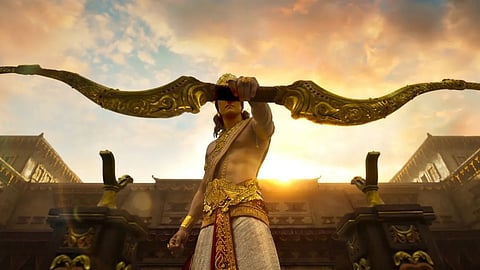
Ranbir Kapoor In Ramayana IMDB
Critical Reception Of The VFX
But the critics weren't so eager. A slew of major Indian and Western critics argued that Ramayana's technical ambition often outstrips its artistic cohesion. The Quint described the movie as “cinema that is rendered,” alluding that the excessive digital effects left the film barren. The harshest assessment came from IGN’s Siddhant Adlakha, who scored the film 4 out of 10, slamming the CGI an “eye-sore” and the action “clunky,” comparing its aesthetics unfavorably to the much-mocked floating-head effects of Marvel’s Thor: Love and Thunder.
In his review, Mint Lounge's Uday Bhatia emphasised the compositions looked "lifelike and lifeless", mentioning their "uncanny sheen" and "empty grandeur". In the Panchavati forest sequences, viewers noted an artificial "shine" and hyper-saturation, pointing out unnatural lighting, skies that looked painted on, and forest floors conspicuously devoid of fallen leaves or organic grime.
Advertisement
The monster fights also drew sharp criticism despite Jatayu’s acclaim. Early forest skirmishes involving demonic creatures left many unimpressed, with viewers specifically citing sequences of Rama's numerous forest battles.The symphony between live-action actors and digital beasts struck many as listless.

One of the film's cinematographers, Pankaj Kumar, put this visual artifice down as intentional. Speaking to The Hollywood Reporter India, he insisted, "See, if we shot Ramayana in a real jungle, the world would look very real, but maybe that’s not what we’re looking for. We want our world to look more enhanced, better than the real forest. For the forests that Ram and Lakshman are walking in to fight demons, realistic trees in the jungle may not give us that larger-than-life experience, with giant monsters attacking and our characters swinging from one tree to the other. Where is realism in that? There is no realism in that. You are giving a fantasy world to the audience. So why be a stickler for realistic-looking leaves or branches? It’s just a different medium of expressing yourself."
Advertisement
Debates over the VFX have to recognise the due value of composition and geography. Ramayana tends to be imprecise in this, rendering a spectacle that soars occasionally but also appears visually flat in large stretches.
Published At:
Tags