Shenpenn Khymsar’s 2026 film follows the Chushi Gangdruk resistance movement.
Tenzin Dhondup and Thupten Chukhatsang lead a largely Tibetan cast.
The film examines Tibetan identity, Buddhist faith, and resistance.
4 Rivers 6 Ranges Review | A Resistance To Remember And A Responsibility To Never Forget
4 Rivers 6 Ranges is a powerful, uneven account of Tibetan resistance, carried by strong performances and a deeply affecting moral conflict.

Summary
Shenpenn Khymsar’s 4 Rivers 6 Ranges: Chushi Gangdruk begins with our protagonists fighting through their village and killing Chairman Mao's invaders in a single take. There is something immediately disorienting about the scene. The camera stays with them and allows the moment to unfold in its raw form. From there, the film settles into its world slowly, almost claustrophobically. You know where this is going. You know that the people on screen are walking towards an impending doom, and the film makes you sit with that knowledge.
Shenpenn Khymsar assembles a largely Tibetan cast, with Tenzin Dhondup leading as Gonpo Tashi and Thupten Chukhatsang as Kunga Samten, his closest aide. Tashi Kalden plays the young 14th Dalai Lama, while Tenzin Jigmey, Robert Lin, Tenzein Choden and Pema Tsamchoe appear as Norbu, General Tang, Namgay Doma and Amo respectively. The performances carry much of the film. Chukhatsang’s Kunga is stoic, courageous, and above all, human. His fear is visible. So is his humanity. The actor understands that courage has little meaning without the possibility of fear.
The film begins with the parallel between two councils. The young Dalai Lama sits with his advisers and the revolutionaries sit together to decide their next move. The two rooms are separated by circumstance, ideology and responsibility, yet both are confronting the same question: what happens to Tibet now? The Dalai Lama is still a teenager. He is revered as the incarnation of the divine, while also being a frightened young man faced with the responsibility of an entire civilisation. Everyone around him looks towards him for direction. He has to absorb the fear of an entire people while carrying his own.
The film understands the strange burden of that position. There are moments when the young Dalai Lama simply looks like a boy. Then the weight of everything around him returns. In one scene, even he is shown carrying a rifle. It is a striking image because of the person holding it, and because of everything the image says about the circumstances surrounding him.
Advertisement
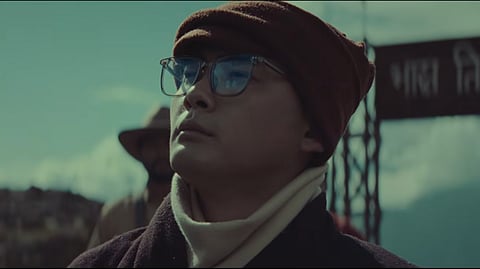
A Still Of Dalai Lama YouTube
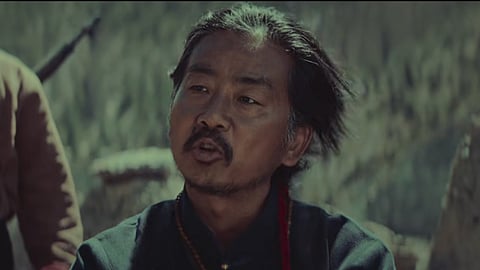
This film also places the Tibetan resistance within the larger history of the Cold War. The presence of the United States and the CIA, and the politics of anti-communism and the Red Scare, form part of the world in which Chushi Gangdruk emerged. There are echoes here of other anti-colonial and anti-imperial rebellions in South Asian history. The film evokes parallels with the Sanyasi Rebellion, Bankim Chandra Chattopadhyay’s Anandamath and the Chittagong uprising. There is a familiar historical pattern in which a people, faced with the destruction of their political and cultural existence, reach the point where resistance ceases to be an abstract question, and that is where the film becomes particularly interesting.
A Still From 4 Rivers 6 Ranges YouTube
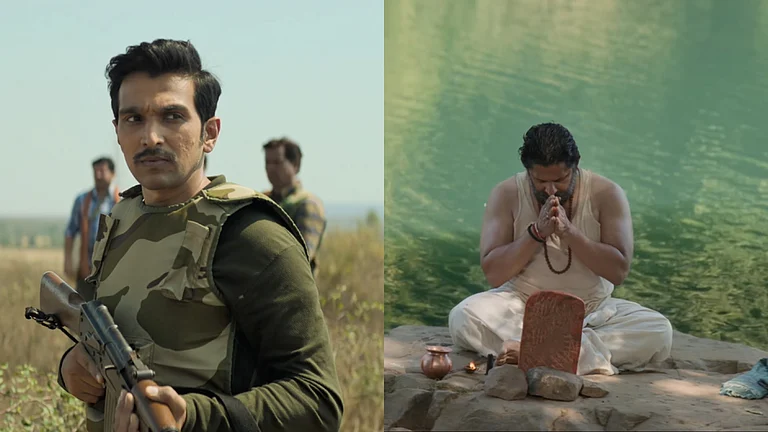
Its central tension lies between the Tibetan resistance and Chinese occupation, and between the fight for freedom and the Buddhist principle of non-violence. It exists within the resistance itself. What does a Buddhist do when the principles by which he has lived appear to conflict with what he believes his people require of him?
Advertisement
The film refuses to make the answer comfortable. In one scene, the revolutionaries debate their use of himsa against their Buddhist commitment to ahimsa. Gonpo Tashi says that he is no longer a Buddhist because he has killed. Yet he is prepared to sacrifice his own humanity for the right of his people to determine their own future. He embodies the spirit of planting a tree, the shadow of which he'll never sit in. The language of the film repeatedly returns to the preservation of dharma, culture, identity, a way of life and an entire civilisation.
The distinction between pacifism and servitude becomes important here. Pacifism cannot automatically be equated with simply accepting whatever is done to you. The film argues that there are circumstances in which resistance itself becomes a moral obligation; it becomes Dharma.
The Buddhist monk who joins the resistance is perhaps the clearest expression of this idea.
Advertisement
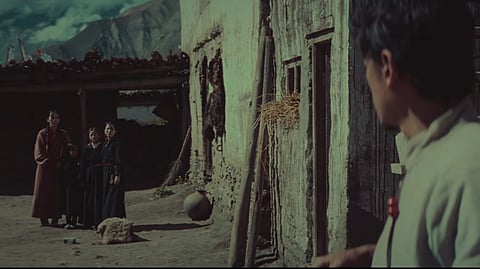
Before firing a gun for the first time, he recites a Buddhist sukta. There is no triumph in the moment. He does not celebrate what he is about to do, nor does he appear to hate the person he is about to kill. He carries non-attachment within him. He asks for the suffering of both himself and those who will die by his hand to come to an end. He knows what he is about to do. He knows why he is doing it.
That scene stayed with me because the film does not turn him into a contradiction for the sake of drama. He does not have to abandon his spiritual framework to understand the necessity he sees before him. The violence remains terrible. The act remains violent. Yet the character's relationship with it is neither celebratory nor condemnatory. He understands.
A Still From 4 Rivers 6 Ranges YouTube
There are interesting historical echoes in that idea too. South Asian traditions have repeatedly wrestled with the question of righteous violence. 4 Rivers 6 Ranges approaches the same question through a people facing the possibility that their civilisation itself may disappear. Gonpo Tashi embodies that dilemma differently. His decision is harsher. If preserving his people requires him to surrender his own conception of himself, he is willing to do it. That is what gives the resistance its tragic quality. These men know that they are fighting a battle in which the odds are overwhelmingly against them.
Advertisement
The film also carries the sense of a people trying to let go of the monk avatar that the outside world has come to associate so completely with Tibet. The image of Tibet as purely peaceful, spiritual and detached from worldly conflict becomes inadequate once the historical circumstances of the resistance are placed on screen. The rifles, the ambushes, the arguments and the blood are all part of the same history.
A Still From 4 Rivers 6 Ranges YouTube
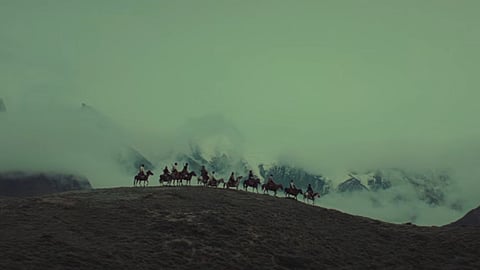
The visual language reinforces that feeling. The mountains are enormous, but the characters often seem trapped inside them. The film is slow and at times cluttered. Its Hindi dubbing can be clunky, particularly in dialogue-heavy stretches. There are moments where the pacing begins to test your patience.
Yet the slowness also has a strange effect. It makes the film feel enclosed. You spend enough time with these people to inhabit their anxiety. The film gives you room to breathe in the fear, the uncertainty and the rage. When violence eventually arrives, it feels like an eruption from a pressure that has been building for a long time.
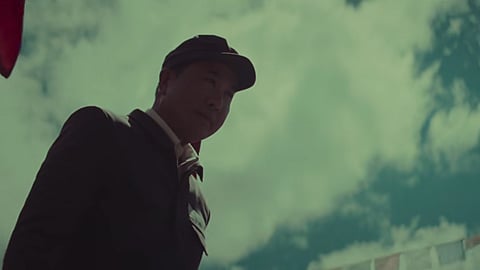
Robert Lin’s General Tang has an almost Inglourious Basterds quality to him, particularly in the way the character’s presence creates an atmosphere of menace whenever he enters the frame. He feels like someone who belongs to a different cinematic register from the resistance fighters, which makes his scenes stand out.
A Still Of General Tang YouTube
The first scene with Kunga and Norbu, the parallel councils, the monk preparing to fire his first shot, and the image of the teenage Dalai Lama with a rifle all belong to the same larger idea. The film is asking what people become when history leaves them with choices they never wanted to make.
That is what makes 4 Rivers 6 Ranges intellectually and emotionally engaging despite its unevenness. It is beautifully shot, the cast is impressive, and the performances give the resistance a human face. More importantly, the film gives its characters room to be frightened, conflicted and angry. They are not monuments to a lost cause.
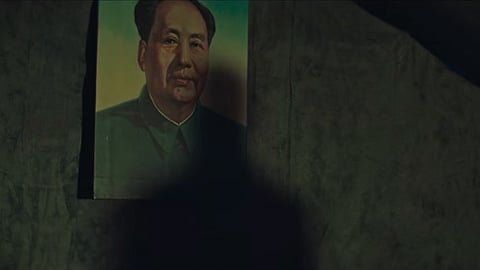
You watch the film knowing that these people are moving towards something terrible. The tragedy is already there in the landscape, in the faces of the characters and in the knowledge of what eventually happens. By the end, the film feels like an attempt to preserve the memory of people who chose to resist when resistance demanded an enormous price.
For all its pacing problems and occasionally awkward dialogue, 4 Rivers 6 Ranges succeeds in making that resistance feel lived. It lets you stay with the fear. It forces you to sit with the moral discomfort. And it leaves you with the question the characters themselves cannot escape: what does a civilisation owe to its own survival when the price of survival is blood?
A Still From 4 Rivers 6 Ranges YouTube
People know Gaza, Sudan, Yemen and Syria. Their suffering has entered our collective consciousness, however imperfectly. Perhaps, somewhere along the way, we have forgotten Tibet. The countless lives massacred. A civilisation destroyed. A civilisation taken away. So many deaths, so much pain, so much anguish, carried across generations. This is why 4 Rivers 6 Ranges is important. So that we may remember. So that the resistance of those who fought, suffered and died does not disappear into the footnotes of history. For the thousands of lives destroyed. For the humanity destroyed.
In the film, Gonpo Tashi says that of the six realms, perhaps humans are the worst, yet across all six realms, only humans possess the ability to hope, and the ability to turn that hope into the possibility of a better future. Perhaps that is what this film ultimately leaves us with.

The responsibility to remember, and the hope that one day Tibet will be free. Free Tibet. Now and forever.
Published At: