Andha Yug reimagines the Mahabharata’s aftermath to reflect the moral collapse and normalised violence of the modern world.
Ashwatthama embodies the destructive cycle of revenge, symbolising how violence erodes moral and human boundaries.
The play presents guilt as collective and enduring, warning against passive complicity and urging humanity to confront the horrors of war.
From Mahabharata to Hiroshima: The Wilful Darkness of 'Andha Yug'
In a post-war world marked by rising inequality and normalised violence, Dharamvir Bharati’s Andha Yug appears uncannily prophetic. The play reimagines an ancient tale as a modern tragedy, where moral and political collapse leads to an “Andha Yug”—a blind age defined not by incapacity, but by a wilful refusal to confront the horrors of war.
Summary
Andha Yug by Dharmvir Bharati, first published in 1953, appeared as a profound response to the moral catastrophe of the twentieth century, particularly the atomic bombing of Hiroshima and Nagasaki in 1945. In the shadow of such unprecedented destruction where humanity witnessed its own capacity to erase entire civilization, Bharati turns to the aftermath of the Mahabharata war in classic Indian epic.
In the unfolding dramatic post-world war world marked by rising global inequality and ethnic violence when even the word violence had itself normalised, even justified as a sign of progress, Dharmvir Bharti’s Andha Yug appeared uncannily prophetic. The play transforms an ancient tale into a modern tragedy, where moral and political failure descends into an “Andha Yug”—a blind age, not as stigma or physical incapacity, but a wilful refusal to confront horrors of war.
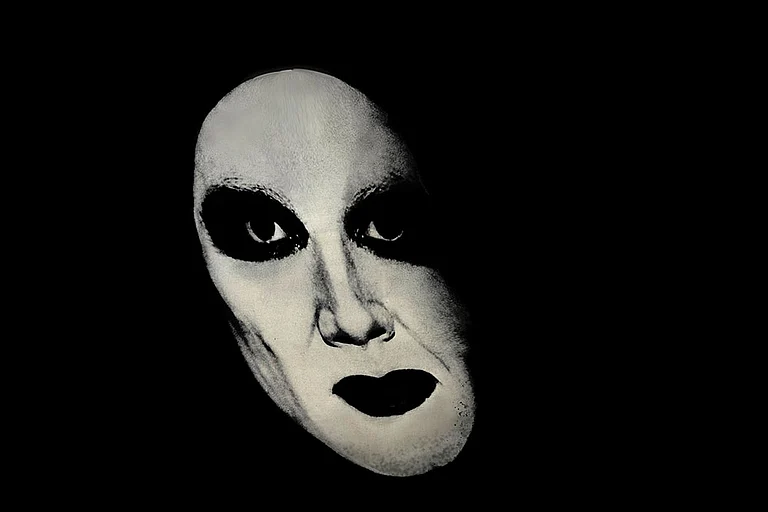
Blending Sanskrit theatrical elements with modern experimentation such as fragmented, episodic structure, Dharmvir Bharati’s five- part verse play created a poetic, symbolic, and theatrically powerful form that reshaped post-independence Indian theatre. Breaking away from traditional heroic and realistic modes, Andha Yug redefined theatrical aesthetics by transforming myth into a reflective and performative medium, and immediately gained popularity for its striking stage power and contemporary relevance.
Informed by European modernist and existential thought, and shaped by the horrors of partition, Bharati reconfigures the idea of a singular villain into a paradigm of collective guilt wherein every figure in the Mahabharata- through action, silence, or moral compromise stands complicit, thereby burring the boundary between dharma ( moral duty) and adharma (moral disorder).

At the core of the play is Ashwatthama a figure of revenge and violence. Grief-stricken by the deceitful killing of his father, the warrior-sage Dronacharya, by the Pandava, he succumbs to vengeance and, in blind fury massacres their sleeping sons in the camp. His rage culminates in unleashing the Brahmastra- evoking nuclear annihilation- against Uttara, Abhimanyu’s pregnant wife, to destroy her unborn child, the Pandava’s last heir, transgressing all codes of war and humanity. Thus, it is no surprise that Dharamvir Bharati opens the play by foregrounding the theme of moral blindness, articulated through the Sutradhar (Narrator), who declares:
Advertisement
This blind age has descended,
where situations, mentalities, and souls are all distorted.)
(“Yah andha yug avtarit hua,
jismein sthitiyan, manovrittiyan, atmaen sab vikrit hain—”)
This is not merely a description of a historical moment but a diagnosis of a condition that persists even in the contemporary world. Bharati suggests that such blindness is self-imposed, arising from fear, ambition , and the desire to avoid responsibility. This collapse of moral vision is further intensified in the voice of Gandhari, mother of Duryodhana and Kauravas, whose lament exposed the absence of moral order-
“Maine kaha tha Duryodhan se—
dharma jidhar hoga, udhar jay hogi;
dharma kisi or nahin tha…”
(“I had told Duryodhana—where there is dharma,
there shall be victory;
yet dharma was nowhere to be found.”)

Gandhari, the queen of the blind king Dhritasrashtra, who, in act of austere devotion, chose to veil her eyes and share in her husband’s blindness, arrives at a devasting realisation that dismantles the very logic of war. If dharma is absent, the distinction between right and wrong collapses. In such a world, victory becomes an illusion, and what remains is only collective grief. Bharati refuses to isolate responsibility within individual characters. Instead, he presents guilt as diffused across society, suggesting that moral failure is shared condition- an awareness the warring nations of the contemporary seem to have lost.
Advertisement
Bharti thus anticipated a modern ethical dilemma- the problem of passive spectatorship in the face of violence. Similar concerns appear in the work of philosophers like Jürgen Habermas, whose reflections examine the ethical consequences of collective silence and inaction during genocide in Germany. The psychological depth of the play is most evident in the central character of Ashwatthama who embodies the destructive continuity of revenge:- “Main kya karunga?
Haay main kya karunga?
Vartamaan mein jiske
main hoon—aur meri pratihinsa hai!”
(What shall I do? Alas, what shall I do? In this present, all that remains is myself—and my revenge.)
Advertisement
Ashwatthama ’s crisis is existential. His identity collapses into a single impulse- revenge. In Freudian and Jungian terms, Bharati reveals how violence reshapes our consciousness, reducing the complexity of human emotion to a singular, destructive drive. Revenge becomes both a justification and a prison. It offers the illusion of purpose while simultaneously eroding humanity. In this sense, Ashwatthama is not merely a character but a symbol of a civilisation trapped in cycles of retaliation. This cycle reaches its ultimate expression when Krishna punishes Ashwatthama by removing the divine gemstone from his forehead and pronouncing a devasting curse in a language of unparalleled severity:
“Tu jeevit rahega, Ashwatthama—
anant kaal tak,
apne paapon ka bojh uthaaye—
akela, bhatakta hua.”
(“You shall live, Ashwatthama—for eternity, bearing the burden of your sins, alone and wandering”.)
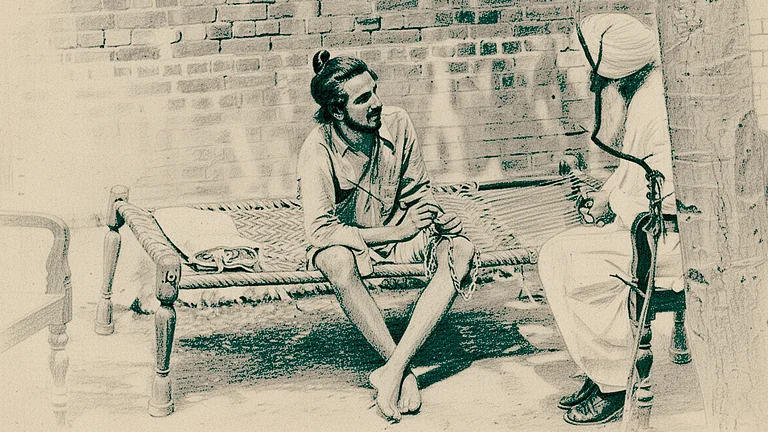
Krishna’s curse for violating the moral taboos of using weapon of mass destruction transforms the narrative from mythic conflict into a terrifying post-apocalyptic vision of existential despair. Ashwatthama’s immortality, once a blessing, becomes an ageless punishment: his wounds never heal—forever raw and burning—his body stained with blood as he wanders through deep forests and unending ages, festering and bound in clinging rags, condemned to live on. This idea resonates strongly with post-war realities, where survivors must live with memory, trauma, and moral ambiguity. Therefore, Bharati’s vision aligns with a broader philosophical understanding of history as cyclical, where humanity repeatedly confronts its own destructive tendencies, as reflected in the ongoing conflicts in Ukraine and the Middle East. And as a poet, overcome with a quiet helplessness, I close with Bharti’s final, unsettling utterance:
Advertisement
“Kya koi sunega,
jo andha nahin hai, aur vikrit nahin hai,
aur maanav bhavishya ko bachayega?”
“Will anyone listen—
one who is neither blind nor distorted—
one who can still save the future of humanity?”
The question lingers, unanswered—echoing across time, as haunting today as ever.
Ashwani Kumar is a poet, political scientist and professor in Mumbai. His most recent book is Map of Memories (2025)
Published At:
Tags