Swarn Samaj activists gheraoed the Himachal Pradesh Secretariat in Shimla on October 22 after a 600-km march.
The regulations established mandatory mechanisms to address discrimination in higher education.
The Supreme Court placed the 2026 regulations in abeyance on January 29, restoring the 2012 framework temporarily, while the Centre reconsiders the disputed rules.
In Himachal Pradesh, UGC Equity Rules Spark Anger And A Clash In Shimla
The Shimla clash is the latest flashpoint in a dispute that has already triggered campus clashes, protest bans and competing political endorsements across India

Summary
A 600-kilometre foot march lasting 21 days ended in confrontation outside Himachal Pradesh’s state Secretariat in Shimla on October 22, 2026, as hundreds of activists from the Swarn Samaj community tried to breach its gates. Police responded with water cannons and force to disperse the protesters.
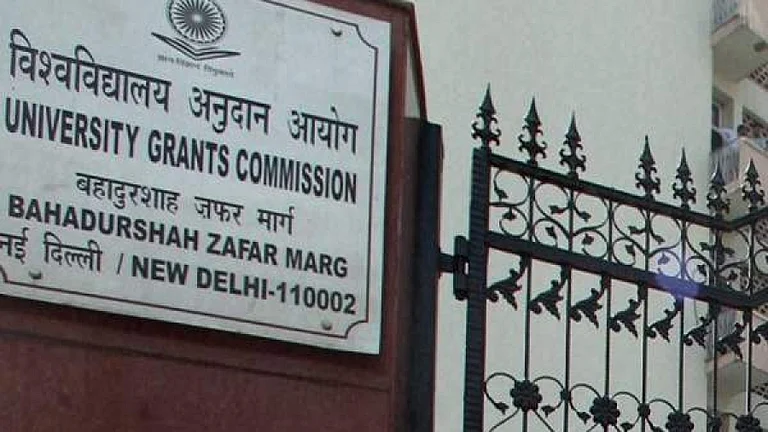
At the heart of the agitation were not state laws, but the University Grants Commission’s Promotion of Equity in Higher Education Institutions Regulations, 2026 — central rules that have remained in legal limbo since January.
The Shimla clash is the latest flashpoint in a dispute that has already triggered campus clashes, protest bans and competing political endorsements across India.
What Happened At The Shimla Secretariat?
Protesters linked to the Rashtriya Devbhoomi Party and the Rajput Karni Sena converged on the Himachal Pradesh Secretariat in Chota Shimla as the 'Swarn Samaj Ashwamedh Nyay Yatra' — a march that began in Himachal Pradesh on October 2 and covered 600 km over 21 days as the fourth phase of a nationwide Swarn Samaj campaign — reached its final stop.
As demonstrators pushed toward the Secretariat, the situation turned tense; protesters broke through part of the gate, and police responded with water cannons and what officials described as mild force to disperse the crowd, bringing traffic in Chota Shimla to a standstill.
What Do The UGC Equity Regulations, 2026 Say
Notified by the UGC on January 13, 2026, and often called the Anti-Discrimination Rules, the regulations replaced a largely advisory 2012 framework with an enforceable mechanism. Every higher education institution must now set up an Equal Opportunity Centre and an Equity Committee, chaired by the institution's head (or by the Centre's coordinator if the complaint is against the head), with mandatory representation from OBC, SC, ST, persons with disabilities, women, faculty, students and civil society. Complaints must be acted on within 24 hours, and institutions that fail to comply risk losing NAAC accreditation, UGC funding, or facing other regulatory and even criminal consequences.
Advertisement
The regulations trace directly back to a 2019 Supreme Court petition filed by Radhika Vemula and Abeda Salim Tadvi — the mothers of Rohith Vemula and Payal Tadvi, students whose deaths were linked to alleged caste-based discrimination on campus — seeking stronger, enforceable safeguards after years of inadequate implementation of the 2012 rules.
Why Do General-Category Groups Oppose The Regulations?
The objection centres on Clause 3(c), which defines "caste-based discrimination" specifically as conduct directed at SC, ST and OBC students, without naming general-category students within that definition. Petitioners' lawyers argued this created a structurally exclusionary mechanism, noting that a separate clause, 3(e), already defines "discrimination" broadly enough to cover religion, race, caste, gender, place of birth and disability — raising the question of why a narrower, group-specific clause was needed at all.
Critics said the narrower definition effectively institutionalised victimhood on one side while denying general-category students equal access to the same dedicated grievance mechanism, and warned it was vague enough to be misused against them. In Himachal, that objection has taken a sharper, more political form: groups like the Rajput Karni Sena and Rashtriya Devbhoomi Party want not just a rollback of the regulations but a new "Swaran Aayog," modelled loosely on the protections offered under the SC/ST (Prevention of Atrocities) Act, to address what they describe as the economic, educational and social challenges facing economically weaker sections of the general category.
Advertisement
Why Do SC/ST/OBC Groups Back The Regulations?
Supporters argue the regulations finally give teeth to protections that existed only on paper for over a decade, pointing to the repeated, documented failure of the 2012 advisory framework to prevent discrimination-linked student deaths, including those of Rohith Vemula in 2016, Payal Tadvi in 2019 and Darshan Solanki in 2023.
They note that Clause 3(e)'s broader definition remains available to general-category students for other forms of discrimination, so Clause 3(c) does not strip them of protection — it simply names, explicitly, the groups that institutional data and judicial findings have repeatedly identified as structurally most vulnerable to caste-based discrimination in Indian academia. BSP chief Mayawati publicly backed the regulations in January, calling rollback demands "completely unjustified" and urging political leaders to avoid stoking social tension, while student groups including AISA and JNUSU organised an "Equity March" at Delhi University in February demanding full implementation rather than dilution.
Advertisement
What Is The Regulations' Current Legal Status?
On January 29, 2026, a Supreme Court bench led by Chief Justice Surya Kant and Justice Joymalya Bagchi placed the 2026 regulations in abeyance, invoking Article 142 to revive the 2012 regulations in the interim, while hearing three writ petitions challenging the rules' constitutionality. The Court described Clause 3(c) as "prima facie vague" and "capable of misuse," repeatedly asking why it was needed given Clause 3(e)'s existing scope, and suggested the regulations be revisited by a committee of eminent jurists.
Hearings continued through the year — the Court gave the Centre four more weeks to respond in August — and in a hearing roughly two months ago, Solicitor General Tushar Mehta told the bench the Union government was itself reconsidering the regulations, prompting the Court to defer formulating the questions for determination until that process concludes. As things stand, the 2026 regulations remain in abeyance, the 2012 regulations continue to operate nationwide, and no final ruling on constitutionality has been made.
Advertisement

How Does Himachal Fit Into The National Protest Pattern?
Since the January notification, the dispute has played out largely on campuses: Delhi University saw student-group clashes in February that led to a month-long ban on protests and gatherings of five or more people, a historian was attacked mid-speech during the unrest, and Banaras Hindu University issued show-cause notices to student leaders over a signature campaign supporting the regulations.
Shimla's protest marks a distinct escalation of the same fight into direct state-capital politics, organised not by students but by a dedicated general-category political outfit explicitly targeting a state government on an issue that, as organiser Rumit Singh Thakur himself acknowledged, does not fall within the state's own jurisdiction — he said the goal was simply to have the government and opposition amplify their concerns. Thakur also used the Shimla rally to position the Rashtriya Devbhoomi Party as a prospective "third alternative" in Himachal's 2027 Assembly election, giving the protest a clear electoral subtext specific to the state.
Who Protested In Shimla, And What Did They Want From The State?
The march and gherao were organised by the Rashtriya Devbhoomi Party together with the Rajput Karni Sena and allied Swarn Samaj associations. Beyond the rollback demand, protesters wanted the Himachal Pradesh government to formally receive a memorandum and establish a state-level Swaran Aayog to study the economic, educational and social challenges facing economically weaker members of the general category, alongside broader calls for stronger legal protections for the Swarn Samaj community, explicitly modelled on protections already available to SC and ST communities.
What Are The Competing Versions Of The Clash?
Organisers framed the gherao as the peaceful culmination of a legitimate, 21-day campaign that turned tense only once demonstrators tried to move toward the Secretariat to deliver their memorandum, with reports describing protesters breaking part of the gate in the process.
Police, for their part, said water cannons and mild force were used specifically to disperse the crowd once it pressed toward the building, framing the response as a proportionate reaction to the attempted breach rather than an unprovoked crackdown. One detained activist was released after a state minister intervened, telling police he stood with the protesters — a detail suggesting at least partial political sympathy toward the demonstrators within the state's own ruling establishment, even as its police force used force to hold the line at the gate.
What Comes Next?
At the national level, the matter now rests on the Centre's own reconsideration process, which has no public deadline; the Supreme Court has deferred framing the constitutional questions at stake until that process concludes, meaning the 2012 regulations will likely remain the operative framework for some time yet. In Himachal specifically, it is unclear whether the state government will act on the memorandum or commit to a Swaran Aayog, given that the underlying UGC dispute sits outside its own jurisdiction.
What does seem likely is that the issue will keep resurfacing — through further Supreme Court hearings tied to the Centre's reconsideration timeline, through renewed campus friction wherever the regulations' fate becomes concrete again, and, in Himachal, through the Rashtriya Devbhoomi Party's evident ambition to turn Thursday's gherao into a recurring campaign theme ahead of the state's 2027 Assembly election.
Published At: