India seeks a competitive edge before signing the US trade agreement.
Piyush Goyal says tariff certainty is crucial for India-US trade deal.
US tariff changes force negotiators to revisit the bilateral trade framework.
What's Holding Up India-US Trade Deal? Piyush Goyal Explains
Speaking at the India Global Forum in London, Goyal listed Vietnam, Thailand, the Philippines, Indonesia, Malaysia and China as the competitors India must surpass

Summary
India will only sign a bilateral trade agreement with the United States when Washington guarantees a competitive edge over regional manufacturing rivals, Union Commerce and Industry Minister Piyush Goyal said on Thursday.
Speaking at the India Global Forum in London, Goyal listed Vietnam, Thailand, the Philippines, Indonesia, Malaysia and China as the competitors India must surpass. His remarks followed the conclusion of bilateral trade negotiations in India on Wednesday by a US delegation led by United States Trade Representative Jamieson Greer, according to Indian Express.
The original agreement relied on specific tariff reductions. These evaporated following legal changes in the US, forcing negotiators to find a new framework to protect Indian export interests.
Securing Competitive Advantage
The initial framework aimed to lower tariffs from 50% to 18%. This reduction was designed to give Indian exporters an advantage over competing ASEAN nations, excluding Singapore.
“The India-US deal was done on February 6th. It was confirmed by both the US and India. There were International Emergency Economic Powers Act (IEEPA) tariffs when we finalised the trade deal. We had negotiated the deal based on bringing down the 50% (tariff) to 18%. The whole deal was centred around that competitive advantage that we got with 18% over our neighbours and competing countries… lower than ASEAN countries other than Singapore,” Goyal said.
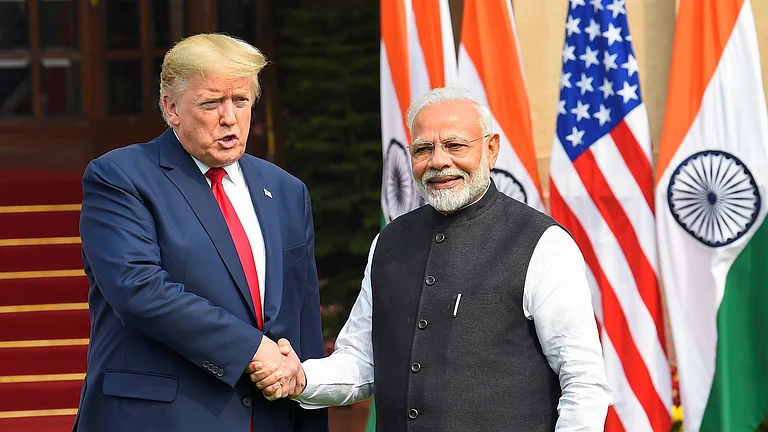
“With the US Supreme Court striking down the IEEPA tariffs, and now with the 10%, which expires on July 24, we have to have some reason to be able to enter into force that agreement which we have agreed upon,” he said.
“And until the framework of getting into the competitive advantage can be finalised, we cannot enter into a US deal,” Goyal said. “That is broadly the discussion on how the US will find the appropriate tools and legal backing to give us the competitive advantage over our competition. The day this happens, the deal is on,” Goyal said.
Global Tariff Shifts
The US Supreme Court ruled the IEEPA tariffs illegal in February. The decision rendered several US trade pacts unenforceable because reciprocal tariffs collapsed. Washington is now transitioning to a new tariff structure under Section 301 of the US Trade Act of 1974.
Advertisement
Meanwhile, the EU Thursday became one of the largest trading partners to enforce the US deal after the US Supreme Court in February this year ruled tariffs under the IEEPA illegal. Several US deals automatically became unenforceable by partner countries as reciprocal tariffs were no longer in effect.
Under the US-EU deal, the EU is expected to eliminate tariffs on all US industrial goods. It will also provide preferential market access for a wide range of American seafood and agricultural goods, including tree nuts, dairy products, fresh and processed fruits and vegetables, processed foods, planting seeds, soybean oil, and pork and bison meat.
The US, in turn, committed to apply the higher of either the US Most Favoured Nation (MFN) tariff rate or a tariff rate of 15 per cent. This rate comprises the MFN tariff and a reciprocal tariff on originating goods of the EU. But on June 18, the US opened a fresh Section 301 investigation on Germany, the EU’s largest economy.
Advertisement
Published At: