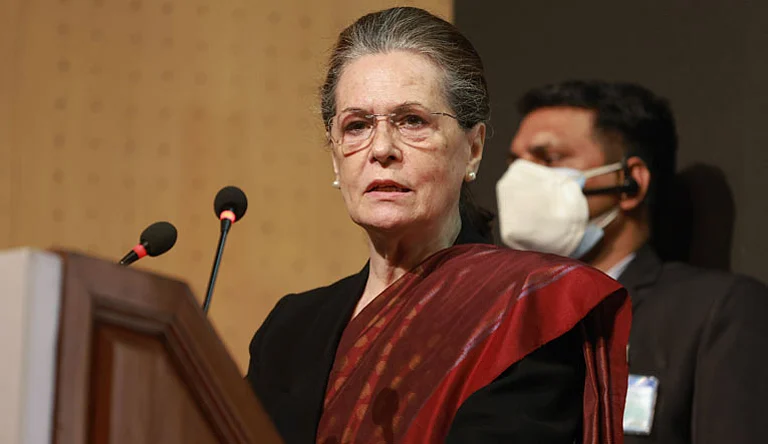
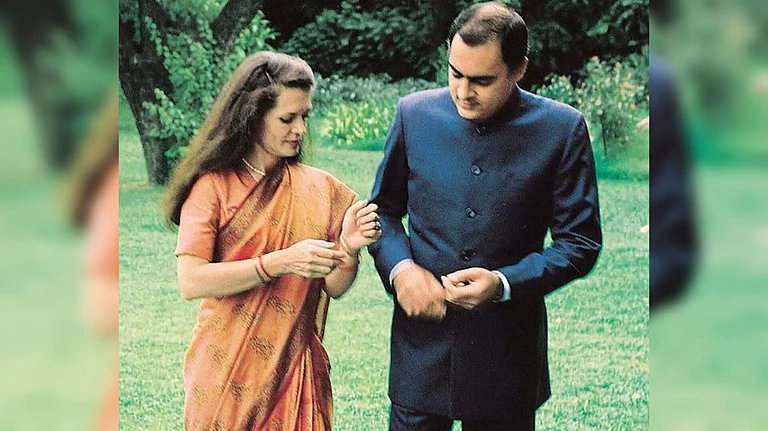
Sonia Gandhi’s memoir, Belonging: A Journey of Love, is framed by photographs taken 60 years apart: one by Rajiv Gandhi in Turin in 1966 and another by her grandson Raihan Vadra and his partner, Aviva Baig, in Delhi in 2026.
Gandhi recounts moving from Italy to India, marrying Rajiv and entering public life after his assassination in 1991.
The book revisits major events, including the Emergency, Operation Blue Star, the 1984 anti-Sikh violence, the Babri Masjid demolition and the UPA years.
Two Photographs, Six Decades: Sonia Gandhi’s Life Between Turin And Delhi
Between the cover and back portraits of the book, Gandhi traces a life shaped by migration, family, political upheaval and personal loss

Summary
Two photographs, taken 60 years apart, frame Sonia Gandhi’s journey from Italy to the centre of Indian politics. The image on the cover of her memoir, Belonging: A Journey of Love, was taken by Rajiv Gandhi in Turin in 1966, when she was 20. The photograph on the back was shot in Delhi in 2026 by her grandson Raihan Vadra and his partner, Aviva Baig.
Between those portraits, Gandhi traces a life shaped by migration, family, political upheaval and personal loss. “They pressed me, arguing that mine was an unusual story: of a girl from a small town in Italy transplanting herself to India,” she writes in the prologue, recalling how friends and relatives urged her to tell her story.

From Italy to India
The memoir begins in Cambridge, where Gandhi met Rajiv. Her father had doubts about her move to India, but bought her a return ticket. “If I didn’t like the place, or if people weren’t kind to me, I shouldn’t hesitate to fly straight back home,” she recalls him telling her.
She stayed. When she and Rajiv married in 1968, neither knew how dramatically their lives would change. Rajiv began working as a commercial pilot and had no plans to enter politics. His younger brother, Sanjay, was widely seen as the political heir to their mother, then prime minister Indira Gandhi.
Sanjay’s death in a plane crash and Indira Gandhi’s assassination in 1984 altered the family’s course. Rajiv entered politics and became prime minister. Seven years later, he was assassinated in a suicide bombing by the Liberation Tigers of Tamil Eelam in Sriperumbudur, Tamil Nadu.
Gandhi writes that Rajiv’s death thrust her into a political life she had disliked and resisted. She went on to lead the Congress for two decades and head the United Progressive Alliance during its 10 years in power, from 2004 to 2014.
The memoir revisits the Emergency, Operation Blue Star, Indira Gandhi’s assassination, Rajiv’s prime ministership, the Bofors controversy, his assassination, the demolition of the Babri Masjid, the UPA years, the BJP’s return to power under Narendra Modi and demonetisation.
Advertisement
The Life She Imagines They Might Have Had
In the epilogue, Gandhi looks back at the future she and Rajiv could have shared if he had remained a pilot. “In my dream we’d have grown old together,” she writes, imagining a life spent with their grandchildren and travelling in India and abroad.
She then returns to the life that unfolded: “He led the country. He was killed. I was propelled into a life I’d disliked and resisted.” Gandhi says she could not abandon her commitment to Rajiv’s vision for India. Working towards it, she writes, showed her “how deep a satisfaction lay in bringing about change and improvement in people’s lives.”
BJP Accuses Sonia Gandhi Of 'Whitewashing Historical Wrongs of Congress'
The memoir has also triggered a political dispute. BJP national spokesperson Pradeep Bhandari said its “underlying thinking throughout the book revolves around the Babri vote bank”. The BJP accused Gandhi of trying to justify the Emergency, remaining silent on the Bofors controversy and making claims about the 1984 anti-Sikh violence that it said were contrary to the facts.
Advertisement
BJP spokesperson C R Kesavan questioned Gandhi’s account of her response to the Babri Masjid demolition and asked whether she had shown similar grief for those killed in the 1984 violence. “Sonia Gandhi could have titled her memoir as ‘Whitewashing’ instead of ‘Belonging’,” he said, accusing her of seeking to “sugar-coat the historical wrongs” of the Nehru-Gandhi family and “justify and normalise the notorious Emergency”.
Congress Rajya Sabha member Rajeev Shukla rejected the BJP’s criticism, saying it was giving the book a “political spin”. “She has penned down all her thoughts. So, I think people should respect her thoughts, respect the sentiments that she has expressed. This should not be turned into a controversy,” he said.
Published At:
Tags