The UGC’s equity rules were rolled back after protests by upper caste groups, despite ongoing caste discrimination on campuses.
Student suicides have risen sharply, with SC, ST and OBC students facing disproportionate exclusion and harassment.
Data shows severe underrepresentation of marginalised communities in faculty posts, challenging claims of reverse discrimination.
The Higher, The Lower: India's Entrenched Caste Hierarchy Feels Challenged By UGC Guidelines
The recent University Grants Commission regulations advocating equity on campuses across the country were rolled back after unprecedented protests by upper caste groups.

Summary
The recent University Grants Commission (UGC) regulations advocating equity on campuses across the country were rolled back after unprecedented protests by upper caste groups. The logic given by the protesters was that their interests are being sacrificed. Certain sections of the media added fuel to the fire by claiming that Hindu society will be further divided. It is highly ironic that those who have enjoyed institutional privileges for centuries are voicing concerns against discrimination, purportedly against themselves. The fact of the matter is that caste is the bedrock of Hindu society. Post-Independence, affirmative action has made it possible for the Scheduled Castes (SCs), the Scheduled Tribes (STs) and the Other Backward Classes (OBCs) to access higher education. Over the years, as the UGC data itself reveals, many students from these social groups have been forced to commit suicide, unable to handle the toxic campus atmosphere.
A few years ago, the mothers of Rohith Vemula and Payal Tadvi—students who died by suicide due to caste-based discrimination on their campus—filed a public interest litigation (PIL) in the Supreme Court (SC) to seek justice. Similar incidents have also occurred in the Indian Institutes of Technology (IITs) located in Delhi and Mumbai. This prompted many individuals (including yours truly) to file additional information for the PIL. Taking cognisance of the gravity of the situation, the SC directed the UGC to formulate regulations for a safe and inclusive campus space.
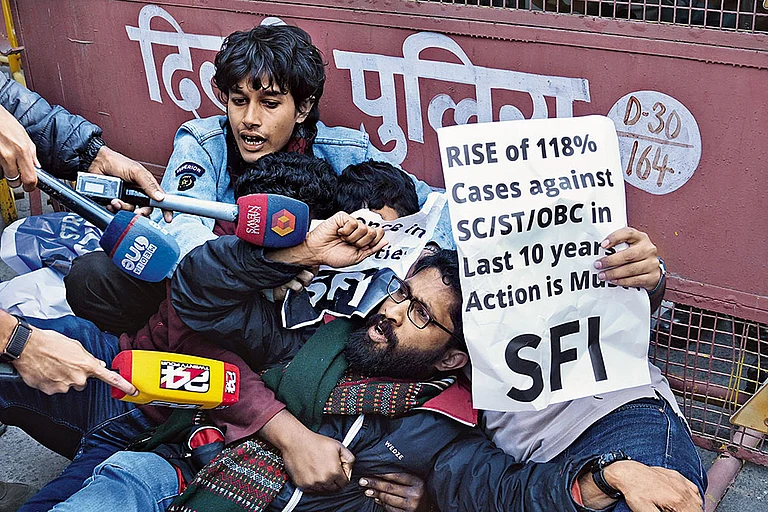
From 2013 to 2023, there has been an increase of 65 per cent in student suicides across the country, as per the National Crime Records Bureau (NCRB) data of 2025. It also reveals that students in residential schools and those from marginalised groups like SCs, STs and OBCs are more at risk. The figures are more alarming when we turn to the IITs. As a nation, we have failed to acknowledge the severe crisis underlying our higher education. Numerous committees have been formed, such as the Mungekar and Thorat committees, including institutional mechanisms to handle such issues, but to no avail. To illustrate, the Thorat committee in 2007 recommended academic and personal mentorship, remedial systems, support-system enhancement such as the setting up of SC/ST cells in academic institutions and legal measures similar to anti-ragging policies. Two decades later, we are still debating the same problems despite periodic directives issued by the UGC like the 2012 equity guidelines.
Advertisement
Hence, it is imperative that the problem is acknowledged and addressed without giving in to empty rhetoric. There exists academic scholarship on caste discrimination on campuses. There are multiple sites of such prejudices, like viva/interviews, assessments, fellowships, research environment, academic gatekeeping, campus administration, and semiotics of humiliation, which all contribute to a sense of alienation among SC/ST and OBC students.
An RTI filed by the Ambedkarite Students’ Association at the University of Hyderabad (UoH) found rampant discrimination during PhD admissions in 2023. For instance, in electronics, an OBC candidate who appeared for the PhD entrance test secured 40 out of 70 marks in the written exam, but was awarded only two marks in the interview out of 30 marks. Interestingly, a candidate from the unreserved category got 24.5 in the written test and 25 out of 30 in the interview—more than what he/she secured in the written exam. An SC candidate who secured 29.75 in the written got only two marks in the interview. In Applied Mathematics, a similar story unfolds. In the written exam, unreserved category students scored less than the SC/ST/OBC candidates. In the interview, the pattern reversed. For the SC/ST/OBC students, the interview marks were in single digits. Another RTI in 2022 reflects the PhD admission data of 13 Indian Institutes of Management (IIMs). Eight IIMs did not admit a single ST student; five IIMs did not admit a single SC student and IIM Nagpur and Shillong did not admit any SC/ST/OBC students.
Advertisement
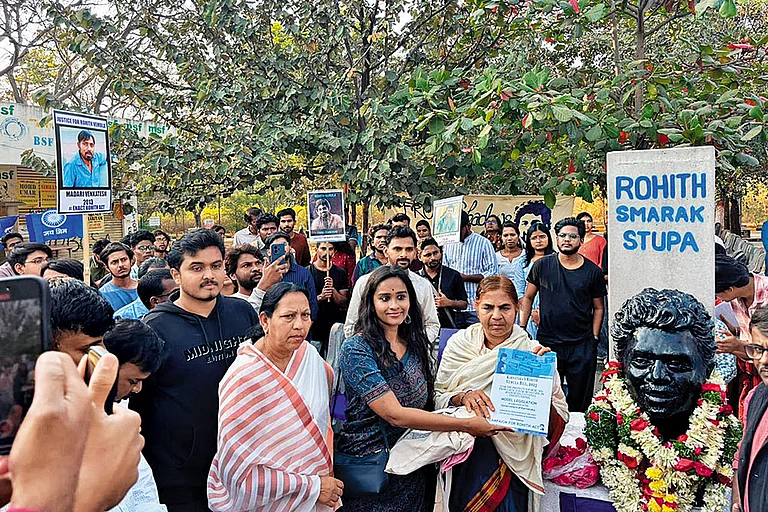
From 2013 to 2023, there WAS an increase of 65 per cent in student suicides across the country, SAYS the NCRB. students from marginalised groups like THE SCs, THE STs and THE OBCs are more at risk.
On June 30, 2025, the Ministry of Education (MoE) stated that the total number of sanctioned and filled positions in all the central universities reflected the skewed nature of faculty appointments from these communities. In IIT Delhi, of the 642 teaching positions, only 20 SCs, and eight STs were appointed in the assistant professor level till 2025. There is a shortfall of 11.9 per cent (76 SC positions vacant) and 6.3 per cent (40 ST positions vacant.) There is only one professor and associate professor from the ST category. The UGC furnished data from 2020 to 2024 regarding teaching positions in central universities. In the UoH, of the sanctioned 225 unreserved teaching positions, 284 have been filled! This includes assistant, associate and professors. So, the UoH has appointed an extra 59 positions in the unreserved category against the sanctioned strength. Neither the UGC nor the MoE has any issue with the violation of norms. In Delhi University, the total sanctioned strength of unreserved teaching positions in the departments is 707, and 625 (88 per cent) have been filled. For SCs, of the 257 positions, 117 (46 per cent) have been filled. For STs, of the 127 positions, only 53 positions were filled, a total of 53 per cent. Interestingly, for both OBC and Economically Weaker Sections (EWSs), there are 459 and 170 sanctioned positions, but only 152 (33 per cent) and 26 (26 per cent) have been filled respectively. Needless to mention, for people with disabilities, of the 57 positions, only 14 have been filled. A similar situation prevails in the Banaras Hindu University. For professors in the unreserved category, of the 102 sanctioned positions, 93 have been filled. For the SCs, only eight of the 33 positions; for the STs, only one of the 16; and, for the OBCs, only five of the 59 positions have been filled respectively. In the Jawaharlal Nehru University (JNU), there were no sanctioned positions for OBCs and EWSs at the professor and associate professor levels. However, five professors and 29 associate professors in the OBC category have been appointed. Additionally, there was no sanctioned post for EWSs at the assistant professor level, but four candidates were appointed. In IIM Indore, there are two OBCs and one EWS assistant professor of 150 total teachers. There are no SCs, STs and persons with disabilities. There are 106 teachers at all levels from the unreserved category. The data is only the tip of the iceberg as every higher education institution has similar stories to disclose when it comes to admissions and recruitments from the socially marginalised groups.
Advertisement

This begs the question: How are the upper castes feeling discriminated against when they are in the majority in terms of teaching, non-teaching and student strength on the campuses? The campus is now a contested space where new forms of political, social and ideological mobilisation are being played out. As the Dalit-Bahujan students and teachers speak out, the status quo gets challenged. The entrenched caste hierarchy feels that power is slipping out from their grasp. They control the state and its multiple organs, then how dare such laws be enacted which forces them to question their own privileges?
At the first sign of protest, the judiciary was ready to roll back the measures by using a legal stay. Apparently, the same bench directed the UGC to set up a task force to inquire into caste-based discrimination on campuses in 2025. The highest court in the land has acknowledged the problem, contemplated it and suggested a solution, but does not have the courage to follow through. A careful reading of the guidelines reflects that caste is only one form of discrimination—apart from gender, disability, ethnicity, race and place of birth. Even EWSs, which include socially privileged groups, are part of the larger equity umbrella.
Advertisement

Additionally, the UGC guidelines call for representation from these communities based on anti-discrimination. It is utopian to think that an assistant professor from the SC/ST/OBC communities, who is at the bottom of the academic hierarchy, can venture to censure a dean or a professor from the socially dominant groups or act against their wishes. If they speak out, their careers are at stake. The majority decision will prevail and the student or teacher who questions it would be targeted. As the data reveals, there is inadequate recruitment from these social groups in various institutions. There is zero accountability on the part of institutions when students kill themselves over various kinds of discrimination. Those who were accused in the cases of Rohith Vemula, Payal Tadvi, Fathima Latheef and many others are leading their lives, whereas the aggrieved families are still fighting for justice. Even after many years, they are yet to secure any form of closure. The current UGC Promotion of Equity in Higher Education Institutions Regulations, 2026, is an outcome of their sustained struggle.
The silence of the state and other political parties, even as civil society debates this issue, speaks volumes about their political interests. Social justice is rendered invisible in the marketplace of ideas. What is more appalling is the lack of basic decorum in public debates on this issue. Casteist slurs are levelled against various political personalities; obnoxious terms are used on social media against marginalised groups; and, vacuous decibels on television debates reflect the weaponisation of identities over the past decade. Many students who protested for the Equity Act to be retained have faced violence on campuses. It is essential to remember that these provisions are based on constitutional provisions which guarantee liberty, equity and the right to equal opportunity to every citizen.
(Views expressed are personal)
N. Sukumar teaches at the Department Of Political Science, Delhi University. He is the author of Caste Discrimination And Exclusion In Indian Universities: A Critical Reflection, routledge 2023. he wishes to thank kiran kumar goud for providing the data
This article appeared in Outlook's February 21 issue titled Seeking Equity which brought together ground reports, analysis and commentary to examine UGC’s recent equity rules and the claims of misuse raised by privileged groups.
Published At:
Tags