The BJP’s Bengal victory cannot be explained by SIR alone. In 86 of the 122 Trinamool-held seats that flipped, the BJP’s own increase in votes was large enough to overturn the 2021 margins even if AITC had retained all its earlier support, pointing to a genuine expansion of the BJP’s electoral base.
At the same time, SIR deletions remain politically significant in a smaller but important set of seats. In 31 constituencies, the number of non-death deletions exceeded the remaining vote gap the BJP needed to bridge, meaning the deletions may plausibly have influenced margins or outcomes in those contests.
While SIR alone did not decide the Bengal mandate, the scale of deletions and adjudications makes it difficult to dismiss concerns entirely, especially given the broader debate over wrongful voter exclusion, electoral integrity, and the need for cleaner voter databases.
The Bengal Mandate And The SIR Question: What The Data Reveals
An examination of vote swings, deletion patterns and electoral margins reveals a layered story behind the BJP’s landmark victory in West Bengal. Even if the Trinamool Congress had retained all its previous voters, the BJP would still have won enough seats to comfortably form the government.

Ending the Mamata Banerjee-led TMC’s 15-year rule, the Bharatiya Janata Party (BJP) stormed to power in West Bengal with a sweeping victory, winning 207 of the state’s 294 Assembly seats in what is arguably the party’s biggest breakthrough in eastern India.
But even as the scale of the BJP’s victory redrew Bengal’s political map, another issue shadowed the election throughout the campaign and after the results: the Special Intensive Revision (SIR) of electoral rolls.
The revision exercise, which was fiercely opposed by the All India Trinamool Congress or AITC and repeatedly attacked by Banerjee as a tool of “harassment” and disenfranchisement, became one of the most politically charged aspects of the election. The party had even moved the Supreme Court against the exercise, alleging that large-scale voter deletions disproportionately affected minorities and traditional Trinamool support bases.
Now, with the verdict delivered, the central question remains: did SIR alter the outcome of the Bengal election? The data suggests that the answer is neither simple nor absolute.
Where Does The Suspicion Come From?
The suspicion around SIR began months before the election results because a very large number of voters were either removed from the voter list or kept in an uncertain category, i.e., “under adjudication”.
The first major flashpoint came on February 28, when the Election Commission released West Bengal’s revised voter list after the SIR. The new list showed that 63.66 lakh voters had already been removed. This amounted to about 8.3% of the entire electorate, reducing the total number of voters in the state from around 7.66 crore to 7.04 crore.
At the same time, another 60.06 lakh voters were not fully cleared to vote. Instead, they were placed under adjudication, meaning the Election Commission was still checking whether they were eligible voters. Many people in this category reportedly received notices asking them to prove their citizenship, identity, or place of residence.
This created political controversy because opposition parties, especially the TMC, argued that lakhs of voters were left uncertain about whether they would be allowed to vote so close to the election. The Election Commission, however, said the exercise was meant to remove duplicate, shifted, dead, or otherwise ineligible voters.
The issue became even bigger in April, when the Election Commission announced the final outcome of the adjudication process. Out of the 60.06 lakh voters whose cases were being checked, 27.16 lakh were ultimately declared ineligible and removed from the voter list, while about 32.68 lakh were restored.
As a result, the total number of deleted voters rose to around 90.82 lakh, nearly 11.6% of West Bengal’s original electorate.
The BJP secured a statewide lead of 32.11 lakh votes over Trinamool. That margin was striking because it was of the same order as the number of voters whose names were under adjudication during the SIR process.
The contention was not limited to the 27.16 lakh voters who were ultimately declared ineligible after adjudication. Opposition parties also questioned a broader category of deletions, particularly “non-death deletions”: voters removed for reasons other than death, i.e., logical discrepancy, unmapped, permanently shifted, untraceable/absent, or already enrolled. These formed the disputed core of the SIR exercise.
Taken together, the scale of these contested deletions became impossible to ignore in the political debate surrounding the election. The question naturally followed: if the BJP’s winning margin itself was around 32 lakh votes, could the SIR have played a decisive role in TMC’s defeat?
At first glance, broader patterns in the data appear to strengthen the opposition’s argument. Constituencies with higher SIR deletions, both total deletions and non-death deletions, also showed sharper declines in TMC votes compared to the BJP’s vote decline. But correlation is not the same as causation.


For instance, several districts with high deletion rates, particularly the Maldah-Murshidabad belt, have long remained demographically favourable to the All India Trinamool Congress.
In the 2021 Assembly elections, the party dominated Murshidabad district by winning 20 of the 22 Assembly seats and securing nearly 54.5 per cent of the vote share. In neighbouring Maldah, the AITC won 8 out of 12 seats, a significant breakthrough in a region historically considered a Congress stronghold, while polling around 53 per cent of the votes. In many such constituencies, even substantial deletions would not have been enough to flip seats. This distinction is crucial because it complicates the sweeping claim that the SIR alone “caused” the BJP’s victory.
More importantly, elections in India are not decided by statewide vote aggregates. They are decided seat by seat. A statewide correlation between deletions and vote decline may indicate a pattern, but it cannot by itself establish electoral impact.
To understand whether the SIR materially altered the election outcome, the analysis therefore has to move beyond statewide trends to constituency-level contests: examining the intensity of deletions across seats, their victory margins in previous elections, and whether the scale of deletions in specific constituencies was large enough to plausibly flip the result.
Seats That Flipped
Before the 2026 Assembly election, the AITC held 214 of the 293 seats (in the 294-member Legislative Assembly) that went to polls. This time, 129 of those seats flipped to the BJP.
Of these 129 seats, the AITC saw its vote tally decline in absolute terms in 122 constituencies compared to 2021, a striking statistic that quickly fuelled allegations surrounding SIR-linked deletions.
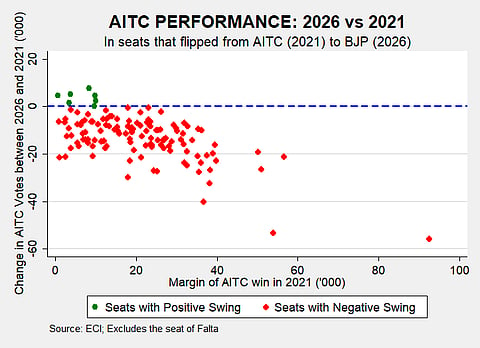
In order to understand the potential effect of the SIR on the AITC’s electoral prospects, we undertook a deep dive into constituency-level data, focusing on the 129 seats (out of 293 counted on May 4) that shifted from the AITC to the BJP. Since most allegations around the SIR centre on deletions potentially reducing the AITC’s vote base, we narrowed the analysis to seats where the party’s total votes actually fell.
A total of 122 constituencies met this criterion. It should be noted that even in the remaining seven seats (and, in fact, even in the 80 seats that the AITC won), the SIR may have played a role in the final outcome. However, this analysis focuses on seats where there may be more immediate concerns among those questioning the exercise.
The BJP Surge Beyond SIR
The analysis first isolates seats where any possible decline in AITC votes due to the SIR would ultimately not have mattered, i.e., where the gain in the BJP’s votes would have been enough to erase the 2021 margin.
Among the 122 flipped constituencies, the analysis found that the BJP’s own rise in support was large enough to independently overturn the 2021 margin in 86 seats.
In other words, even if the AITC had retained all its previous voters, the BJP would still likely have won these constituencies because of the scale of its own vote expansion.
The seat of Noapara illustrates this shift clearly. In 2021, the AITC had won the constituency by 26,710 votes. By 2026, the BJP had improved its tally by 26,922 votes, which was enough on its own to erase the earlier deficit.
A similar trend appeared in Saptagram, where the BJP, after losing by nearly 10,000 votes in 2021, increased its tally by almost 19,000 votes in the latest election.
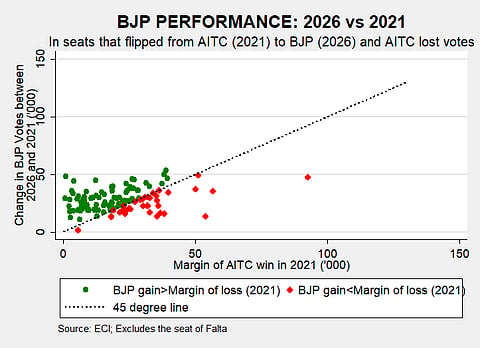
These constituencies point to a larger political reality often overshadowed in the SIR debate: the BJP was not merely benefiting from deletions, but was also substantially expanding its own electoral base across large parts of Bengal. One can argue about why that happened (including potential additions to the electoral rolls), but that is beyond the scope of this piece.
The party’s gains in urban belts, sections of south Bengal, and segments of Jangal Mahal reflected an organisational and political consolidation that cannot be reduced solely to electoral roll revisions.
According to Amitabh Tiwari, founder of Vote Vibe—an independent public opinion platform that tracks voter mood, governance, and polling trends—this was the clearest indication that the election was shaped by a much larger political churn.
“The biggest reason for the loss was excessive minority appeasement, which triggered a counter-consolidation of Hindus,” he said, arguing that the BJP successfully converted discontent over governance, corruption, and women’s safety into a broader electoral wave.
Tiwari added that the BJP’s gains reflected not just vote deletions, but also a substantial shift in voter behaviour. The BJP, he argued, effectively countered the AITC’s traditional “three Ms”—Mamata, Muslims, and Mahila voters—with its own campaign built around “misgovernance, minority appeasement and mahila asuraksha (women’s insecurity).”
The Grey Zone
The more contentious picture emerges in the remaining 36 seats.
These were constituencies where the BJP’s increase in votes alone was insufficient to overcome the AITC’s 2021 winning margin. In such seats, the decline in AITC votes became electorally significant.
To test whether the SIR could plausibly have influenced these outcomes, the analysis compared the “vote deficit” the BJP still needed to bridge with the number of non-death deletions under the SIR.
The underlying idea was straightforward: if the number of deletions exceeded the remaining electoral gap, then the deletions may have had the capacity to influence the final result.
According to our analysis, in 31 of these 36 seats, non-death deletions were higher than the remaining gap the BJP needed to close. When all deletions (including deaths) were considered, the number rose to 33 seats.

For instance, in Karandighi, the AITC had won the seat in 2021 by nearly 37,000 votes. In 2026, not only did the BJP make up that margin, it also won the seat by almost 20,000 votes. That implies a relative swing of almost 57,000 votes in the BJP’s favour between the two elections.
In order to win the seat, based on the 2021 result, the BJP required the sum of its gains and the AITC’s losses to exceed 37,000 votes. Between 2021 and 2026, the BJP gained roughly 17,000 votes in this seat. If we assume that all of the AITC’s losses are attributable to non-death SIR deletions, then any situation in which the number of non-death SIR deletions exceeds the deficit of 20,000 votes (37,000–17,000) makes this a contentious seat.
Indeed, Karandighi witnessed over 44,000 non-death deletions, which makes it a problematic seat under the assumption that a large majority of the deleted votes were affiliated with the AITC. If, however, this assumption is relaxed, the analysis changes. For instance, if a larger share of deletions occurred among pro-BJP voters, then it is possible that the BJP’s victory margin in 2026 may, in fact, have been much higher in the absence of deletions. In that case, the margin would have been different even though the winning party would have remained the same (the BJP).
Notably, of the 31 contentious seats (categorised as such under the assumption that all non-death SIR deletions, or a major share of them, reduced the AITC’s vote count), 22 are located in south-east Bengal, three in the Maldah-Murshidabad belt, and the remaining six in the Jangal Mahal area.
Was it enough to alter the mandate? No.
Even if all 31, or even 33, of these potentially affected seats had remained with the AITC, the BJP would still have comfortably crossed the majority mark in the Assembly. However, this highlights the grey areas introduced by the SIR into the broader electoral process.
The analysis makes it difficult to argue that the SIR alone handed Bengal to the BJP. At the same time, the data also makes it difficult to dismiss the issue outright.
Tiwari points to one of the overlooked aspects of the SIR debate. “The actual story is in additions, not deletions,” he said. Existing data also suggests that an analysis of deletions alone may not be sufficient.
Take the case of Karandighi again. In 2021, the constituency had 2.62 lakh electors. That rose to 2.78 lakh electors by 2024. In 2026, however, the number dropped to 2.31 lakh voters.
When comparing SIR deletions, most analysts compare the pre-SIR 2025 electoral roll with the post-SIR electoral roll of 2026. However, that assumes that any changes (net additions, in this case) between 2021 and 2025 led to a roughly equal increase in electors for both parties, or that the composition of new voters was close to the proportion of the parties’ vote shares in 2021. Any violation of these assumptions would turn the analysis on its head.
According to Tiwari’s analysis, compared to the 2021 Assembly election, the number of electors increased in 47 constituencies. Of these 47 seats, the BJP won 44, an overwhelming strike rate that, he argued, complicates the narrative that SIR-driven deletions alone powered the party’s victory.
This, of course, does not discount the fact that even a single vote denied without valid reason comes with significant social and human costs and is, therefore, unacceptable. At the same time, all deletions aimed at reducing voter fraud should be unambiguously supported.
Yashwant Deshmukh, founder and director of C-Voter, maintained that no legally entitled voter should ever be excluded from the rolls. Calling wrongful deletions “unfortunate and unacceptable”, he argued that the controversy should push India towards deeper electoral reforms, including cleaner and more integrated voter databases.
“The only foolproof process is a biometric-enabled electoral system,” he suggested, adding that digitisation should ensure that duplicate entries, deaths, and address changes are automatically reflected in voter rolls.
The story was a collaboration with Kartikeya Batra, an Assistant Professor of Economics at Azim Premji University (Bengaluru). He holds a PhD in Economics from the University of Maryland (College Park) and a Masters in International Affairs and Policy from the Fletcher School at Tufts University. His research is primarily focused on developing countries, and spans the areas of Growth and Development, Political Economy, Institutions, and Public Policy.