The rollback of the 10-minute delivery promise follows worker protests but leaves intact the algorithmic regime that disciplines gig workers through impossible temporal demands and constant surveillance.
India’s gig economy thrives on a permanently available, disposable workforce whose waiting time, data trails, and bodily endurance are silently converted into value and efficiency.
Removing the slogan does not return time or dignity to workers; real change lies in wages, rights, transparency, and collective bargaining, not in cosmetic adjustments that soothe consumers while preserving exploitation.
Ten Minutes Too Late: When Speed Becomes Exploitation
Speed here functions as ideology, masking exploitation beneath spectacle. Ten minutes becomes a brand, a promise of modernity, a sign that “India is catching up.” In reality, it is a disciplinary weapon, reorganising labour-time through code.

Summary
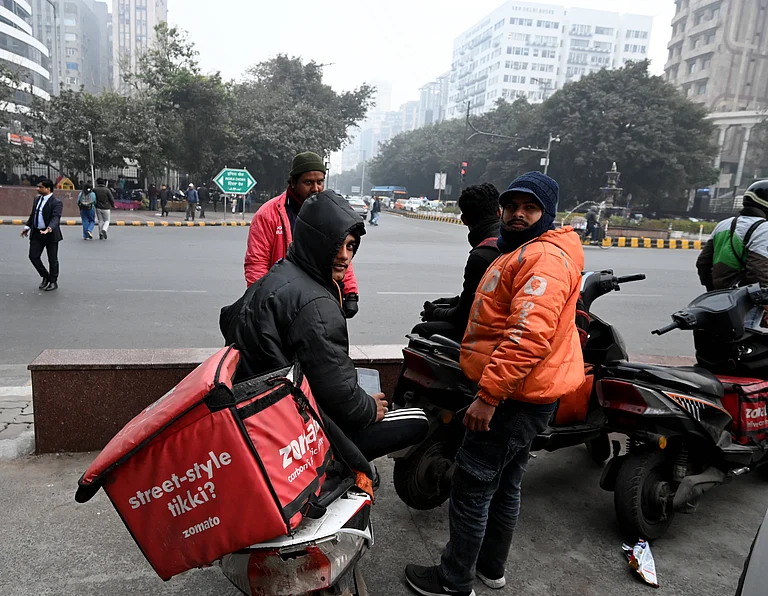
Acting on an informal intervention by the Labour Ministry, quick-commerce platform Blinkit this week withdrew its much-publicised 10-minute delivery promise, with competitors such as Zepto and Swiggy Instamart expected to follow. Crucially, no court directive or binding government order mandated this shift. It emerged instead from a closed-door meeting, an exercise in managerial persuasion rather than regulatory compulsion. The move followed nationwide protests by gig workers’ unions, after which Union Labour Minister Mansukh Mandaviya urged companies to abandon the branding.
Across cities and neighbourhoods, riders mobilised not only against low pay, but against the relentless regime of speed imposed by algorithms: quotas, surge-based penalties, and the impossible temporality of hyper-fast delivery. They raced through congested streets only to be penalised for restaurant delays; they waited unpaid as orders pile up, their bodies absorbing danger, friction, heat, rain, and infrastructural breakdowns that the system refuses to acknowledge. The protests offered a stark reminder that labour, human, embodied, finite, remains the substrate of accumulation, the pulse no machine can automate away.
Yet this rollback is far from structural reform. It sits uneasily alongside the Social Security Code, which continues to treat gig workers as legal anomalies neither fully workers nor entirely outside labour relations, offering welfare without rights, protection without power. Ministerial concern signals benevolence but leaves untouched the deeper logic of extraction. Riders remain algorithmically compelled, their bodies compressed, their time condensed, their endurance commodified. Even without the “10-minute” slogan, algorithmic temporalities govern every moment: pay slabs tethered to completion speed; automated allocation of routes and zones that can push riders away from high-demand areas; surge bonuses calibrated to exhaustion; and punitive measures for delays outside workers’ control. Failure to meet platform expectations, refusal of work, acts of dissent and organising, customer complaints, or system glitches can potentially trigger lockouts, temporary deactivations, or suppressed orders, disciplining workers even as they struggle to meet impossible expectations.
The slogan may vanish, but the velocity it encoded persists. Time remains the capital's command. India’s gig economy, employing an estimated 7.7 million workers in 2020–21 and projected by NITI Aayog to reach 23.5 million by 2029-30, is celebrated as a story of “employment” and digital inclusion. But beneath these numbers and slick interfaces lurks another reality: the surplus population of platform labour. Their availability, their bodies on call, their time compressed and stretched, fuels the system’s capacity to simulate abundance, responsiveness, and omnipresence. They orbit the app as potential, redundant yet indispensable, the living reserve army of digital capital. Every idle minute, the hours spent waiting for the next ping, the next surge, the next order, is a latent resource, a stockpile of human endurance that can be mobilised at a moment’s notice. They are surplus, and yet this surplus is productive. Availability itself becomes labour. In this system, waiting is not outside work but folded into it. Surveillance, availability, and anticipation are not “extra” activities, they are forms of labour captured by the platform. Even before a single delivery is completed, living labour is already being expended, sustaining the abstractions through which value is organised and extracted.
Advertisement

Yet this surplus is inseparable from a condition of structural unemployability: workers are simultaneously indispensable and disposable, necessary and excluded, active and yet never fully “employed” in any sense that guarantees stability, dignity, or recognition. The platform mobilises precisely this disposability: by maintaining a surplus pool of workers, it ensures that supply always exceeds demand, that riders are perpetually replaceable, and that the fear of exclusion disciplines those on call. This redundancy allows platforms to guarantee speed and constant availability, locking in users through the illusion of abundance, while extracting value from workers through onboarding fees, mandatory training, and the shifting of capital costs onto their bodies. Every phone, every insulated bag, every scooter that the gig worker needs as part of their work is borne by them, and these costs are normalised as “entry requirements” for the privilege of participation.
Advertisement
Moreover, with Aadhaar effectively mandatory for registration, this extraction extends beyond mere tools, workers’ identities, biometrics, and life histories are enrolled into the system, rendering them perpetually surveilled and fully legible to algorithmic management. The platform profits not only from their labour but from their constant traceability, converting presence, compliance, and vulnerability into data streams that underpin the seamless, frictionless illusion of service. The surplus population is never idle. It is gamified, ranked, quantified, and calibrated. The app tracks micro-behaviours, punishes delays, converts waiting into anticipation, anticipation into data, and data into optimisation.
Each pause, reroute, puddle navigated, red light endured, or kitchen delay absorbed is logged and monetised. This unpaid labour in data form circulates as infrastructure of the platform economy, boosting its capacity to “match” demand and supply in real time. The time workers spend hovering around hotspots becomes metrics, heat maps, metadata. Every act of effort put in by the worker feeds predictive algorithms and dispatch models, enabling platforms to anticipate demand and monetise attention, through data markets where congestion, speed, and location are converted into capital.
Advertisement
Gig workers thus exist as both living labour and the instrument of algorithmic command, alive in pedalling, lifting, waiting, rerouting; governed through past deliveries, clicks, ratings, traffic metadata, and predictive logs that return as disciplinary commands. These commands compel riders to move faster, absorb delays, and fill gaps in algorithmic expectation. Every hour of unpaid monitoring, every device purchased or lent at the worker’s expense, transforms endurance into a medium of capital extraction. Their bodies produce not only service for consumers but the infrastructure for future labour allocation, wage calibration, and algorithmic optimisation. It is their frenzied movement through the city that generates metadata governing the next wave of labour, producing the interface’s “frictionless” appearance while rendering the body both source and subsidy.
Value, thus, is no longer tied solely to living labour; it hinges on the system’s capacity to simulate signals generated through workers’ movements, creating benchmarks for efficiency, anticipating demand, automating command, and transforming endurance into throughput. Speed becomes extraction itself, a regime where living labour is disciplined by the accumulated weight of dead labour. The 10-minute promise was never merely a marketing slogan. It was the capital's temporal dictatorship condensed into a number, coding coercion into every pickup, swipe, and delivery. Its removal does not end exploitation, restore sovereignty, or return time to workers. It merely exposes what has always been rendered invisible: the worker, the pulse, the body that circulates capital through fatigue and anticipation. Dead labour and living labour cohabit in the same flesh. The surplus population becomes at once reservoir, instrument, and justification, the medium through which platforms claim efficiency and inevitability.
Advertisement
The 10-minute mandate attempted to hard-code a fantasy: that space can be abolished, traffic negated, exhaustion overridden by interface design. The gig worker’s body became the sacrificial altar upon which this fantasy was performed. Traffic jams, restaurant delays, wrong addresses, all absorbed by muscle and nerve. He waits so the system does not have to. He reroutes so the algorithm remains “optimal.” His unpaid time; the dead hours hovering around hotspots, the forced availability never appearing on a payslip, becomes the hidden subsidy behind the app’s smoothness. The platform’s speed is purchased through the worker’s risks, insecurity, fatigue, and stretched time chasing incentives.
For capital, labour is never merely a resource. It is both the condition of extraction and its primary obstacle, the terrain on which value and risk are organised. Under real subsumption, labour is no longer external to capital’s circuits but fully integrated, formatted, disciplined, rendered legible through algorithms and metrics. Workers sustain a system that neither requires their sovereignty nor recognises their presence. The body becomes a living organ of the machine, the conduit through which digital capital measures and circulates value. Human effort must disappear so that the system can appear frictionless, autonomous, self-moving.
Labour thus becomes the horizon on which platforms offset externalities. The worker’s endurance internalises risk, injury, inefficiency, and infrastructural breakdowns that the system presents to consumers as smooth service. The rollback exposes the central contradiction of platform capitalism: between fetishised instantaneity and the exhausted, stretched bodies that sustain it. The protest was not about a more convenient form of exploitation. It was about the right to time itself, a refusal of the colonisation of lived duration by optimisation metrics. It punctured the ideology that faster delivery equals social good, revealing acceleration as surplus extraction dressed up as innovation. In a limited sense, then, the verbal promise of rollback matters because it interrupts, however briefly, the attempt to formalise speed as destiny, to turn acceleration into law. However, it remains non-binding and can therefore feel tokenistic as a gesture, given the massive backlash that the CEO of Eternal received in the recent past over his comments on the gig economy being an emancipatory terrain for workers.
Yet it is crucial to note that this was not what the protest was about. The demands were concrete and material: minimum wages, limits on algorithmic opacity and management, collective bargaining rights, and social security not tied to performance metrics. These are the structural questions. By shifting attention to the mere immediacy of the service, and not the structural imperative of speed encoded in the platform economy, it recentres the moral universe around the consuming class, even when ostensibly speaking about workers. This is the low-hanging fruit of corporate ethics, soothing consumer conscience while leaving relations of production intact. The worker becomes a mirror for consumer morality rather than a political subject with demands. Speed here functions as ideology, masking exploitation beneath spectacle. Ten minutes becomes a brand, a promise of modernity, a sign that “India is catching up.” In reality, it is a disciplinary weapon, reorganising labour-time through code.
Published At: