KMB refuses to divulge more details about the resignation of Bose from the Foundation
The next curator will be appointed well in advance, says the CEO
Bose stepped down just a month into the current Biennale edition
Strong Systems in Place: Biennale Foundation Assures Continuity Despite Leadership Change
After Krishnamachari’s resignation, KMB Foundation initiates search for a new president

Summary
Bose Krishnamachari’s sudden departure from the Kochi Biennale Foundation marks a significant moment for an institution that, for over a decade, was shaped by his vision and leadership. Although he has cited personal reasons for stepping down, the timing and abruptness of his exit have prompted speculation within artistic and cultural circles.
The Foundation is set to begin formal steps to appoint a new president, even as the current Biennale, which opened on December 12 and closing on March 31, continues. Within the organisation, concerns are growing about replacing Bose Krishnamachari. A co-founder and long-standing anchor, his influence went well beyond his official role, spanning fundraising, networks, and the careful negotiation between artistic freedom and political realities. His exit raises pressing questions about leadership succession and whether the Biennale can move beyond its founding figures without losing coherence or stature.
“It is almost impossible to find a replacement for Bose Krishnamachari. At the same time, the more gratifying aspect is that the Foundation is in a much better shape today—financially and administratively, it is on a strong footing. Having said that, he was a real go-getter; he carried the Biennale forward, weathering every challenge,” said a person associated with the Foundation, who requested anonymity.
Bose Krishnamachari resigned on January 14, citing family reasons, a move that has triggered speculation, particularly as the sixth edition of the Kochi-Muziris Biennale is barely a month old. The timing of the resignation has drawn attention not only because of the ongoing edition, but also because of Krishnamachari’s long-standing role as a central figure in shaping both the Biennale and the Kochi Biennale Foundation as an institution.
The Foundation has remained guarded about the circumstances surrounding the resignation, maintaining that it will not affect the ongoing Biennale. Chairman Dr Venu V confirmed that internal discussions on succession have begun but emphasised that the process is still at an early stage. “The Foundation deed sets out the procedure. We have reached out to a few people, but discussions are preliminary,” he told Outlook.
Venu added that it is not yet clear whether a new president will be appointed before the current Biennale ends, reflecting the Foundation’s cautious approach to ensuring stability while replacing a founding figure. He declined to comment further on Bose Krishnamachari’s resignation, maintaining the Foundation’s reserved public stance.
Advertisement
The relatively smoother conduct of the current edition has therefore been seen by many as a sign of greater institutional stability, even as leadership uncertainties have now emerged. This year, the Biennale did witness a flashpoint when Christian conservative groups protested against artist Tom Vattakuzhy’s Supper at a Nunnery, a reworking of Leonardo da Vinci’s The Last Supper, in which a dancer occupies the place of Jesus and is surrounded by nuns instead of disciples. Following sustained protests by Christian fundamentalist groups, the exhibition was eventually closed.
In the initial days of the controversy, Bose Krishnamachari had indicated that the exhibition would resume after a brief pause. However, the decision was later reversed, and the work remained shut, marking one of the few contentious episodes during an otherwise relatively smooth edition of the Biennale.
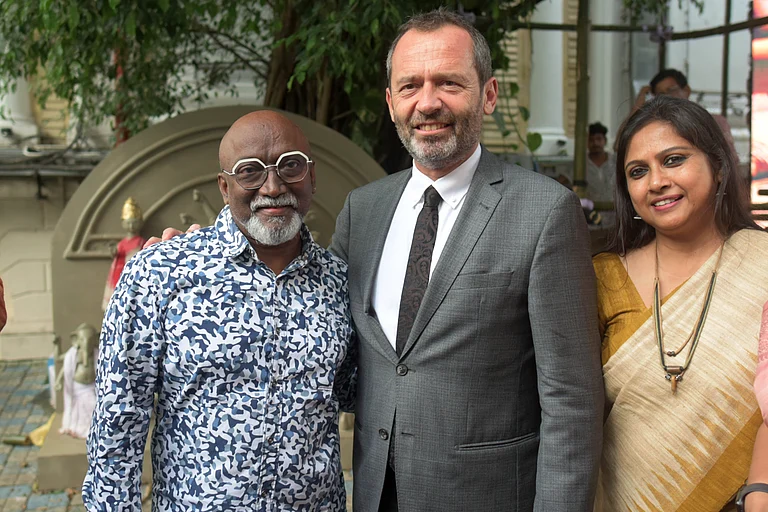
The Chief Executive Officer of the Kochi Biennale Foundation, Thomas Varghese, said that a new president would be selected in due course, stressing that the organisation’s functioning remains stable. “We have a strong administrative system in place and everything is going smoothly. For this edition, we announced the curator a year in advance, and that precedent will be followed for the next edition as well,” he said.
Advertisement
Varghese, who was appointed CEO in 2024, brings prior experience from the United Nations Economic and Social Commission for Asia and the Pacific (ESCAP).
Institutional challenges are not new to the Kochi Biennale Foundation. During the previous edition, held in the aftermath of the COVID-19 lockdowns, financial constraints—particularly those related to securing and maintaining venues—emerged as the Biennale’s most significant hurdle, affecting both scheduling and execution resulting in 10-day delay in its opening. This, at that time, provoked strong reactions from participating artists. The artists issued a damning letter against the management, accusing it of inefficiency. There were also reports suggesting that Shubigi Rao, the Singapore-based artist and curator, was unhappy with certain developments then. She curated the 2022–23 edition, which was originally planned for 2020–21, but was delayed due to COVID-19. Rao, however, did not respond to the new developments at the KMB.
The Foundation has also faced leadership turbulence before. Co-founder and artist Riyas Komu resigned in 2018 following sexual misconduct allegations, claiming he had been “marginalised” after what he described as an unfounded complaint.
Advertisement
Established in 2010, the Kochi Biennale Foundation launched the Kochi-Muziris Biennale in 2012, with Bose Krishnamachari and Riyas Komu serving as its first co-curators. Kochi was chosen as the venue for its layered, composite history, shaped by centuries of interaction among Jewish, Arab, and European traders. To invoke the port city’s pre-colonial modernity, the Biennale also drew on the legacy of Muziris, the ancient port town that once anchored global trade networks.
Over the years, the Kochi-Muziris Biennale has grown into India’s largest and most high-profile contemporary art event, attracting artists and audiences worldwide. With its most recognisable face now gone, the Foundation faces the challenge of proving its resilience and steering the Biennale forward beyond the shadow of its founders.
Published At: