Shiv (name changed) has been desperately searching for a new role since April. The job hunt isn’t voluntary, stemming from aspiration—such as a better designation or a higher pay package. The 52-year-old has been applying to at least five companies each day, but without success.
Cover Story | Slow Death of IT Sector Jobs: How AI Layoffs Are Reshaping India’s Tech Workforce & Middle Class Dreams
The IT sector has long been the engine of India’s middle-class aspiration and white-collar employment. As AI eats into jobs in the sector, India faces a massive socio-economic challenge

One evening, he found himself snapping at his wife for no reason. “When you spend 14 years in a company, you expect some continuity. I was content with the work and the culture. Now, I’m mostly restless,” Shiv says. He was among the 12,000 who were laid off by US-headquartered software giant Oracle in India in March this year.
The cuts at Oracle spanned hierarchies, affecting employees with decades of experience as well as freshers. Take for instance Priyanka (name changed), for whom the tech giant had been a first step towards a more secure future. When the 25-year-old woke up early one morning for the gym and glanced at her inbox, an e-mail coldly announced that she was being let go.
Tens of thousands of employees have been laid off by some of the largest and hottest tech firms in the world over the past 18 months. While some of the companies have openly said it was because of automation of work by artificial intelligence (AI), others have kept silent.
AI is improving at a tremendous pace. When ChatGPT burst into the scene in late 2022, it was first seen as a spectacular toy. In no time, it became clear that generative AI—the technology behind ChatGPT—was going to be a job killer. Today it has become adept at doing most white-collar work at a significant level of efficacy. AI can already draft emails and summarise large documents, analyse business plans and craft glossy presentations, create realistic images and videos, and even crunch numbers. Last month, AI stumped the maths world as it solved a problem that has eluded humans for nearly 80 years.
But AI’s biggest success yet has been its ability to write code. That’s why the deepest job cuts have been in tech companies. “We built the technology, learnt it, developed it. And after using it, we were asked to leave,” Shiv says with a heavy heart.
If Microsoft let go 15,000 workers last year, Amazon cut 30,000 jobs in the past seven months. The total number could be as high as 1.65 lakh over the past year, according to a tracker called Layoffs.fyi. While most of these companies are headquartered in the US where a significant part of these layoffs are happening, AI has also hit Indian tech hubs like Bengaluru and Hyderabad where many like Shiv and Priyanka do a bulk of the back-office engineering work for such firms.
Advertisement
Not surprisingly, the biggest shockwaves have been felt in India’s information technology (IT) sector, which does low-value software work for companies in the West and employs about six million people in the country.
If Microsoft let go 15,000 workers last year, Amazon cut 30,000 jobs in the past seven months. The total number could be as high as 1.65 lakh over the past year.
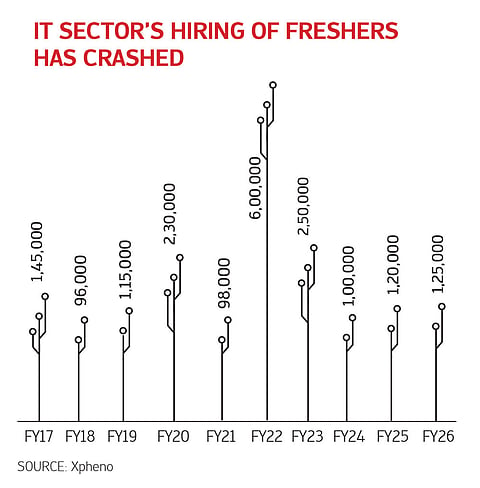
Twice in the past three years, the country’s top IT companies saw their combined workforce shrink. While an estimated 50,000 people in the sector lost jobs last year, the biggest bombshell was dropped by Tata Consultancy Services (TCS) when it fired 12,000 employees. Things are only getting worse as tech job openings are at a 28-month low in June, according to staffing company Xpheno.
For over three decades now, India’s IT sector has been the cornerstone of its economic engine—creating millions of white-collar jobs, facilitating upward mobility for its youth, and fuelling middle-class aspirations. Now, AI is threatening to upend the entire system.
Advertisement
“Aspirations around high salaries, overseas assignments, higher education and upward social mobility may become much harder to achieve. For many families, the dream of making it big through the IT industry could remain unfulfilled,” says Pavanjit Mane, a senior office-bearer of IT workers’ body, Forum for IT Employees (FITE).
Good Old Days
Growing up, the cramped one-room apartment where Pooja lived with her parents and which doubled as a kitchen was her home. The building in a suburb of Kolkata had just one bathroom, shared by nearly 70 people. She desperately wanted to get out of the place.
The chance came when in 2005, Pooja received her diploma. Her first job was as a coder in Gurgaon, with a salary of Rs 7,056 a month. Step by step, she climbed the corporate ladder. Today, she works at one of the top IT companies and earns Rs 35 lakh a year. For many like Pooja, who grew up in the India of the 1990s and even the 2000s, the IT sector has been a golden ticket of opportunity.
Advertisement
The IT boom happened at a critical time for the country. The early 1990s were among the most turbulent years in independent India’s history. A severe economic crisis left it with barely enough money for a few weeks of imports. Political instability pervaded daily life as riots and bomb blasts rocked the country. Governments collapsed like house of cards. And, the issue of reservation inflamed college campuses. While Asian peers like South Korea and China had rapidly industrialised and climbed up the income ladder, India lagged behind.
The young were becoming restless.
It was then that the dot-com era came as a boon for India. Suddenly even a student from a small town with an engineering degree and workable English could compete alongside graduates from metros.
“The idea was simple. You take a loan of Rs 4-5 lakh, complete engineering and land a job in companies like TCS, Infosys or HCLTech. Your life was set,” says Neeti Sharma, chief executive officer of staffing firm TeamLease Digital. The young Indian IT professional suddenly became the most sought-after commodity in the world.
Advertisement
There was another first. The opportunities were no longer limited to men. Women were able to contribute to the growth story steered by the IT sector. Unlike manufacturing, where the demands of manual labour resulted in limited female participation, the IT industry drew women from small towns and middle-class families into offices and corporate careers.
Nasscom, an industry body, released findings from its report titled Gender Diversity & Inclusivity Trends in the IT-BPM Sector in 2016. As per the report, the sector had 1.3 million women—34 per cent—in its workforce. It was India’s second-largest private-sector employer in the organised sector, with women constituting 51 per cent of entry-level hiring.
The IT sector providing women with well-paying corporate jobs directly boosted family incomes and elevated their status in society. They became a part of the decision-making process, both inside homes and in workplaces. Seeing women thrive in technical, analytical and leadership roles dismantled patriarchal stereotypes about female capabilities and inspired young girls to dream big. As young IT workers went on offshore stints in the US and Europe, their outlook globalised further.
“The secondary literature based on empirical study on women workforce in the IT sector reveals that this sector has undoubtedly enhanced the social mobility and high work participation of women employees... It has further enhanced the financial autonomy and bargaining capacity in the household decision-making process for the women,” researchers affiliated to the Indian Statistical Institute, Kolkata wrote in a paper in IOSR Journal of Humanities And Social Science in 2012.
It changed the outlook of employers as well. The influx of female IT professionals pushed companies to adopt robust safety measures like providing night drops, implementing strong anti-harassment policies and offering benefits like child care.
For many first-generation salaried professionals, especially women and lower-middle-class youth, the industry became more than just a source of employment. It offered an escape from social barriers that had long limited economic mobility in India.
The Multiplier Effect

In 1993, Jitu Virwani was about 27 years old. He had spent the previous few years supporting his father’s construction business in what was then called Bangalore. It was still a sleepy city with a lot of gardens that pensioners liked to retire to. After a disagreement with a partner, the senior Virwani wanted to discontinue the business. But Jitu, who was newly married at the time, would not give up. He saw an opportunity brewing in the city—in leasing office spaces to IT companies—that would ultimately make him a billionaire. In a nutshell, that is how Embassy Group became one of India’s biggest commercial landlords.
There are stories abound like Virwani’s of fortunes being made in IT hubs like Bengaluru, Hyderabad, Pune and Gurgaon across sectors. Restaurants, private schools, health-care services and retail businesses mushroomed. Many high-end malls came up. Pubs and clubs bloomed.
Between 1995 and 2000, a period when the IT sector in India first took off, southern cities, which were at the forefront of the IT boom, saw greater vehicle growth on their roads. At the turn of the millennium, Bengaluru had 15.5 lakh vehicles on its roads and Hyderabad boasted 9.51 lakh—compared to Ahmedabad’s 7.99 lakh and Jaipur’s 5.98 lakh.
The IT boom also coincided with a rapid expansion of housing loans, as banks increasingly lent to a new generation of salaried professionals seen as financially secure borrowers. The share of housing loans in India’s GDP has risen from 0.6 per cent in 1995 to around 11 per cent today. Nearly 35 per cent of these loans are concentrated in southern India—which accounts for the largest share by region—and is home to the country’s biggest IT hubs. In cities such as Bengaluru and Hyderabad, almost entire housing markets have come to depend on the stability of white-collar technology incomes.
As the IT ecosystem took root in these cities, it created a knock-on effect on other parts of the economy. For example, demand for domestic workers, drivers, security guards, cooks and nannies also went up. According to a Nasscom-Crisil report, by 2007 every IT job was already creating roughly four more elsewhere in the economy, many of them held by people with only school-level education. One could see the impact of this in India’s fast-moving consumer goods sector between 1995 and 2005—when majors like Hindustan Unilever and ITC tripled their annual sales.

Illustration: Saahil
Fear Factor
But as the dream run of the IT sector is coming to an end, it’s a matter of concern.
By the time Shiv and Priyanka got laid off from Oracle, they had already adapted to a way of life they believed they deserved in a rapidly modernising India, one where aspirations were no longer limited to roti, kapda aur makaan.
For Shiv, taking his family out to restaurants once a week or watching a film in theatres over the weekend had become part of a normal middle-class life. Vacations, too, he feels, are not a luxury but something important for the people he earns for. Letting go of that life is not easy for him.
“I have been staying in the same house with my family for the past 15 years. I don’t want to uproot them from their origin,” says Shiv, who pays Rs 50,000 a month in rent. Priyanka finds herself in a similar position. “Bengaluru is where I get exposure and more opportunities. I don’t know how long I can manage the rent, but I want to stay in the city,” she says.
“A key immediate effect of these layoffs is the strain on employment and income stability,” says Rajani Sinha, chief economist at CareEdge Ratings. “Reduced disposable income can dampen consumption, creating spillover effects in sectors like real estate, retail and hospitality that rely heavily on this consumer segment,” she adds.
Some early impacts are already becoming visible.

For example, when house sales in India’s top cities fell by 13 per cent in the first three months of 2026, experts were quick to point out that IT sector layoffs were one of the main causes. When the demand for paying-guest (PG) accommodations suddenly dropped in Bengaluru last year, newsdaily Deccan Herald had reported that PG owners held the IT sector responsible.
Another insidious consequence that is building up is unsecured loans. Many youngsters like Priyanka are trying to hold together a lifestyle shaped by steady salaries and easy credit. At present, she is dipping into her savings to service two EMIs, one for her iPhone and another for her scooty, with a combined monthly outgo of Rs 20,000.
“One of the things we are hearing is that plenty of laid-off people who sense they are going to get laid off are loaded up with debt, knowing that the layoff is imminent. So, some of the loan growth in the past 12 months has come from people who have been laid off and they have taken personal loans, home loans…obviously, this is a dangerous strategy,” says Saurabh Mukherjea, a veteran fund manager who closely tracks the Indian economy (see interview).
Chaos Coming?
In November last year, thousands of young, visibly angry, IT professionals gathered on the streets of Bengaluru, along with trade-union workers. They were holding placards and protesting against a government policy that threatened to exploit them. Their collective sloganeering was making the atmosphere charged up. Police arrived and lathicharged them. They were grabbed by collars and taken away. Some were picked up and locked up in vans. Hundreds were detained.
Such scenes were typical for disgruntled blue collar and government workers once upon a time. But over the past year, anxious and angry IT-sector workers across Indian cities have been coming out in hordes to join public demonstrations like these.
Early last year, there was a massive hue and cry raised by IT unions after Infosys let go 400 trainees from its Mysuru training campus. While the company claimed that it had filtered out those who could not clear a certain skill test three times in a row, the victims alleged that the evaluation process was made ‘unjustifiably’ difficult to weed them out. Nascent Information Technology Employees Senate, a union of IT workers, claimed that bouncers were deployed to remove the trainees from the campus on short notice. Similar protests erupted once again when TCS laid off 12,000 employees later in the year. In both instances, employees’ unions compelled the government’s labour department to probe into the matter. However, Karnataka IT Minister Priyank Kharge described the layoffs as a business decision that did not require government intervention. Even as concerns grow over AI-led disruption in white-collar employment, the government is attempting a balancing act.
But how long can the despondency be contained?
“AI-led job losses and the stress associated with job insecurity could certainly become a political issue if governments do not intervene with fair policies to protect employees,” cautions Mane of FITE. “There is growing concern that some companies may use AI as a justification for aggressive hiring and firing practices. The issue has already been raised in Parliament and state Assemblies, indicating that it is increasingly entering public policy and political discourse,” he adds.
“AI-led job losses and the stress associated with job insecurity could certainly become a political issue if governments do not intervene.”
Meanwhile, Mukherjea says that the number of discontented youth is only going to rise. Every year India produces around eight million graduates overall, of which nearly three million are engineering graduates, out of which about 1.5 million are considered ‘decent engineers’.
“Until 2020, all of the decent ones were absorbed into IT services jobs…In the past three years, these 1.5 million jobs per annum have declined to almost zero, which, in turn, means that even the better engineering graduates now have very little demand for their services,” he contends.
It is not hard to see that by absorbing a substantial share of the talent pool of young graduates, the IT industry has been playing a crucial role in maintaining socio-economic stability in the country. Meanwhile, nearly 40 per cent of young graduates in India are unemployed, a figure that has remained largely unchanged for four decades, according to the State of Working India 2026 report by Azim Premji University. The report shows that unemployment among graduates aged 15–29 remains persistently high, with about 40 per cent of those aged 15–25 and 20 per cent of those aged 25–29 unable to find work.
It is even more frustrating because India’s rich are likely to grow richer. Indians spend nearly five hours a day on social media, where they see curated images of wealth and luxury.
“The top 0.1 per cent, those controlling major platforms, networks and intellectual property, will continue to consolidate wealth. There may be some redistribution within the upper tier, with the top one-two per cent gaining access to scalable digital assets such as startups, creator platforms and algorithmic trading,” says Nitin Bharti, an economist specialising in wealth inequality, education and development in South Asia. “Beyond this, overall wealth inequality is likely to widen,” he adds.
The meteoric rise of the Cockroach Janata Party (CJP), which has amassed a bigger social media following than India’s biggest political parties, is a case in point (see interview). What began as a satirical response to remarks made by Chief Justice of India Surya Kant on May 15, in which unemployed youth were allegedly compared to “cockroaches” and “parasites of society”, has quickly evolved into something much larger.
Its traction can’t be ignored at a time when disillusioned youngsters in neighbouring countries like Bangladesh and Nepal have recently risen up in revolt against their governments. While it might be easy to dismiss the Gen Z as politically immature, history is full of instances of youth anger transforming to national upheavals. From May 1968 protests in France that shook Charles de Gaulle to the digitally mobilised crowds of the Arab Spring, there are enough examples of the young causing political tremors.
The CJP’s online movement has already managed to tap into the anxieties of the youth related to unemployment and economic insecurity. The fact that it has coincided with the government’s mismanagement of high school and college entrance exams, which are particularly important from a career point of view, is adding fuel to fire. All while teenagers and twenty-somethings are all frazzled about what AI means for their life and work.
By Nabodita Ganguly and Parth Singh
Published At: