Four Nicobarese residents allege tribal consent was not properly obtained before 166 square kilometres of forest land was approved for diversion.
The Centre argues the tribal leaders approached the court too late and are neither necessary nor proper parties to the case.
The Calcutta High Court is hearing a challenge to the legality of the forest-rights settlement process under the Forest Rights Act, 2006.
One Signature, 166 Sq Km, A Withdrawn Consent: Great Nicobar’s Forest Rights Puzzle
Union Tribal Affairs Ministry has opposed four Nicobarese residents’ plea to join a Calcutta High Court case challenging the settlement of forest rights on Great Nicobar Island

Summary
The Union Tribal Affairs Ministry has opposed a plea by four Nicobarese residents seeking to join a case challenging the settlement of forest rights on Great Nicobar Island, saying they are “neither necessary nor proper parties” to the proceedings, according to court documents reported by Mongabay India.
The dispute concerns the government’s claim that forest rights were settled before 166 square kilometres of forest land was approved for diversion for the Great Nicobar Island infrastructure project. The Nicobarese residents allege that the process relied on consent from non-tribal settler communities and that no Gram Sabha meeting of tribal communities was convened to discuss the diversion of forest land.
The case is pending before the Calcutta High Court, where former Union government secretary Meena Gupta has challenged the procedures followed under the Forest Rights Act (FRA), 2006.
What Is The Dispute Over Forest Rights?
On July 9, 2026, four Nicobarese residents sought to join Gupta’s petition, arguing that government certifications claiming forest rights had been settled relied on resolutions passed by Gram Sabhas of non-tribal settlers.
The Nicobarese are among the principal claimants to forest rights on the island. The other major tribal community affected by the project is the Shompen, a particularly vulnerable and largely uncontacted tribe. The island is also home to families of ex-servicemen from the mainland who were settled there under a government scheme from 1969 onwards.
The residents alleged that no Gram Sabha meeting of the tribal communities had been convened to discuss the diversion of forest land. They also raised objections to the role of Barnabas Manju, chief of the Great Nicobar Tribal Council, whose signature appeared on a No Objection Certificate (NOC) for the diversion.
Manju subsequently wrote to the Union Environment Ministry seeking rehabilitation within ancestral villages. In November 2022, he withdrew consent for the NOC, alleging that the implications of forest diversion had not been properly explained to him.
The Tribal Affairs Ministry said the plea deserved “outright rejection”, arguing that the leaders had failed to raise their alleged rights during the statutory process. It also maintained that correspondence with authorities did not constitute formal objections, claims or appeals under the law.
Advertisement
What Does The Forest Rights Act Say?
The Scheduled Tribes and Other Traditional Forest Dwellers (Recognition of Forest Rights) Act, 2006, commonly known as the Forest Rights Act, recognises the historical rights of Scheduled Tribes and other traditional forest dwellers over forest resources. Its provisions require forest rights to be recognised and settled before forest land is diverted for a project.
Under the Act, Gram Sabhas pass resolutions concerning individual and community forest rights. A Sub-Divisional Level Committee examines these resolutions and assesses their validity.
The dispute centres on whether the process followed on Great Nicobar complied with these requirements. According to the petitioners, the Gram Sabhas that approved diversion were those of settler communities rather than the tribal forest dwellers whose rights were at stake.
The petitioners have also questioned the circumstances in which the NOC was signed and alleged that Manju was not given sufficient information to make an informed decision.
Advertisement
How Was Consent Obtained?
Official documents show that the Lieutenant Governor constituted the Sub-Divisional Level Committee on July 26, 2022. A special Gram Sabha was held on August 12 and reportedly resolved to allow the diversion of 166 square kilometres of forest land. The committee met the following day and concluded that the diversion would not infringe any rights.
An NOC bearing Manju’s signature was appended to the committee’s minutes on August 16. He withdrew consent in November 2022.
The petitioners have alleged that tribal communities were excluded from the Gram Sabha process and that no inquiry was conducted after the withdrawal. They have also questioned whether the chairperson of the tribal council could consent on behalf of the entire Nicobarese community.
The Union government and the Andaman and Nicobar Islands administration maintain that forest rights have been settled on the island. However, the Ministry of Tribal Affairs’ annual report for 2024–25 does not list claims as settled under the Act in the archipelago as of March 2025, according to Mongabay India.
Advertisement
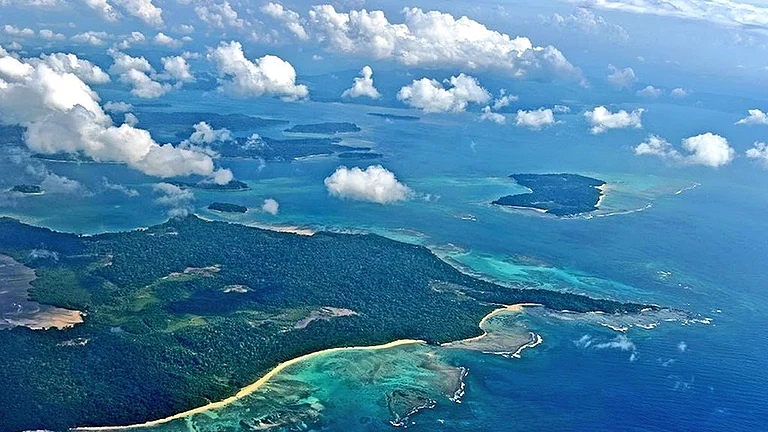
What Is The Great Nicobar Project?
The government’s Holistic Development of Great Nicobar Island project proposes a transshipment port, a greenfield international airport, a township and solar and gas-based power infrastructure. The project is a major infrastructure development with strategic and economic significance.
The legal challenge raises concerns about the implications for the Nicobarese, including their long-standing demand to return to ancestral villages after displacement by the 2004 tsunami. The petition also raises concerns about the Shompen, whose settlements, hunting and foraging areas could be affected by the proposed development.
The Union government approached the Supreme Court challenging the maintainability of the proceedings. On October 5, 2026, the court declined to interfere and asked the Calcutta High Court to proceed with the pending cases. Justice Joymalya Bagchi observed that preservation of culture is a constitutionally protected fundamental right.
Advertisement
The Calcutta High Court has scheduled the next hearing for November 25 and 26, 2026.
Published At: