Delhi Police invoked Section 163 ahead of the CJP's 'Sansad Chalo' march over alleged NEET paper leaks.
Section 163 empowers magistrates to issue temporary orders preventing threats to public order and safety.
Supreme Court says protest restrictions must remain reasonable and should not become blanket prohibitions.
Explained: Section 163 Of BNSS And The Right To Protest In India
The police crackdown on the CJP's 'Sansad Chalo' march has renewed focus on the emergency provision, its use, and Supreme Court rulings on regulating public protests

Summary
The Delhi Police's crackdown on the Cockroach Janta Party (CJP)-led 'Sansad Chalo' march over the alleged NEET-UG 2026 paper leak has once again brought Section 163 of the Bharatiya Nagarik Suraksha Sanhita (BNSS) into focus.
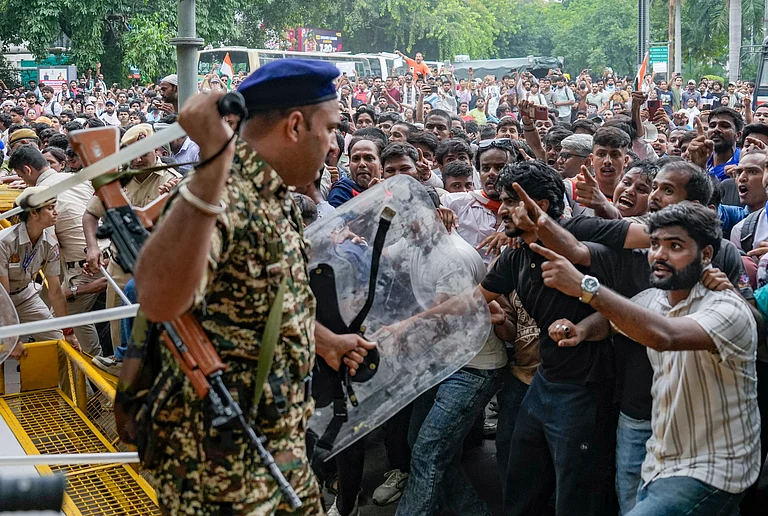
Thousands of protesters attempted to march from Jantar Mantar to Parliament on July 20, demanding the resignation of Union Education Minister Dharmendra Pradhan over alleged irregularities in the NEET-UG examination and multiple paper leaks.
Ahead of the march, the Delhi Police imposed prohibitory orders under Section 163 across the New Delhi district. Deputy Commissioner of Police Sachin Sharma said no permission had been sought or granted for the march and warned that legal action would be taken against those violating the order.
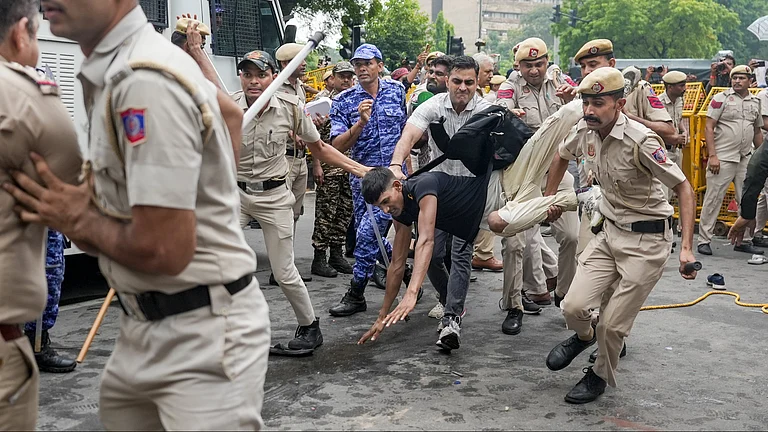
As protesters tried to move towards Parliament, police stopped them at multiple barricades. While the Delhi Police said the protest was handled professionally, eyewitnesses reported police using lathis to push back sections of the crowd.
The developments have revived questions about what Section 163 allows, how it is used, and what the law says about the right to protest.
What Is Section 163 of the BNSS?
Section 163 is the BNSS equivalent of the erstwhile Section 144 of the Code of Criminal Procedure (CrPC), which was replaced on July 1, 2024, when India's new criminal laws came into force.
The provision empowers a District Magistrate, Sub-Divisional Magistrate or any other Executive Magistrate authorised by the state government to issue written prohibitory orders where there is sufficient ground and immediate prevention or speedy remedy is necessary.
Such orders may direct individuals to refrain from specific acts or regulate the use of property to prevent obstruction, annoyance or injury to any person lawfully employed, danger to human life, health or safety, disturbance of public tranquillity, or the likelihood of a riot or affray. An order ordinarily remains in force for up to two months, although the state government may extend it for a maximum of six months.
Advertisement
In practice, Section 163 is commonly invoked to prohibit public gatherings, protests, processions or the carrying of weapons in areas where authorities anticipate a threat to public order.
What Was Section 144?
For decades, Section 144 of the CrPC was among the most widely used provisions to maintain public order. Although it has now been renumbered as Section 163 under the BNSS, its core purpose and powers remain largely unchanged. The change is primarily one of legislative restructuring under the new criminal law framework rather than a substantive expansion or reduction of executive powers.
What Have Courts Said?
The Supreme Court has consistently held that the power to impose prohibitory orders is preventive in nature and must be exercised only in exceptional circumstances.
In Babulal Parate v. State of Maharashtra (1961), the Court upheld the constitutional validity of Section 144 but said it could be invoked only to prevent specific threats to public order, observing that the power was not "unlimited or untrammelled".
Advertisement
In Himat Lal K. Shah v. Commissioner of Police (1973), the Court held that the right to assemble peacefully is an essential part of democracy. While the State may regulate public assemblies to maintain order, it cannot impose arbitrary or blanket restrictions.
In Mazdoor Kisan Shakti Sangathan v. Union of India (2018), the Supreme Court struck down a National Green Tribunal order that had effectively banned protests near Jantar Mantar. It held that regulation cannot become prohibition and directed authorities to evolve a mechanism for granting permission for demonstrations. The Court also observed that, in practice, authorities had turned a permission-based system into an effective ban by routinely refusing permission.
More recently, in Amit Sahni v. Commissioner of Police (2020), popularly known as the Shaheen Bagh case, the Court ruled that while citizens have a right to protest, demonstrations must be held at designated places and should not indefinitely block public roads or inconvenience the public.
Advertisement
India has also told the 47th Session of the UN Human Rights Council in 2021 that peaceful assemblies and marches are an integral part of its democratic tradition. At the same time, it maintained that the State has a responsibility to balance the right to protest with the need to preserve public order and protect the rights of others.
Published At: