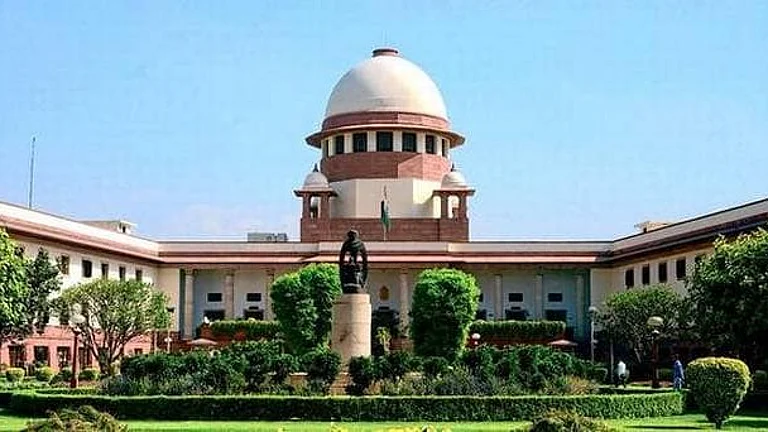
In November 2026, a Supreme Court bench suspended the life sentences and granted bail to two Bilkis Bano case convicts citing over 17 years in custody and severe disability in one case.
Nearly 25 years ago, a pregnant Bano and four other women in her family were gang-raped, her daughter killed by smashing her head against a rock and 14 members of her family murdered by 11 men of her village.
In January 2008, a special court in Mumbai sentenced the 11 accused to life imprisonment (one had died) and incarcerated a policeman for three years for trying to destroy evidence.
Bilkis Bano And Our Repeated Betrayals
The unimaginable violence and loss that Bilkis Bano suffered and her struggle for justice and safety without end diminishes every Indian

Summary
The staggeringly brave epic battle for justice waged by Bilkis Bano for nearly a quarter century is a chronicle of singular courage, resilience and dignity. For this, she has earned the admiration and gratitude of the nation.
But this battle is one that Bano should never have been called upon to fight. The communal carnage in 2002 in Gujarat should have been swiftly controlled by state authorities. The crimes of gang rape, arson and mass murder should not have been permitted. And the state―its police, its courts and its executive―should have been in the vanguard of ensuring protection, healing, safety and justice to the survivors.
None of this happened. Instead, nearly 25 years ago, a pregnant Bano and four other women in her family were gang-raped, her daughter killed by smashing her head against a rock and 14 members of her family murdered by 11 men of her village. And her battle for justice was stymied at many turns by recurring betrayals and failure by every institution of the state.
And only now India’s highest court has also betrayed her, by ordering the suspension of sentence and release on bail of two men convicted for the rape and murder.

The Events Of 2002
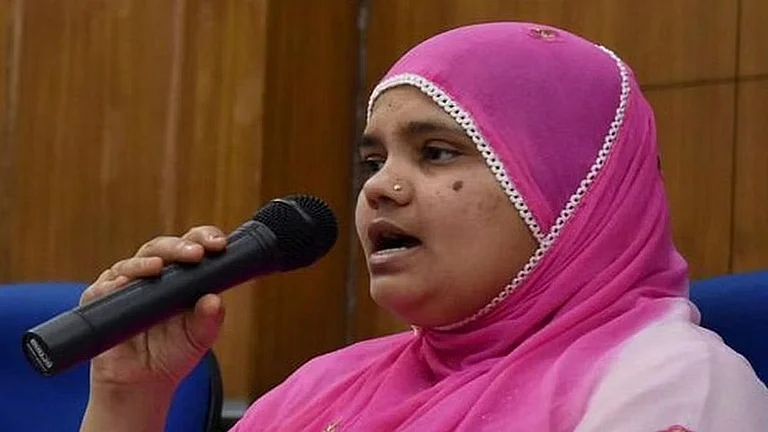
Bano responded with what she described as “fresh tears of pain, shock and disbelief”. She said she still could not believe that for the second time, the Supreme Court had passed an order without hearing her.
“I was a young girl, just 19 years old, when my world, my baby daughter, my family, my home, my trust in humanity was brutally wrenched from me,” she said. “For 24 long years since that day, I have stood up to fight for justice―for myself and for women everywhere―again and again and again. For 24 years I have searched for and found reservoirs of courage I did not know I had, only because a million voices of support and solidarity came my way.”
Advertisement
It is imperative to recall at this moment what actually transpired with Bano and her family. I return to my earlier notes.
During the 2002 Gujarat communal carnage, in Randhikpur village in Dahod, 200 km from Ahmedabad, Bano’s neighbours set fire to all of around 60 Muslim homes there. As she and her terrified family ran into the fields behind their house, she turned around for one last look at their burning home. In the exodus that followed, Bano and her family sought refuge first at the residence of the village sarpanch, then in a school in the village of Chundadi, and thereafter in the village mosque of Kuvajal. Here, Shamim, her cousin, delivered a baby girl in the house of a midwife.
The next day, the family fled again, knowing that they were not safe. Hiding in the shadows and the overgrowth of forests all the way and avoiding the big highways, they tried to reach a Muslim-majority settlement. Along the scary journey, they were shielded and provided for by compassionate people. As Special Judge U. D. Salvi of the Mumbai sessions court observed in his judgement in 2008, despite its gruesomeness, the case also brought to light instances of human kindness shown by neighbours and acquaintances of victims of the massacre who gave shelter to those on the other side of the communal divide. The search for a sanctuary set them on the path to Pannivel village. But they were not to reach their destination. On March 3, 2002, on the kachha road leading to the village, two truckloads of 20 – 30 people brandishing swords and sickles obstructed their truck. “Aa rahya Musalmano, emane maaro, kaato,” they shouted. (These are the Muslims, kill them, cut them). They were all men from their village, people they knew and had been raised with. Among them was the son of a medical practitioner who treated Bano’s father and lived right across the street; a man who owned a bangle shop in the village; another who owned a hotel in the neighbourhood where Bano and her family resided; and the husband of an elected member of the gram panchayat. Bano would say years later that what rankled her most in her memories of that day was that men she had known since she was a child were the ones who brutalised her so mercilessly. Bano was clutching her three-year-old daughter, Saleha, in her arms when one of the men snatched the little girl away and smashed her head on the ground, killing her instantly. Three men, all known to her and from her village, grabbed Bano and tore her clothes away even as she pleaded that she was pregnant. They also ignored her entreaties that they were like her brothers and uncles, and they raped her by turn. In the mayhem around her, the 14 members of her family were being raped, molested and hacked to death by others in the mob. Shamim, who had delivered a child the day before, and her infant child were also killed. When Bano ultimately lost consciousness, the assailants took her for dead and after their pillaging, left the scene of the carnage. When she regained consciousness, she found herself naked, surrounded by the corpses of her family members. She covered her body in a petticoat lying nearby and ran up a hillock, and spent a night there in dread, foreboding and mourning. The next day, she came upon an Adivasi woman near a hand pump when looking for water. The woman gave her some clothes. She then spotted a uniformed police officer and approached him for help. He took her to the Limkheda police station in his vehicle.
Advertisement
The Lonely And Rocky Road To Justice
Bano was the lone witness and survivor of eight gangrapes and 14 murders. As I reproduce from my earlier writings: she knew the names of her attackers, and told the policeman all that had happened in painful detail.
But the head constable, Somabhai Gori, refused to register her complaint. He dispatched her instead to a relief camp, where she was reunited with her distraught husband, Yakub Rasool. She told him of her unthinkable suffering, and how they had lost their daughter and so many members of their family.
Two days after the killings, some local photographers found some of the bodies of the massacred family―and it was this public exposure that forced the police to act. Bano was gutted as she identified the bodies of several members of her family, including her three-year-old daughter. Four days after her rape, she was medically examined at Godhra Civil Hospital and biological samples were sent to the local pathology lab, after she had been sent to the Godhra relief camp. Meanwhile, no inquest was carried out as required by law and the bodies were left unguarded to rot away. Doctors who conducted the post-mortem did not collect any blood or biological samples, and recorded evidence and opinions that they knew to be false. It was later proved that the bodies were buried in unmarked mass graves on the orders of the police.
Advertisement
Fifteen days after her rape, Bano finally managed to register her statement to the police in the relief camp. The police made her place her thumb impression on a blank sheet, and obliterated all significant details in her statement like the names of the men who had raped her. She could do nothing at that time as she was both unread and powerless. The police dismissed her repeated pleas and ultimately, the judicial magistrate on March 25, 2003, closed the case for want of evidence, claiming that there were inconsistencies. Undeterred, Bano moved the Supreme Court with the assistance of the National Human Rights Commission. In December 2003, the Supreme Court directed the reopening of the Bilkis Bano case and transferred the investigation to the Central Bureau of Investigation (CBI).
The Exemplary Investigations Of The CBI
Two months later, the Supreme Court asked for an independent investigation by the CBI into the murders and rapes. The CBI team seized police documents, photographs, reports and evidence, recorded the statements of Bano and other witnesses, and exhumed the remains of seven of the victims, four females and three children. The bodies of the other seven were never found.
Advertisement
The investigation was exemplary both for its independence, fairness and professionalism. When the bodies were exhumed as part of a fresh investigation by the CBI, they found that none had skulls. It seems that they had been decapitated after the post-mortem to prevent identification, and salt had been sprinkled on the corpses so that they would decompose quickly. A prosecution witness testified that he was taken by the police to the place where the bodies were buried in unmarked graves, and he found two doctors there as well. He buried the corpses with the help of two other men the police had brought in to dig the pits, and they were each paid Rs 200 for their labours and silence. In its ruling 15 years later, the Bombay High Court was to describe the policemen as “villains” who “wanted to suppress the fact of rape committed on Bilkis”. The men in uniform manipulated evidence, ensured the post-mortem of the dead was not done properly, and they also did not take Bano to the crime spot so that she could identify it, even though she was at the police station at that time. This “tainted” their investigation, reflecting “dishonesty and callousness”.
The Wire reported, “On May 12, 2004, the CBI submitted its final report to the Supreme Court in which it catalogued the complicity and involvement of the Gujarat government in the cover-up which followed the March 2002 crime.” It added, “Most significantly, it asked that the criminal trial be held outside the state… that the government of Narendra Modi, who was chief minister at the time, could not even be trusted with the conduct of court proceedings in the matter. The Supreme Court concurred and on August 6, 2004, ordered the trial venue shifted from Gujarat to Maharashtra.
Two Different Standards Of Judicial Conscience
For six years―much of which she and her family were forced to spend in hiding― Bano fought her case with robust and unshaken resolve, supported all along by fine activists like Farah Naqvi and Gagan Sethi of Jan Vikas. These human rights workers did all they could to bolster her morale and guide her through the intricacies of the legal process. Rasool, Bano’s husband, remained steady in his support to her through these many years of legal battle. Through these years, the family was in effect exiled from their village, because they would not be safe there. They shifted from place to place, their identities hidden, their faces covered when they appeared in public meetings and courts. On January 18, 2008, the special court in Mumbai sentenced the 11 accused to life imprisonment (one had died), and incarcerated a policeman for three years for trying to destroy evidence. This case marked the rarest instance in which sexual violence during a communal massacre was punished. Even so, the special court refused to punish the doctors and policepersons accused of burying the bodies of the victims to destroy evidence of the crime. It did, however, convict Somabhai Gori, the head constable of Limkheda police station, who had refused to take down Bano’s initial complaint. The CBI, in its appeal, sought the death penalty for the 11 convicts. They argued that the case was one of mass murder as 14 members of a family had been killed, and that the riots had caused an exodus and, thus, belonged to the rarest of rare category. The High Court did not concur, and maintained the punishment of imprisonment for life. “We do agree that it is a rare massacre manifesting ugly animosity and hostility,” it noted. But it added that the convicted men are not “history-sheeters or hard-core criminals”. They were part of “a mob on account of the Godhra incident… in search of Muslims. They were boiling with revenge… We do agree that the crime is uncommon and a large number of persons from the Muslim community were murdered, however, the sentencing policy is also required to be balanced on the scale of proportionality…”.
I observed at that time, “In a stark but telling coincidence, the day after the Bilkis Bano ruling, on Friday, the Supreme Court upheld the death penalty for four men convicted of the gruesome gangrape and murder of a paramedical student in Delhi (who came to be known as Nirbhaya) on December 16, 2012, to celebratory headlines across the country. The judges described this as a ‘barbaric crime’ that had created a ‘tsunami of shock’”. “That it was, no doubt”, I noted, “but it is hard to understand why one crime―in which the face of a child was also smashed, eight people gangraped and 14 people killed in a frenzy of mob hate―was more grievous than the other. Surely, the learned bench could not be suggesting that ‘boiling for revenge’ after the Godhra train burning created a context that somehow mitigated the hate crimes that followed?” Nirbhaya was called by many as “India’s daughter”. In what way is Bilkis Bano also not “India’s daughter”.
What Changed After 2014
Bilkis Bano, her husband and her children at last felt safe enough to end their nomadic existence in prolonged hiding, and return to Gujarat, picking up the shattered pieces of their lives. But this was not meant to last. It is important to underline that justice ultimately became possible only because the case was moved out of Gujarat where, as this judgement established, police officers felt free to destroy evidence and protect those who committed the gravest hate crimes. There can be little doubt that they derived their impunity from the top. But then the government changed in Delhi. The leadership in Gujarat during the 2002 communal carnage now held national office and power. The first blow came when the Gujarat government resolved to observe the 75th anniversary of India’s independence by setting free 11 men who had been sentenced to life in prison for gang-raping Bano and four other women.
Bano said she was “bereft of words” and "numb". “Today, I can only say this—how can justice for any woman end like this? I trusted the highest courts in our land. I trusted the system, and I was slowly learning to live with my trauma. The release of these convicts has taken from me my peace and shaken my faith in justice. My sorrow and my wavering faith are not for myself alone but for every woman struggling for justice in the courts,” Bano said to Article 14.
Her trauma was compounded when―as her rapists and the murderers of 14 members of her family walked from―crowds greeted them with garlands and sweets at the office of the Vishwa Hindu Parishad. “I appeal to the Gujarat government,” Bano said, “please undo this harm. Give me back my right to live without fear and in peace. Please ensure that my family and I are kept safe.”
Nearly five months later, the Supreme Court on January 8, 2024, reversed the order of remission. The grounds cited for striking down the remission order, however, were disappointingly technical, rather than delving into deeper questions of the ethics of punishment and reformation and laying down guidelines for the future. The court instead held that since the trials were held in Maharashtra, the Gujarat government was not competent to pass this remission order.
Then, less than three years later, in November 2026, the Supreme Court ordered the release of two of these men convicted of the crimes of gang rape and mass murder. The Supreme Court notably passed this order without hearing Bano. Its reasons were terse. One that the convicts had been under incarceration for a period of more than 17 years, and one of the appellants had a severe handicap. And second that “there are issues to be decided in the appeal, both on fact and law”.
The Ideal Citizen
In a public statement, Bano says, “I have walked to courtroom after courtroom, and been grateful each time I was vindicated; each time my faith in the idea of justice was restored. I have rebuilt from the rubble of my life, with the love of family and friends. I have yearned for peace. I have learned to smile”.
“Yet today,” she says, “I find myself losing the very justice I had fought so hard to win. Familiar fears are resurfacing. I am scared once again. For myself, my family and my children. And I am scared of losing faith in justice, yet again. How could the honourable Supreme Court simply suspend the sentence of the men who did this to me? How could they not even inform me? How could they not even make sure my voice was heard in their courtroom?”
“I will fight this order. I must. I do this for my children, who do not deserve to live haunted by these fears and scars for the rest of their lives. I do this for my three-year-old Saleha who deserved to live, and whose memory demands justice. I do this for women everywhere. Because no woman, no survivor, no citizen should have to endure this eternal test of belonging and equality, and fight for justice for the rest of her life”.
I signed a statement after this latest order of the Supreme Court. “Bilkis Bano is an ideal citizen,” the statement read. “She has kept her faith intact and has displayed extraordinary courage in her long fight for justice. We acknowledge her courage and offer our solidarity, compassion and unwavering support. Her struggle must not be allowed to become yet another story of a survivor being left to battle the system alone”.
The unimaginable violence and loss that Bano suffered and her struggle for justice and safety without end diminishes every Indian. India’s governments, its police, its courts and its people have failed Bano over and over again.
(The author is a columnist, teacher, and social activist)
(Views expressed are personal)
Published At:
Tags