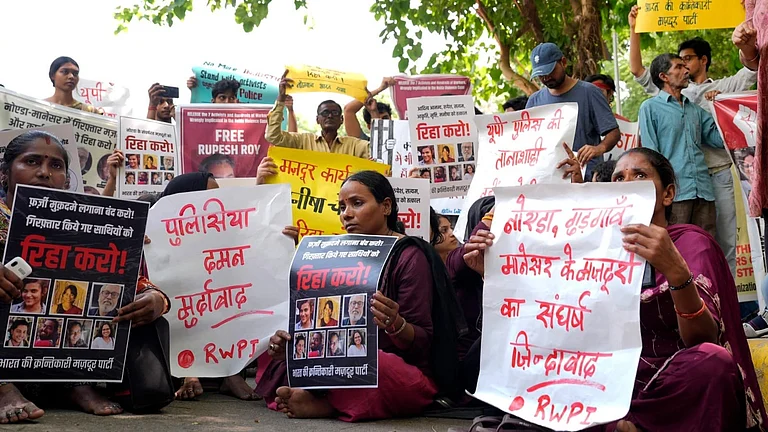
CARWAN activists rallied in Mumbai’s heat against the "vindictive" invocation of the NSA on journalist Satyam Verma and student leader Aakriti Chaudhary
Longstanding low wages, poor job security, and a sharp cost-of-living rise, fueled by Haryana’s 35 percent wage hike,. triggered violent demonstrations from April 10-13, 2026.
Chaudhary was arrested two days before the violence (April 11); Verma was arrested later from Lucknow (April 17). On May 13, the UP government slapped the NSA on both.
Noida Workers Protest: Activists Rally At Mumbai's Azad Maidan Against Use Of NSA On Journalist, Student Leader
Activists at Mumbai’s Azad Maidan protest the Uttar Pradesh government’s use of the National Security Act against journalist Satyam Verma and student leader Aakriti Chaudhary, highlighting alleged illegal arrests, harsh working conditions, wage disparities and calls to repeal the ‘draconian’ NSA.

Summary
In the scorching heat near Mumbai’s Azad Maidan, members from Campaign for Release of Workers and Activities of Noida (CARWAN) raised slogans protesting against the arrest of Satyam Verma, a writer and senior journalist associated with Mazdoor Bigul magazine and Aakriti Chaudhary, a member of the Disha Students' Organization. The Uttar Pradesh government has invoked the National Security Act of 1980 against Chaudhary and Verma.
Meanwhile in Azad Maidan, members of CARWAN said that the draconian NSA should be repealed and they should be released. “They have arrested these activists to create an environment of fear among others. Amongst those who raise their voice for justice and peace,” said a CARWAN member.
The protests in Noida, which began in early April 2026, did not emerge from a single incident but were the result of long-standing economic pressures faced by the region's largely migrant workforce. These workers, employed on temporary contracts through private agencies, earn between Rs.11,000 and Rs.13,000 per month for grueling 12-hour shifts, often without basic protections like Provident Fund or job security. The immediate trigger for the protests was a sharp rise in the cost of living, particularly the price of cooking gas cylinders, which was exacerbated by inflationary pressures linked to the conflict in West Asia. This made basic survival increasingly difficult on existing wages.
The final spark was a wage revision in the neighbouring state of Haryana on April 9, 2026, which raised minimum wages by about 35 percent. Workers in Noida, doing similar jobs for significantly less pay, questioned this disparity, leading to the outbreak of demonstrations.
The protests began peacefully on April 10 but escalated dramatically on April 13, 2026, when they turned violent. In response, police resorted to using tear gas and lathi charges to disperse the crowds. The Uttar Pradesh government moved quickly, announcing a 21 percent interim wage increase, but this did not immediately quell the unrest as workers continued to demand parity with Haryana's higher hike and better working conditions.
In the crackdown that followed, hundreds of workers were detained and arrested. Among those taken into custody were two individuals who were not factory workers: Chaudhary was arrested earlier on April 11 from the Botanical Garden Metro Station, two days before the major violence occurred. Verma was arrested later on April 17 from Lucknow. His associates maintain he was not in Noida during the protests and had not visited the city in over a decade. Other than these, five others were also arrested, Rupesh Roy, Aditya Anand, Srishti Gupta, Manisha Chauhan and Himanshu Thakur. On May 13, 2026, the Uttar Pradesh police invoked the stringent National Security Act (NSA), 1980 against both Satyam Verma and Aakriti Chaudhary. The NSA is a preventive detention law that allows for detention for up to a year without trial.
Advertisement
CARWAN members demanded that alongside Satyam Verma and Aakriti Chaudhary, others should also be released.
Published At: