Child marriage has fallen sharply across generations in the 21 surveyed Kangra villages.
The decline has slowed, with early marriage still persisting among younger women.
Women’s agency remains limited, particularly in finances and mobility.
Across 21 Villages In Himachal's Kangra, Child Marriage Retreats But Refuses To Disappear
A door-to-door survey of 402 women across 21 Kangra villages examines how marriage age has shifted across generations

Summary
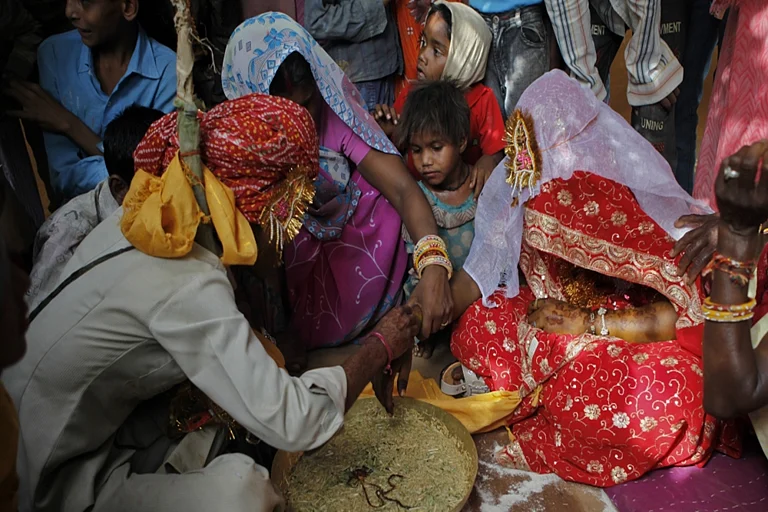
More than half of the women surveyed in a new assessment of rural life in Himachal Pradesh's Kangra district were married at or before the age of 21, and one in eight before they turned 18, findings that researchers say show early marriage has declined sharply across generations but has yet to disappear.
The figures come from the "Rural Women's Agency and Inclusion Assessment 2026," published by the Enlightened India Foundation (EIF), a non-profit organisation whose all-women field team interviewed 402 women across 376 households in 21 villages between January and March 2026, recording responses directly in respondents' homes.

Decline Across Generations Levels Off
EIF broke the data down by age group to trace how this has changed across generations. Among women aged 56 and over, 35% said they had married before 18. Among women now aged 46 to 55, that figure was 8% - a drop of around 27 percentage points. Among women aged 36 to 45 and 26 to 35, the rate had eased further, to 3% and 6% respectively.
"These findings do indicate a substantial drop, though the pattern appears to level off in younger adult groups," the report stated. Child marriage has long been documented as a challenge in rural parts of Himachal, where traditional expectations around a daughter's marriage have historically influenced the age at which girls are married.
Notably, the findings sit alongside official data cited in the report. The National Family Health Survey (NFHS-5), conducted in Himachal Pradesh in 2021, recorded that 5% of women aged 20-24 in the state had married before 18, down from 9% in the previous survey round, NFHS-4.
The report separately examined households where male members are reported to consume alcohol. It does not draw a direct link to marriage age, but records that women in these households reported lower participation in financial decisions, less personal time, and narrower aspirations expressed for daughters, compared with women in households without reported male alcohol use.
Advertisement
The survey also recorded a geographic split. Villages within 30 minutes' travel of urban centres reported a marriage-before-18 rate of 15%, compared with 9% in villages more than 30 minutes from urban centres. EIF describes near-urban and remote villages as facing "different structural configurations of the same underlying conditions."

Wider Findings On Education, Agency And Mobility
On education, 79% of respondents said they had received ample educational opportunity while growing up. That figure was lowest, at 69%, among women aged 26 to 35, the youngest cohort EIF considered large enough for reliable comparison.
The report covered six areas of rural women's lives: education and marriage, household decision-making, mobility and safety, digital inclusion, aspirations for the next generation, and geographic and household conditions.
Separately, EIF found that 42% of respondents took part in household financial decisions, against 96% who said they could express their views freely at home. Fewer than half of women surveyed said they felt comfortable travelling alone to their local market, health centre or panchayat office.
Advertisement
Universal Support For Equal Opportunity
One finding was returned by all 402 respondents without exception: that girls should have the same opportunities as boys. EIF's president, Smita Choudhary, described this as the survey's most consistent result.
EIF stated that the report is intended as a descriptive evidence resource. It does not seek to establish causality, evaluate specific programmes, or prescribe interventions.
Notably, Chief Minister Sukhvinder Singh Sukhu declared Himachal Pradesh a "fully literate state" on International Literacy Day, 8 September 2025, citing a rise in the state's literacy rate from around 7% at the time of independence to 99.3%, above the national average of 95%.
Meanwhile, EIF's findings on marriage age offer a separate lens on the same region, suggesting that gains in literacy have not necessarily translated into a uniform decline in early marriage across all age groups surveyed in Kangra's villages.
Advertisement
Published At: