Indian communist artists use visual culture to challenge authoritarianism and majoritarian narratives.
Street art, posters, and social media imagery transform collective memory into political power.
Visual resistance connects past left movements with current struggles for justice and solidarity.
Images Against Darkness: 100 Years Of The Indian Communist Movement And The Culture Of Rebellion, In Photos
Artists across India are reclaiming visual culture as a political force as the communist movement marks one hundred years.

Summary
As the Indian communist movement completes one hundred years, India finds itself in a moment when the struggle over images is inseparable from the struggle over truth, justice, and democracy. For a century, communist politics has shaped intellectual and working-class life in India, yet it has often underestimated the power of culture—particularly visual culture—as a field of ideological formation. Meanwhile, the political right, especially the Rashtriya Swayamsevak Sangh (also completing a century), has invested continuously in symbols, narratives, and imagery, shaping social consciousness long before shaping electoral outcomes. In a world saturated with visuals, this asymmetry demands attention.
The last two decades have revealed that images no longer merely document events; they actively produce political meaning. Video footages of the World Trade Center attacks, photographs from Abu Ghraib and Guantanamo, and in India, the viral circulation of social media forwards depicting majoritarian violence, lynchings, and everyday brutality—these images shape emotional climates, fuel propaganda, and normalise hatred. They are not passive witnesses to violence; they participate in its unfolding. As politics moved onto screens, images became battlegrounds.
We now inhabit an expanded visual field—television, billboards, cinema, social media, memes, animation, surveillance footage, virtual realism—in which we do not simply see images; we live inside them. These environments are ideal soil for authoritarian cultures: Islamophobia, casteism, misogyny, and hyper-nationalist fantasies flourish through repeated visual cues. Even if an authoritarian government falls, the cultural psyche it leaves behind cannot be undone overnight. Culture is slower than politics; it embeds itself in emotions, habits, aesthetics, and everyday speech.
In this context, the visual artists featured in here reclaim the image as a tool of resistance, solidarity, and memory. They work not from elite art circuits but from within movements themselves—from the streets, fields, campuses, borders, and homes where people struggle, organise, and recollect. Their practices insist that the future of political struggle is inseparable from the future of cultural struggle.
THE ARTISTS
Across different regions and experiences, the artists gathered here share a commitment to transforming visual culture into political energy. Together, they form a counter-archive—an aesthetic record of dissent, pain, solidarity, and stubborn hope.
Advertisement
Uttam Ghosh’s visual language emerged from the Russian cultural presence in rural Nashik—its books, exhibitions, films, and October Revolution pageantry—before being reshaped in Mumbai’s student movements in the 1980s through poster-making, shared design practices, and encounters with Dalit artists and activists. The imagery of the textile strike, from trade union collaborations to the songs of Shahir Vilas Ghogre and Sambhaji Bhagat, further sharpened his aesthetic and political sensibilities. Drawing on Soviet poster design, Dalit Panther iconography, and the visual idioms of Maharashtra’s left and Ambedkarite traditions, his work has continually adapted—from screen-printing and photocopying to contemporary social media—insisting that resistance must always be visually imagined.
Nitin Prakash Kushwaha reflects on a long arc of left political engagement, beginning with the echoes of Naxalbari and Telangana that shaped the artistic imagination of the 1980s. His involvement in collective artistic work in Banaras during the 1990s and his experience of its dissolution in the 2000s mirror the trajectory of progressive politics in India—moments of collective hope followed by fragmentation. Yet his reflections are not melancholic; they insist that ideological resolve must be rebuilt through emotional solidarity. Nitin’s practice bridges past struggles with present urgencies, reminding us that the affective dimension of politics—trust, care, and commitment—is as crucial as ideological clarity.
Advertisement
Jit Natta, working through Bengal’s folk and resistant performance traditions, centres land, memory, and sound as political forms. His images emerge from student movements, folk festivals, and street protests, where community becomes method. Using earth pigments and low-cost materials, Jit reminds us that resistance is grounded—literally—in the soil. His work recognises the rise of post-internet and cyber-fascism, yet asserts that collective voices, rhythms, and traditions continue to disrupt the machinery of power. For him, the image is not a symbol but a living participant in struggle.
Labani Jangi works at the intersection of scholarship and community visual culture, particularly among migrant labourers in Bengal. Her piece, based on a widely circulated image from the Delhi riots of 2021, confronts how the state weaponises violence to suppress movements like the anti-CAA-NRC protests. Labani’s practice exposes what dominant media narratives try to bury: the everyday lives of migrants, rural labourers, borderland communities, and women whose struggles form the backbone of India. By reworking photographic evidence of violence, she asserts that memory is political—and forgetting is engineered.
Advertisement
Anupam, shaped by seventeen years in CPI-ML (Liberation), produces art that is immediate, mobile, and rooted in the momentum of street protest. His work emerged during the Nirbhaya movement, in collaboration with the All-India Students’ Association (AISA). Through posters, stencils, hand-drawn graphics, and zines, he demonstrates how art becomes an organising tool—quick to produce, quick to circulate, emotionally direct. Anupam’s practice stands against the spectacle-driven media machine and argues for an art of urgency, clarity, and collective authorship.
Sandip K. Luis, an artist and children’s book illustrator turned art historian and critic, explores the potential of images to act as historical forces. Since his student years at Jawaharlal Nehru University, New Delhi, he has used visuals as political tools to challenge majoritarian manoeuvres. A fellow traveller of far-left organisations, Sandip situates people’s movements from his native Kerala to Delhi—where he currently teaches the history of art—within global histories of working-class mobilisations and anti-colonial struggles. He demonstrates that visual imagery can affirm and sustain the morale and dignity of the common masses.
Advertisement
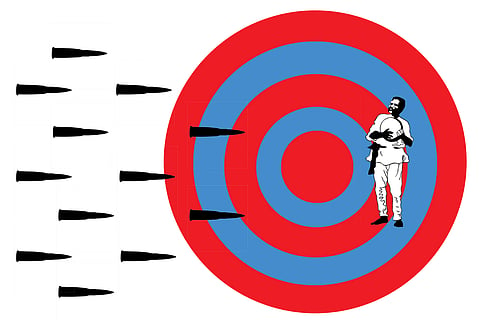
Tribute to Vilas Ghogre and the Martyrs of Ramabai Colony Uttam Ghosh
Tribute to Vilas Ghogre and the Martyrs of Ramabai Colony
The songs of Shahir Vilas Ghogre and Sambhaji Bhagat shaped Ghosh’s political and aesthetic awakening, with the Red and the Blue growing alongside his practice even as visual art remained marginal within both traditions.
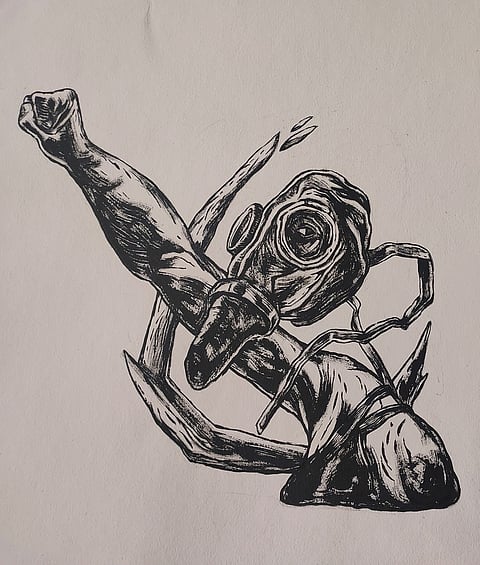
Untitled Nitin Prakash Kushwaha
Untitled
A reflection on solidarity and memory across decades of Left struggle, the work traces how emotional commitment sustains political imagination.
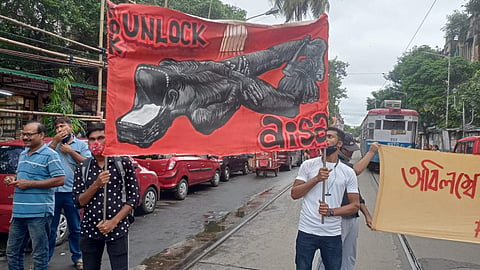
Hok Unlock Protest Banner Jit Natta
Hok Unlock Protest Banner
Made with earth pigments during the 2022 student mobilisation in Kolkata, it embodies the material urgency and grounded energy of collective protest.
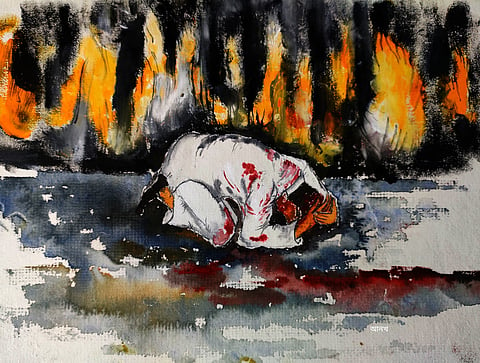
On Delhi Riot Labani Jangi
On Delhi Riot
A re-interpretation of a widely circulated riot image that exposes state-enabled violence, the work insists on memory as a form of resistance against manufactured forgetting.
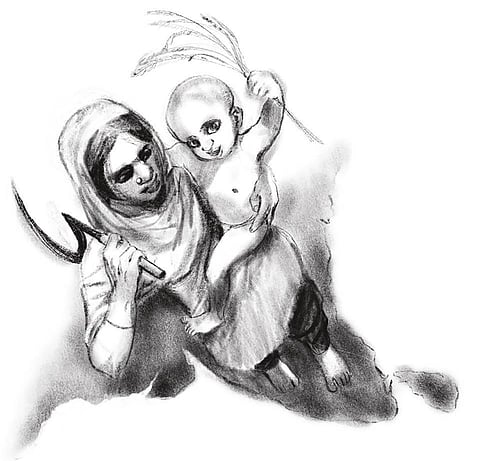
Farmers’ Movement Poster Sandip K. Luis
Farmers’ Movement Poster
Widely used during the nationwide agrarian protest to assert dignity and solidarity, the work counters the majoritarian narrative of the movement as ‘anti-national.’
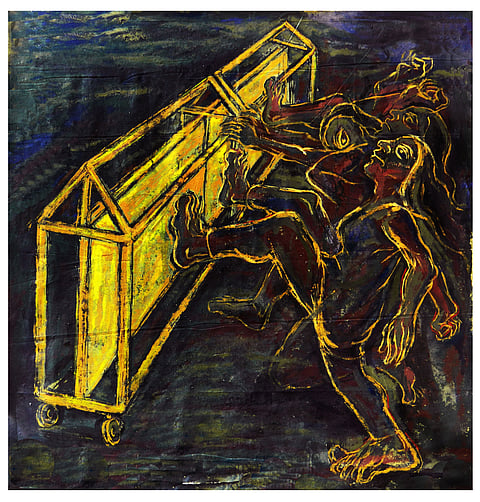
Nirbhaya Movement Poster Anupam Roy
Nirbhaya Movement Poster
Created with student activists in New Delhi during the historic feminist uprising, its graphic intensity reflects the immediacy of street-level resistance.
Published At: